
 Afrika
 Asië
Asië Europa
 Suid-Amerika
 Australië & Oseanië
 Antarktika
 Stille Oseaan
 Atlantiese Oseaan
 Indiese Oseaan
 Arktiese Oseaan
 Middellandse See
 Rooi See
 Karibiese See
 Koraalsee
 Suid-Chinese See
 Filippynse See
 Andamansee
 Noordsee
 Timorsee & Arafurasee
 Baai van Bengale
 Golf van Kalifornië
African crested rat
 Gif in sy velEet: PlanteGiftig om aan te raak of te eet, nie deur 'n byt of steek nie
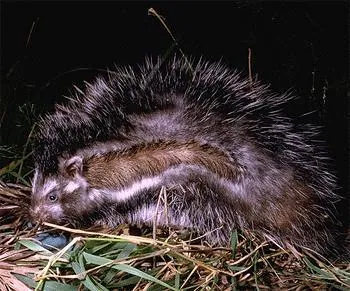
The African crested rat is a large, nocturnal rodent with long hair and a bushy tail. It looks a little like a porcupine. It lives in East Africa, where it is the world's only known poisonous rodent, coating itself in plant toxins to keep predators away.1



 Hoe om dit te herken
- Large, nocturnal rodent with long, silver and black-tipped guard hairs over a woolly grey and white undercoat1
- A mane of longer black-and-white banded hairs runs from the top of the head to just beyond the base of the tail1
- A broad, white-bordered strip of glandular skin sits beside the mane, and it becomes visible when the animal is threatened1
- Bushy tail and short black fur on the face and limbs1
- Superficially resembles a porcupine1
Gifkrag
Sy vel is giftig. Dit is gevaarlik om aan te raak, te lek of te eet.
Wat doen sy gif as jy daaraan raak of dit eet?
This animal is poisonous rather than venomous, so it does not bite or sting to inject poison. It smears poison from the bark of the poison arrow tree onto the hairs of its glandular skin patch. A predator that bites it can be sickened or even killed by this poison.1
Hoe gevaarlik is dit vir mense?
Gevaar vir mense: ErnstigAs iemand daaraan raak of dit eet, moet hy dokter toe gaan. Sterftes is baie skaars.Its poison is a risk to predators that try to bite it. The rat itself is not harmed by the toxins it stores.1
Wat doen dit as dit bang is?
When threatened or excited, the mane stands up and the glandular strip parts, exposing the skin that carries the poison.1
 As iemand daaraan geraak of dit geëet het
- As iemand dit geëet het of simptome kry nadat hy dit geëet het: bel dadelik jou noodnommer of 'n gifsentrum.
Bel altyd eers jou noodnommer (112, 000, 911). Dit is algemene noodhulpraad, nie mediese advies nie. Noodhulp-basiese beginsels
 Bly veilig
- Moet nooit aan 'n wilde dier raak, dit vang of terg nie, selfs nie 'n kleintjie nie, en selfs nie as dit lyk of dit slaap of dood is nie.
- Gee dit spasie. As jy een raakloop, bly kalm, stap stadig terug en laat dit sy eie pad gaan.
- As jy daaraan geraak of dit geëet het: moenie jou oë of mond vryf nie, was jou hande en kry mediese hulp.
Dit is nie uit om jou te kry nie. Sy gif is net daar sodat niks dit eet nie. Meer oor veilig bly
Waar in die wêreld?
Hoe groot is dit?
Hoe lank is dit?
Hoe swaar is dit?

 so lank soos 10 speelgoed-boublokke in 'n ry
 kan 100 meter in 72 sekondes aflê (die vinnigste mens het 9,6 nodig)
Hoe groot is African crested rat in vergelyking met JOU?
Net wiskunde in jou blaaier. Niks word gestoor of enige plek heen gestuur nie.
Hoe vinnig is dit?


Feite
It is the world's only known poisonous rodent.1
It is the only rodent known to use and store toxins from a different species in nature to protect itself, and it suffers no known harm from them.1
Its stomach has five anatomically distinct sections, a feature found in very few rodents.1
The skull is covered with small bony projections that give it a pebbled look.1
Its large size may allow microbes in its foregut to break down cellulose from plants by fermentation.1
Mite-breker
Mite: The maned rat was believed to be solitary.
Waarheid: It is now known to be somewhat sociable. Several animals are found in the same territory, and they purr and groom one another, so they may form family groups of a male, a female and their young.1
Vir gifkenners
- Wetenskaplike naam
- Lophiomys imhausi
- Groep
- Ander diere wat giftig is om aan te raak of te eet
- Familie
- Muridae2
- Orde
- Rodentia
- Kontinente
- Afrika
- Babas
- Litters have 1 to 3 young. The young are slightly haired at birth, their eyes open by day 13, and they are weaned by day 40.1
- Hoe dit in die natuur gaan
- Least Concern1
- Gevaar vir mense
- 3 / 5: Ernstig3
Waar die feite vandaan kom
- Maned rat (Wikipedia (CC BY-SA 4.0))
- Lophiomys imhausi (iNaturalist): name en klassifikasie.
- Venom Wiki: die gevaarvlak, die tipiese grootte en die spoedskatting is ons eie. Kyk hoe ons dit uitwerk: Hoe ons gevaar gradeer.
Elke feit op hierdie bladsy het 'n nommer wat na sy bron wys. As ons iets verkeerd het, jammer, ons is dierfanatici, nie 'n wetenskaplike joernaal nie. Laat weet ons by [email protected] en ons maak dit reg.
 Die skerpioen is honger! Venom Wiki is 'n eenmanprojek: gratis, sonder advertensies en sonder spoorsnyers. 'n Klein fooitjie help om dit aanlyn te hou.Voer die skerpioen
Meer uit dieselfde groep: Ander diere wat giftig is om aan te raak of te eet
 Common quailAnder diere wat giftig is om aan te raak of te eetMaak net seer
 Spur-winged gooseAnder diere wat giftig is om aan te raak of te eetMaak net seer
 Fahaka pufferfishAnder diere wat giftig is om aan te raak of te eetKan doodmaak
 Red-striped oil beetleAnder diere wat giftig is om aan te raak of te eetMaak net seerMoenie aanraak nie
 Japanese pufferfishAnder diere wat giftig is om aan te raak of te eetDodelik
 Hawksbill sea turtleAnder diere wat giftig is om aan te raak of te eetKan doodmaak
 Black mamba
 Deathstalker
 Egyptian cobra
 Puff adder
 Boomslang
 Fat-tailed scorpion