
 Afrika
 Asië
Asië Europa
 Suid-Amerika
 Australië & Oseanië
 Antarktika
 Stille Oseaan
 Atlantiese Oseaan
 Indiese Oseaan
 Arktiese Oseaan
 Middellandse See
 Rooi See
 Karibiese See
 Koraalsee
 Suid-Chinese See
 Filippynse See
 Andamansee
 Noordsee
 Timorsee & Arafurasee
 Baai van Bengale
 Golf van Kalifornië
Army ant
 Steke
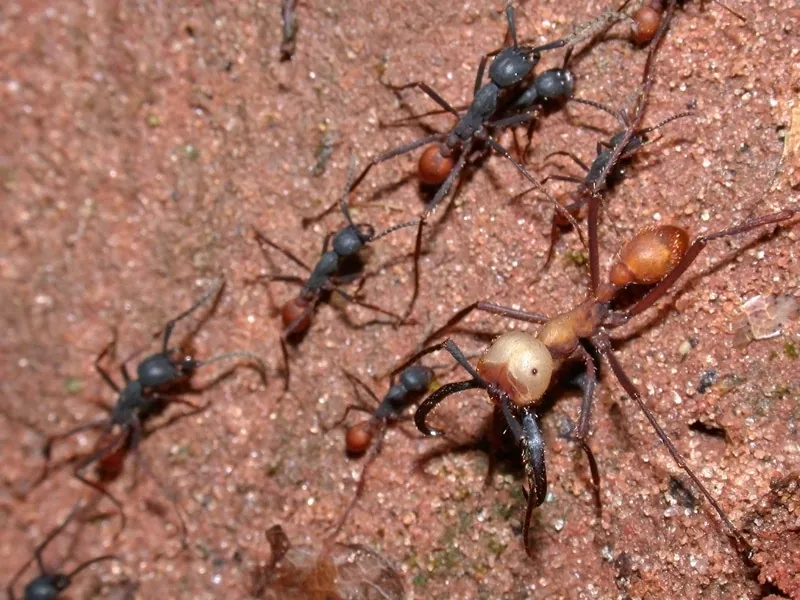
StekeThe Burchell's army ant is a tropical ant that moves in huge, organised swarms called raids. It lives in the jungles of Central and South America. Its raids are so large that many other animals, including birds, follow them to catch prey.1


 Hoe om dit te herken
- Colour varies from deep golden to dark brown.1
- Workers are 3 mm to 12 mm long, and there are four sizes of worker.1
- Soldiers have much larger heads and long, pointed, sickle-shaped jaws (mandibles).1
- Long legs and an elongated body give it a spider-like appearance.1
- Raids move as a loose swarm over the leaf litter on the forest floor.1
Gifkrag
Gif kom deur 'n angel uit.
Hoe gevaarlik is dit vir mense?
Gevaar vir mense: PynlikDit kan regtig seermaak, maar dit is amper nooit ernstig nie.Wat doen dit as dit bang is?
Soldier ants have much larger heads and specialised jaws for defence, and workers have a well-developed sting.1
 As dit steek
- Was en koel die steke af.
- As die persoon sukkel om asem te haal, die gesig of keel swel, of hy voel flou, is dit 'n allergiese noodgeval: bel jou noodnommer.
Bel altyd eers jou noodnommer (112, 000, 911). Dit is algemene noodhulpraad, nie mediese advies nie. Noodhulp-basiese beginsels
 Bly veilig
- Moet nooit aan 'n wilde dier raak, dit vang of terg nie, selfs nie 'n kleintjie nie, en selfs nie as dit lyk of dit slaap of dood is nie.
- Gee dit spasie. As jy een raakloop, bly kalm, stap stadig terug en laat dit sy eie pad gaan.
- As een jou steek: bly kalm, bly stil, bel jou noodnommer (112, 000, 911) of kom vinnig by 'n hospitaal uit. Onthou hoe dit gelyk het, 'n foto help.
Dit is nie uit om jou te kry nie. Dit gebruik sy gif om kos te vang of om homself te beskerm, en kruip baie eerder weg. Meer oor veilig bly
Waar in die wêreld?
Hoe groot is dit?
Hoe lank is dit?
 klein genoeg om op jou vingernael te sit
Hoe groot is Army ant in vergelyking met JOU?
Net wiskunde in jou blaaier. Niks word gestoor of enige plek heen gestuur nie.
Hoe vinnig is dit?


Feite
Workers can link their bodies to form living bridges and fill holes in the trail, so the whole colony can move faster.1
A single raid can be up to 200 metres long and use up to 200,000 ants.1
Over 500 other species live around these colonies, more than for any other single species, and over 300 are thought to depend on them.1
Colonies move their living nest, called a bivouac, almost every night, taking six to eight hours to relocate.1
Colonies can have 100,000 to 600,000 adult ants, all from one queen.1
Workers are a mix of four sizes, and genetics as well as diet affect which size an ant becomes.1
Waar die feite vandaan kom
- Eciton burchellii (Wikipedia (CC BY-SA 4.0))
- Eciton burchellii (iNaturalist): name en klassifikasie.
- Venom Wiki: die gevaarvlak, die tipiese grootte en die spoedskatting is ons eie. Kyk hoe ons dit uitwerk: Hoe ons gevaar gradeer.
Elke feit op hierdie bladsy het 'n nommer wat na sy bron wys. As ons iets verkeerd het, jammer, ons is dierfanatici, nie 'n wetenskaplike joernaal nie. Laat weet ons by [email protected] en ons maak dit reg.
 Die skerpioen is honger! Venom Wiki is 'n eenmanprojek: gratis, sonder advertensies en sonder spoorsnyers. 'n Klein fooitjie help om dit aanlyn te hou.Voer die skerpioen
 Bullet ant
 Red imported fire ant
 Giant Amazonian ant
 Maricopa harvester ant
 Trap-jaw ant
 Acacia ant
 Terciopelo
 Eastern coral snake
 Eastern diamondback rattlesnake
 Eyelash viper
 Timber rattlesnake
 Western diamondback rattlesnake