
 Afrika
 Asië
Asië Europa
 Suid-Amerika
 Australië & Oseanië
 Antarktika
 Stille Oseaan
 Atlantiese Oseaan
 Indiese Oseaan
 Arktiese Oseaan
 Middellandse See
 Rooi See
 Karibiese See
 Koraalsee
 Suid-Chinese See
 Filippynse See
 Andamansee
 Noordsee
 Timorsee & Arafurasee
 Baai van Bengale
 Golf van Kalifornië
Black-footed yellow sac spider
 Byte
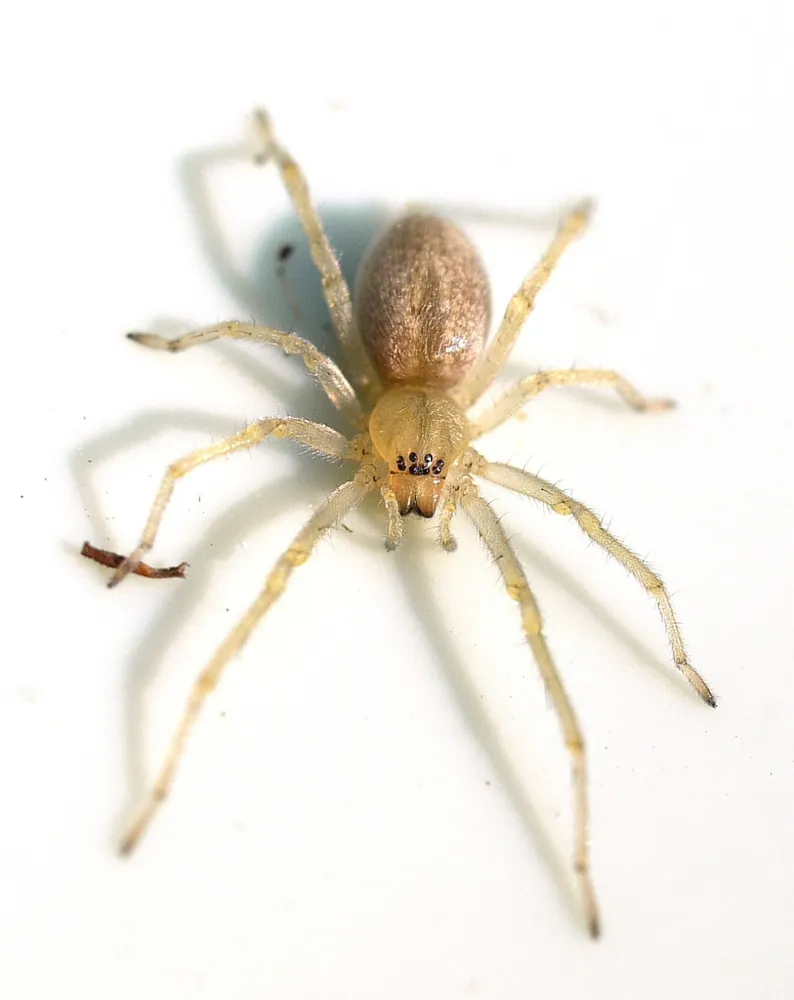
ByteThe black-footed yellow sac spider is a small, pale yellow spider native to the Americas. It hunts at night and does not spin webs to catch food. It sometimes lives in homes, but its bites rarely cause more than local symptoms.1

 Hoe om dit te herken
- Pale yellow-beige body colour.1
- Dark brown markings on the palps, jaws (chelicerae) and the ends of the feet (tarsi).1
- Often an orange-brown stripe running down the top-centre of the abdomen.1
- Eight similar-sized eyes in two parallel horizontal rows.1
- Females measure 5 to 9 mm in body length and males 4 to 8 mm. The leg span can reach 2.5 cm, and the front pair of legs is longer than the other three pairs.1
Word dikwels verwar met: Cheiracanthium mildei, an introduced species from Europe, is similar in appearance and natural history. It can also be found in North American homes.1
Gifkrag
Gif kom deur sy giftande of tande uit wanneer dit byt.
Wat doen sy gif as dit byt of steek?
A bite begins with moderate pain, followed by itching. Symptoms usually clear within 7 to 10 days. The venom rarely causes more than local symptoms.1
Hoe gevaarlik is dit vir mense?
Gevaar vir mense: PynlikDit kan regtig seermaak, maar dit is amper nooit ernstig nie.Bites are rare. Females bite more often than wandering males. The venom rarely causes more than local symptoms.1
 As dit byt
- Was die byt en sit 'n yspak daarop vir die pyn. Kry mediese hulp as die pyn erg is, versprei of die persoon sleg voel.
Bel altyd eers jou noodnommer (112, 000, 911). Dit is algemene noodhulpraad, nie mediese advies nie. Noodhulp-basiese beginsels
 Bly veilig
- Moet nooit aan 'n wilde dier raak, dit vang of terg nie, selfs nie 'n kleintjie nie, en selfs nie as dit lyk of dit slaap of dood is nie.
- Gee dit spasie. As jy een raakloop, bly kalm, stap stadig terug en laat dit sy eie pad gaan.
- As een jou byt: bly kalm, bly stil, bel jou noodnommer (112, 000, 911) of kom vinnig by 'n hospitaal uit. Onthou hoe dit gelyk het, 'n foto help.
Dit is nie uit om jou te kry nie. Dit gebruik sy gif om kos te vang of om homself te beskerm, en kruip baie eerder weg. Meer oor veilig bly
Waar in die wêreld?
Hoe groot is dit?
Hoe lank is dit?
 omtrent so lank soos 'n skuifspeld
Hoe groot is Black-footed yellow sac spider in vergelyking met JOU?
Net wiskunde in jou blaaier. Niks word gestoor of enige plek heen gestuur nie.
Hoe vinnig is dit?


Feite
It hunts at night and builds a new small silk nest every day, in under 10 minutes.1
It can spread to new trees and shrubs by releasing a long silk thread that the wind carries, or by ballooning through the air on a silk line.1
It does not spin a web to catch prey. It hunts actively instead.1
Females mate only once and produce their first egg mass about 14 days after mating.1
Mite-breker
Mite: Cheiracanthium bites cause necrosis, the death of skin and tissue.
Waarheid: Bites cause only localised swelling.1
Vir gifkenners
- Wetenskaplike naam
- Cheiracanthium inclusum
- Groep
- Spinnekoppe
- Familie
- Cheiracanthiidae2
- Orde
- Araneae
- Kontinente
- Noord-Amerika, Suid-Amerika
- Babas
- Females usually lay two egg masses, though they may lay from one to five. Each mass holds 17 to 85 eggs, and up to 112 have been reported. The female guards the eggs and then the young for about 17 days.1
- Gevaar vir mense
- 2 / 5: Pynlik3
Waar die feite vandaan kom
- Cheiracanthium inclusum (Wikipedia (CC BY-SA 4.0))
- Cheiracanthium inclusum (iNaturalist): name en klassifikasie.
- Venom Wiki: die gevaarvlak, die tipiese grootte en die spoedskatting is ons eie. Kyk hoe ons dit uitwerk: Hoe ons gevaar gradeer.
Elke feit op hierdie bladsy het 'n nommer wat na sy bron wys. As ons iets verkeerd het, jammer, ons is dierfanatici, nie 'n wetenskaplike joernaal nie. Laat weet ons by [email protected] en ons maak dit reg.
 Die skerpioen is honger! Venom Wiki is 'n eenmanprojek: gratis, sonder advertensies en sonder spoorsnyers. 'n Klein fooitjie help om dit aanlyn te hou.Voer die skerpioen
 Brazilian wandering spider
 Brown recluse
 Southern black widow
 Amazon wandering spider
 Chilean recluse
 Northern black widow
 Terciopelo
 Eastern coral snake
 Eastern diamondback rattlesnake
 Eyelash viper
 Timber rattlesnake
 Western diamondback rattlesnake