
 Afrika
 Asië
Asië Europa
 Suid-Amerika
 Australië & Oseanië
 Antarktika
 Stille Oseaan
 Atlantiese Oseaan
 Indiese Oseaan
 Arktiese Oseaan
 Middellandse See
 Rooi See
 Karibiese See
 Koraalsee
 Suid-Chinese See
 Filippynse See
 Andamansee
 Noordsee
 Timorsee & Arafurasee
 Baai van Bengale
 Golf van Kalifornië
Carolina wolf spider
 Byte
ByteThe Carolina wolf spider is a large ground-dwelling spider found across much of North America. It is the biggest wolf spider in the region. It lives in burrows in the ground and hunts by waiting at the entrance to ambush its prey.1


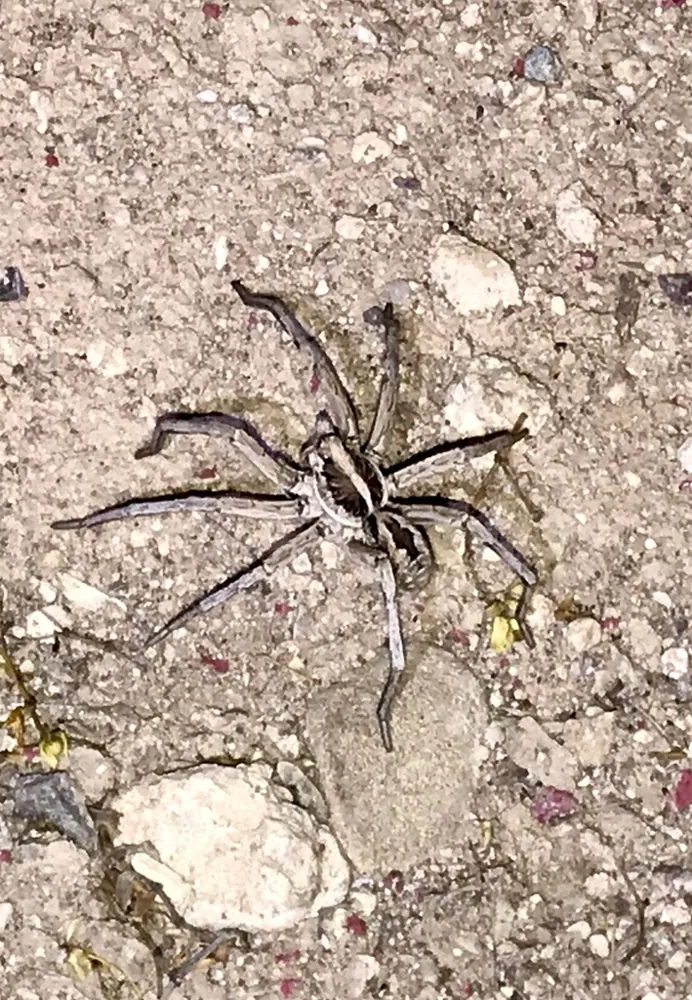
 Hoe om dit te herken
Gifkrag
Gif kom deur sy giftande of tande uit wanneer dit byt.
Wat doen sy gif as dit byt of steek?
Its venom is unusual. It paralyses the spider's prey, which stops the prey from escaping. The venom also helps prevent microbes from the prey infecting the spider.1
Hoe gevaarlik is dit vir mense?
Gevaar vir mense: LigSoos 'n bysteek of minder. Basies onskadelik vir mense.Wat doen dit as dit bang is?
When it senses a threat it either returns to its burrow, if one is nearby, or runs away.1
 As dit byt
- Was die byt en sit 'n yspak daarop vir die pyn. Kry mediese hulp as die pyn erg is, versprei of die persoon sleg voel.
Bel altyd eers jou noodnommer (112, 000, 911). Dit is algemene noodhulpraad, nie mediese advies nie. Noodhulp-basiese beginsels
 Bly veilig
- Moet nooit aan 'n wilde dier raak, dit vang of terg nie, selfs nie 'n kleintjie nie, en selfs nie as dit lyk of dit slaap of dood is nie.
- Gee dit spasie. As jy een raakloop, bly kalm, stap stadig terug en laat dit sy eie pad gaan.
- As een jou byt: bly kalm, bly stil, bel jou noodnommer (112, 000, 911) of kom vinnig by 'n hospitaal uit. Onthou hoe dit gelyk het, 'n foto help.
Dit is nie uit om jou te kry nie. Dit gebruik sy gif om kos te vang of om homself te beskerm, en kruip baie eerder weg. Meer oor veilig bly
Waar in die wêreld?
Hoe groot is dit?
Hoe lank is dit?
 omtrent so lank soos 'n skuifspeld
 kan 100 meter in 240 sekondes aflê (die vinnigste mens het 9,6 nodig)
Hoe groot is Carolina wolf spider in vergelyking met JOU?
Net wiskunde in jou blaaier. Niks word gestoor of enige plek heen gestuur nie.
Hoe vinnig is dit?


Feite
It is the largest wolf spider in North America.1
Its burrows can go as deep as 30 cm and are about 4°C cooler than the surface, which helps it survive hot desert conditions.1
Females carry their egg sacs on their bodies while the eggs develop, and they are often seen sitting near the top of their burrow with the sac raised up.1
Newly hatched spiderlings stay with their mother for their first six days.1
Male spiders flee from threats more often than females, partly because they own fewer burrows to escape into.1
Waar die feite vandaan kom
- Hogna carolinensis (Wikipedia (CC BY-SA 4.0))
- Hogna carolinensis (iNaturalist): name en klassifikasie.
- Venom Wiki: die gevaarvlak, die tipiese grootte en die spoedskatting is ons eie. Kyk hoe ons dit uitwerk: Hoe ons gevaar gradeer.
Elke feit op hierdie bladsy het 'n nommer wat na sy bron wys. As ons iets verkeerd het, jammer, ons is dierfanatici, nie 'n wetenskaplike joernaal nie. Laat weet ons by [email protected] en ons maak dit reg.
 Die skerpioen is honger! Venom Wiki is 'n eenmanprojek: gratis, sonder advertensies en sonder spoorsnyers. 'n Klein fooitjie help om dit aanlyn te hou.Voer die skerpioen
 Brown recluse
 Southern black widow
 Northern black widow
 Western black widow
 Bold jumping spider
 Golden silk orb-weaver
 Terciopelo
 Eastern coral snake
 Eastern diamondback rattlesnake
 Eyelash viper
 Timber rattlesnake
 Western diamondback rattlesnake