
 Afrika
 Asië
Asië Europa
 Suid-Amerika
 Australië & Oseanië
 Antarktika
 Stille Oseaan
 Atlantiese Oseaan
 Indiese Oseaan
 Arktiese Oseaan
 Middellandse See
 Rooi See
 Karibiese See
 Koraalsee
 Suid-Chinese See
 Filippynse See
 Andamansee
 Noordsee
 Timorsee & Arafurasee
 Baai van Bengale
 Golf van Kalifornië
Giant house spider
 Byte
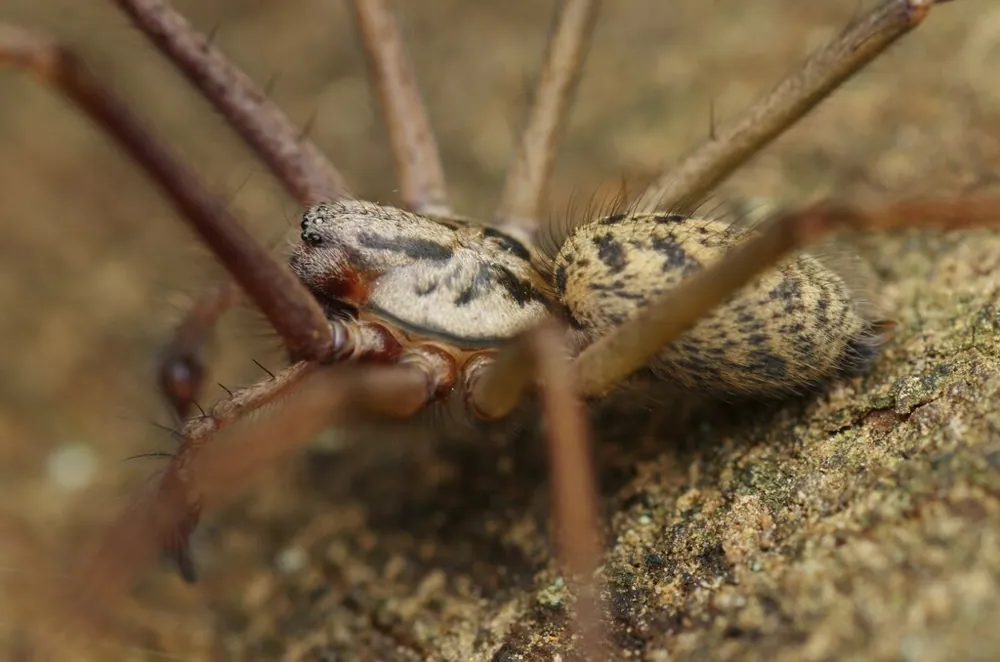
ByteThe giant house spider is a large, brown spider that often lives indoors, especially in Europe, where it is native. It is also found in parts of North America, where it was introduced. Its bite is not considered dangerous to people or pets.1
 Hoe om dit te herken
- Mainly dark-brown body, in earthy tones of brown and muddy-red or yellow.1
- A lighter arrow-shaped marking on the front part of the body (the sternum), with three light spots on each side.1
- A lighter middle line on the abdomen, with six light spots on each side.1
- Conspicuously hairy legs, palps and abdomen.1
- Females reach up to 18.5 mm in body length. Males are slightly smaller, at around 12 to 15 mm. Males have larger palps and a slimmer abdomen than females.1
Word dikwels verwar met: The giant house spider has the same colouring as the domestic house spider, Tegenaria domestica. The two closest relatives, E. duellica and E. saeva, look the same as E. atrica. The three species can only be separated by microscopic measurements of the body parts.1
Gifkrag
Gif kom deur sy giftande of tande uit wanneer dit byt.
Hoe gevaarlik is dit vir mense?
Gevaar vir mense: LigSoos 'n bysteek of minder. Basies onskadelik vir mense.Bites are not considered dangerous to humans or pets.1
 As dit byt
- Was die byt en sit 'n yspak daarop vir die pyn. Kry mediese hulp as die pyn erg is, versprei of die persoon sleg voel.
Bel altyd eers jou noodnommer (112, 000, 911). Dit is algemene noodhulpraad, nie mediese advies nie. Noodhulp-basiese beginsels
 Bly veilig
- Moet nooit aan 'n wilde dier raak, dit vang of terg nie, selfs nie 'n kleintjie nie, en selfs nie as dit lyk of dit slaap of dood is nie.
- Gee dit spasie. As jy een raakloop, bly kalm, stap stadig terug en laat dit sy eie pad gaan.
- As een jou byt: bly kalm, bly stil, bel jou noodnommer (112, 000, 911) of kom vinnig by 'n hospitaal uit. Onthou hoe dit gelyk het, 'n foto help.
Dit is nie uit om jou te kry nie. Dit gebruik sy gif om kos te vang of om homself te beskerm, en kruip baie eerder weg. Meer oor veilig bly
Waar in die wêreld?
Hoe groot is dit?
Hoe lank is dit?
 korter as jou pinkie
 kan 100 meter in 190 sekondes aflê (die vinnigste mens het 9,6 nodig)
Hoe groot is Giant house spider in vergelyking met JOU?
Net wiskunde in jou blaaier. Niks word gestoor of enige plek heen gestuur nie.
Hoe vinnig is dit?


Feite
The eyes are all the same size and sit in two rows. They contain few visual cells, so the spider can probably only tell light from dark.1
Until 2018, the giant house spider was treated as one species. Research then showed three separate species, which can only be told apart under a microscope.1
Males wander while searching for females during mating season, which runs from late summer into autumn. This is when they are most often noticed.1
Males have no Y chromosome. Males carry X1 and X2, and females carry two pairs of X chromosomes. This form of sex determination is the most common in spiders and is probably the ancestral form.1
Waar die feite vandaan kom
- Eratigena atrica (Wikipedia (CC BY-SA 4.0))
- Eratigena atrica (iNaturalist): name en klassifikasie.
- Venom Wiki: die gevaarvlak, die tipiese grootte en die spoedskatting is ons eie. Kyk hoe ons dit uitwerk: Hoe ons gevaar gradeer.
Elke feit op hierdie bladsy het 'n nommer wat na sy bron wys. As ons iets verkeerd het, jammer, ons is dierfanatici, nie 'n wetenskaplike joernaal nie. Laat weet ons by [email protected] en ons maak dit reg.
 Die skerpioen is honger! Venom Wiki is 'n eenmanprojek: gratis, sonder advertensies en sonder spoorsnyers. 'n Klein fooitjie help om dit aanlyn te hou.Voer die skerpioen
Meer uit dieselfde groep: Spinnekoppe
 Mediterranean black widow
 Diving bell spider
 European yellow sac spider
 Noble false widow
 Tarantula wolf spider
 Daddy long-legs spider
Leef ook in: Europa
 Common European adderAdders & vipersMoet 'n dokter sien
 Spanish flyAnder diere wat giftig is om aan te raak of te eetMoet 'n dokter sienMoenie aanraak nie
 Common waspBye, wespe & perdebyeMaak net seer
 European hornetBye, wespe & perdebyeMaak net seer
 Fire salamanderGifpaddas, skurwepaddas & salamandersMaak net seerMoenie aanraak nie
 Western honey beeBye, wespe & perdebyeMaak net seer