
 Afrika
 Asië
Asië Europa
 Suid-Amerika
 Australië & Oseanië
 Antarktika
 Stille Oseaan
 Atlantiese Oseaan
 Indiese Oseaan
 Arktiese Oseaan
 Middellandse See
 Rooi See
 Karibiese See
 Koraalsee
 Suid-Chinese See
 Filippynse See
 Andamansee
 Noordsee
 Timorsee & Arafurasee
 Baai van Bengale
 Golf van Kalifornië
Golfodulcean poison frog
 Gif in sy velEet: InsekteGiftig om aan te raak of te eet, nie deur 'n byt of steek nie
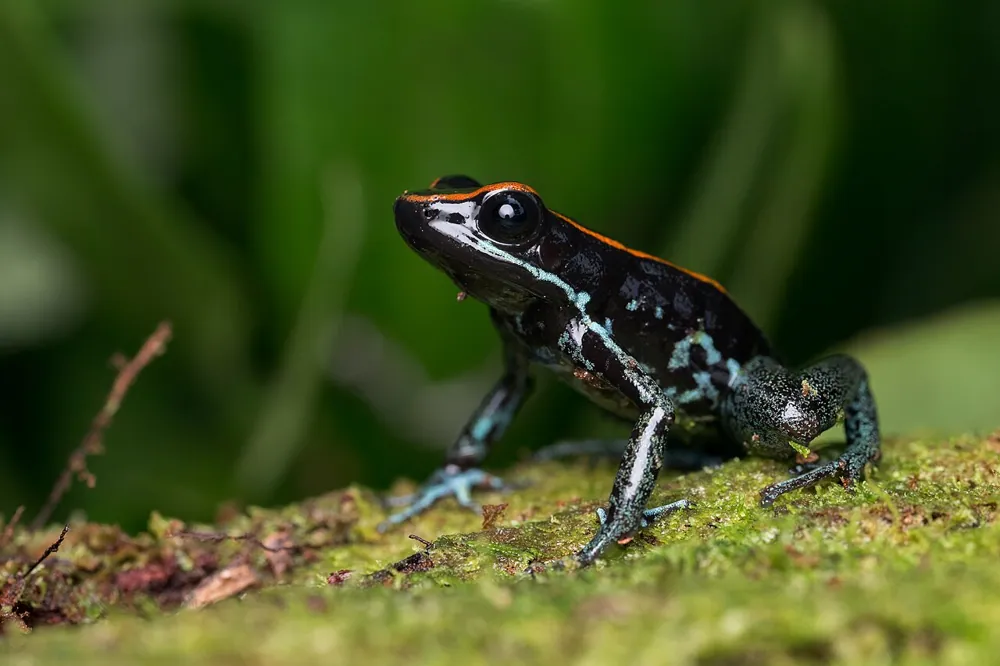
The Golfodulcean poison frog is a small, brightly marked frog that lives only in Costa Rica. Its skin contains a strong nerve poison, so it is one of the most toxic frogs in its genus, and it is a reminder that bright colours can be a warning. It lives in wet forests near streams.1

 Hoe om dit te herken
- The body is black, but it can look glittery because of pigments in the skin.1
- Two stripes run down the back from just above the vent to the tip of the nose. They are usually fire orange, but can be golden, yellow or green.1
- The legs are mottled blue, and the sides often have a blue or green marble pattern.1
- It is a fairly large poison frog for its genus, with a smooth, sloping back. Its shoulder blades are usually hidden under the skin, so it can look a little plump.1
- Females are typically larger than males. Adults reach about 3.5 cm long.1
Word dikwels verwar met: The related P. bicolor and P. terribilis have visible shoulder blades under the skin, which the Golfodulcean poison frog usually lacks, so it looks smoother and rounder.1
Gifkrag
Sy vel is giftig. Dit is gevaarlik om aan te raak, te lek of te eet.
Wat doen sy gif as jy daaraan raak of dit eet?
Its skin contains batrachotoxin, a neurotoxic alkaloid poison, which attacks the nerves. A large enough dose causes severe pain, then tonic-clonic seizures (violent convulsions) and paralysis.1
Hoe gevaarlik is dit vir mense?
Gevaar vir mense: PynlikDit kan regtig seermaak, maar dit is amper nooit ernstig nie.It is highly toxic, though it is only the fourth most toxic species in the genus Phyllobates. The poison is in the skin, so the risk comes from handling the frog or getting the poison from its skin into the body.1
Wat doen dit as dit bang is?
Its bright, multi-coloured body advertises its toxin as a warning to predators.1
 As iemand daaraan geraak of dit geëet het
- As iemand aan een geraak het: was die hande goed en moenie aan die oë of mond raak nie. As 'n kind of troeteldier een gelek of geëet het: bel 'n gifsentrum of jou noodnommer.
Bel altyd eers jou noodnommer (112, 000, 911). Dit is algemene noodhulpraad, nie mediese advies nie. Noodhulp-basiese beginsels
 Bly veilig
- Moet nooit aan 'n wilde dier raak, dit vang of terg nie, selfs nie 'n kleintjie nie, en selfs nie as dit lyk of dit slaap of dood is nie.
- Gee dit spasie. As jy een raakloop, bly kalm, stap stadig terug en laat dit sy eie pad gaan.
- As jy daaraan geraak of dit geëet het: moenie jou oë of mond vryf nie, was jou hande en kry mediese hulp.
Dit is nie uit om jou te kry nie. Sy gif is net daar sodat niks dit eet nie. Meer oor veilig bly
Waar in die wêreld?
Hoe groot is dit?
Hoe lank is dit?
 omtrent so lank soos 'n skuifspeld
 kan 100 meter in 100 sekondes aflê (die vinnigste mens het 9,6 nodig)
Hoe groot is Golfodulcean poison frog in vergelyking met JOU?
Net wiskunde in jou blaaier. Niks word gestoor of enige plek heen gestuur nie.
Hoe vinnig is dit?


Feite
It is one of the few frogs whose poison is named batrachotoxin, a potent nerve toxin.1
Its climbing toe pads stick to leaves in a similar way to geckos, and it can climb out of an unsealed container.1
Male frogs carry their tadpoles on their backs, often for 1 to 2 days, to puddles, pools in palm leaves, or water-filled tree holes.1
Frogs in captivity have no toxin, which shows that their poison comes from what they eat.1
Its skin holds a large amount of poison, because it is comparatively large for a poison dart frog.1
The tadpoles become frogs after about 45 days, and the young frogs become sexually mature after ten months.1
Vir gifkenners
- Wetenskaplike naam
- Phyllobates vittatus
- Groep
- Gifpaddas, skurwepaddas & salamanders
- Familie
- Dendrobatidae2
- Orde
- Anura
- Kontinente
- Noord-Amerika
- Babas
- During the breeding season, the female lays 7 to 21 eggs per clutch on leaves, about every one or two weeks, and the male guards the eggs and carries the hatched tadpoles on his back to water.1
- Gevaar vir mense
- 2 / 5: Pynlik3
Waar die feite vandaan kom
- Golfodulcean poison frog (Wikipedia (CC BY-SA 4.0))
- Phyllobates vittatus (iNaturalist): name en klassifikasie.
- Venom Wiki: die gevaarvlak, die tipiese grootte en die spoedskatting is ons eie. Kyk hoe ons dit uitwerk: Hoe ons gevaar gradeer.
Elke feit op hierdie bladsy het 'n nommer wat na sy bron wys. As ons iets verkeerd het, jammer, ons is dierfanatici, nie 'n wetenskaplike joernaal nie. Laat weet ons by [email protected] en ons maak dit reg.
 Die skerpioen is honger! Venom Wiki is 'n eenmanprojek: gratis, sonder advertensies en sonder spoorsnyers. 'n Klein fooitjie help om dit aanlyn te hou.Voer die skerpioen
Meer uit dieselfde groep: Gifpaddas, skurwepaddas & salamanders
 Cane toadGifpaddas, skurwepaddas & salamandersMoet 'n dokter sienMoenie aanraak nie
 Strawberry poison-dart frogGifpaddas, skurwepaddas & salamandersMaak net seerMoenie aanraak nie
 California newtGifpaddas, skurwepaddas & salamandersKan doodmaakMoenie aanraak nie
 Rough-skinned newtGifpaddas, skurwepaddas & salamandersKan doodmaakMoenie aanraak nie
 Colorado River toadGifpaddas, skurwepaddas & salamandersMoet 'n dokter sienMoenie aanraak nie
 Panamanian golden frogGifpaddas, skurwepaddas & salamandersMoet 'n dokter sienMoenie aanraak nie
 Terciopelo
 Eastern coral snake
 Eastern diamondback rattlesnake
 Eyelash viper
 Timber rattlesnake
 Western diamondback rattlesnake