
 Afrika
 Asië
Asië Europa
 Suid-Amerika
 Australië & Oseanië
 Antarktika
 Stille Oseaan
 Atlantiese Oseaan
 Indiese Oseaan
 Arktiese Oseaan
 Middellandse See
 Rooi See
 Karibiese See
 Koraalsee
 Suid-Chinese See
 Filippynse See
 Andamansee
 Noordsee
 Timorsee & Arafurasee
 Baai van Bengale
 Golf van Kalifornië
Guinea paper wasp
 Steke
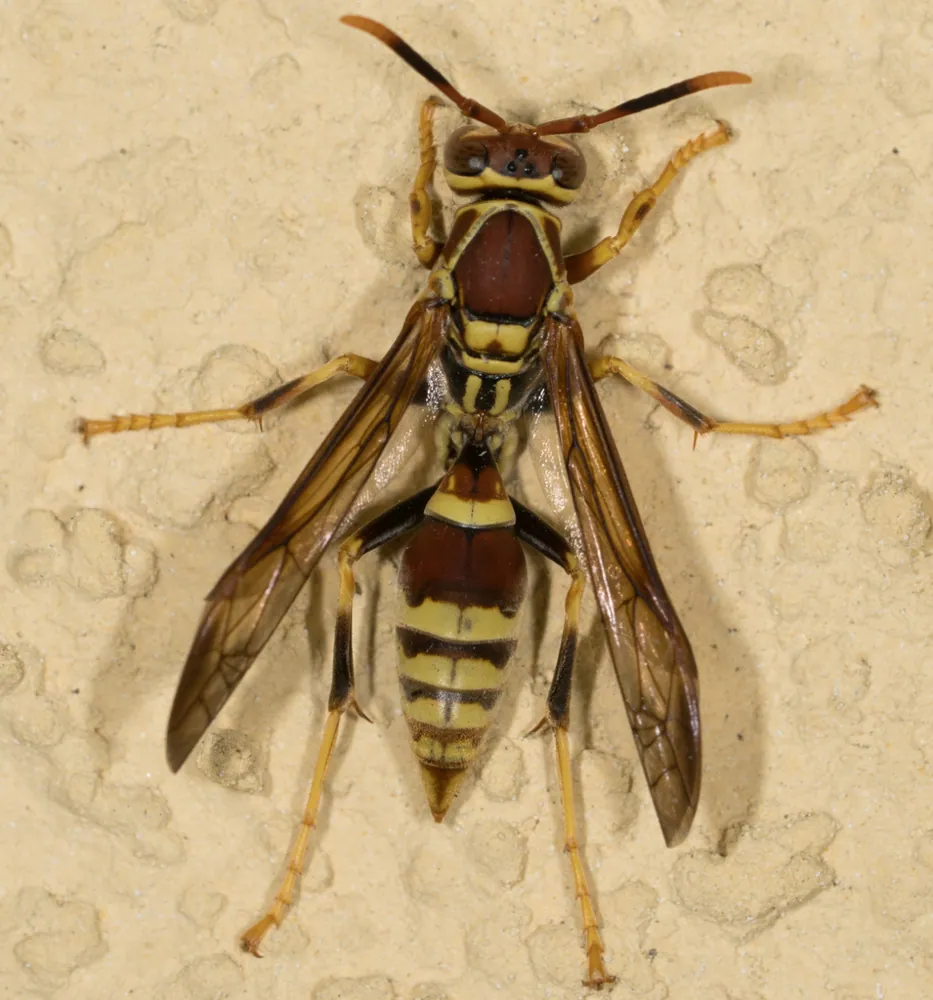
StekeThe Guinea paper wasp is a social wasp that builds small, open nests in colonies of up to about one hundred individuals. It lives in parts of North America, including the eastern United States, Ontario in Canada, and Mexico. Its colonies are often found near buildings and other man-made structures.1
 Hoe om dit te herken
- Typical form: mostly yellow markings on the back of the thorax and the propodeum (the rear part of the thorax), and wings that are purple-tinged rather than yellow.1
- Variable form: red-brown body with dark, almost black, markings on the middle of the antennae, the bases of the abdominal segments and the wings, and pale ivory-white markings spread across the body.1
- Antennae banded with red, black and yellow, unlike most paper wasps, which have only one antenna colour.1
- Females have forewings of 13.0 to 16.5 mm; males have forewings of 12.0 to 15.0 mm.1
- Males have bulging eyes and slender antennae.1
Word dikwels verwar met: The typical form is often confused with Polistes fuscatus, Polistes crinitus and Polistes minor.1
Gifkrag
Gif kom deur 'n angel uit.
Hoe gevaarlik is dit vir mense?
Gevaar vir mense: PynlikDit kan regtig seermaak, maar dit is amper nooit ernstig nie. As dit steek
- Skraap 'n byangel uit en koel die plek af.
- As die persoon sukkel om asem te haal, die gesig of keel swel, of hy voel flou, is dit 'n allergiese noodgeval: bel jou noodnommer en gebruik sy adrenalienpen (outo-inspuiter) as hy een het.
Bel altyd eers jou noodnommer (112, 000, 911). Dit is algemene noodhulpraad, nie mediese advies nie. Noodhulp-basiese beginsels
 Bly veilig
- Moet nooit aan 'n wilde dier raak, dit vang of terg nie, selfs nie 'n kleintjie nie, en selfs nie as dit lyk of dit slaap of dood is nie.
- Gee dit spasie. As jy een raakloop, bly kalm, stap stadig terug en laat dit sy eie pad gaan.
- As een jou steek: bly kalm, bly stil, bel jou noodnommer (112, 000, 911) of kom vinnig by 'n hospitaal uit. Onthou hoe dit gelyk het, 'n foto help.
Dit is nie uit om jou te kry nie. Dit gebruik sy gif om kos te vang of om homself te beskerm, en kruip baie eerder weg. Meer oor veilig bly
Waar in die wêreld?
Hoe groot is dit?
Hoe lank is dit?
 korter as jou pinkie
 kan in 15 sekondes oor 'n hele sokkerveld vlieg
Hoe groot is Guinea paper wasp in vergelyking met JOU?
Net wiskunde in jou blaaier. Niks word gestoor of enige plek heen gestuur nie.
Hoe vinnig is dit?


Feite
Queens survive cold better than workers. In one test at 5 °C over 15 days, 76% of queens survived compared with 17% of workers, partly because they build up sugars that act as antifreeze and a layer of body fat.1
When a queen dies, the oldest female worker becomes the new queen, because the colony ranks its members by age.1
Whether a wasp becomes a worker or a queen is set by the temperature it experiences as an immature wasp.1
Nests are small, usually with fewer than one hundred individuals, so the queen is often the most active wasp in the nest and directly controls the nest's activity.1
Out of six wasp species studied, this was the only one that nested in artificial sites.1
Waar die feite vandaan kom
- Polistes exclamans (Wikipedia (CC BY-SA 4.0))
- Polistes exclamans (iNaturalist): name en klassifikasie.
- Venom Wiki: die gevaarvlak, die tipiese grootte en die spoedskatting is ons eie. Kyk hoe ons dit uitwerk: Hoe ons gevaar gradeer.
Elke feit op hierdie bladsy het 'n nommer wat na sy bron wys. As ons iets verkeerd het, jammer, ons is dierfanatici, nie 'n wetenskaplike joernaal nie. Laat weet ons by [email protected] en ons maak dit reg.
 Die skerpioen is honger! Venom Wiki is 'n eenmanprojek: gratis, sonder advertensies en sonder spoorsnyers. 'n Klein fooitjie help om dit aanlyn te hou.Voer die skerpioen
Meer uit dieselfde groep: Bye, wespe & perdebye
 Tarantula hawkBye, wespe & perdebyeMaak net seer
 Executioner waspBye, wespe & perdebyeMoet 'n dokter sien
 Warrior waspBye, wespe & perdebyeMoet 'n dokter sien
 Bald-faced hornetBye, wespe & perdebyeMaak net seer
 Cow killer velvet antBye, wespe & perdebyeMaak net seer
 Eastern cicada killerBye, wespe & perdebyeOnskadelik
 Terciopelo
 Eastern coral snake
 Eastern diamondback rattlesnake
 Eyelash viper
 Timber rattlesnake
 Western diamondback rattlesnake