
 Afrika
 Asië
Asië Europa
 Suid-Amerika
 Australië & Oseanië
 Antarktika
 Stille Oseaan
 Atlantiese Oseaan
 Indiese Oseaan
 Arktiese Oseaan
 Middellandse See
 Rooi See
 Karibiese See
 Koraalsee
 Suid-Chinese See
 Filippynse See
 Andamansee
 Noordsee
 Timorsee & Arafurasee
 Baai van Bengale
 Golf van Kalifornië
Lace monitor
 Byte
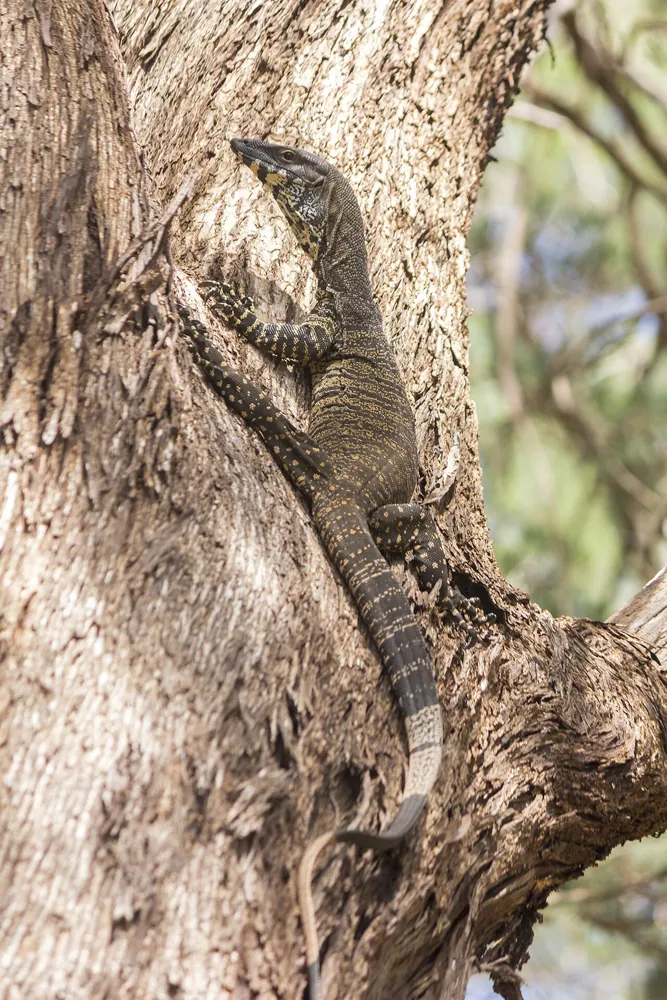
ByteThe lace monitor is a large lizard that lives in eastern Australia, and it can grow up to 2 metres long. It is a skilled climber that often lives in trees, and it is one of the country's biggest monitor lizards. It is also known as the tree goanna.1



 Hoe om dit te herken
- The main form is dark grey to dull bluish-black with scattered cream-coloured spots.1
- The head is black, and the snout has prominent black and yellow bands that extend under the chin and neck.1
- The tail has narrow black and cream bands that get wider towards the tip.1
- Bell's form has a yellow-brown or yellow base colour with fine black mottling and broad black or dark brown bands from the shoulders to the tail.1
- Juveniles have more defined banding, with five narrow black bands on the neck and eight on the body.1
Gifkrag
Gif kom deur sy giftande of tande uit wanneer dit byt.
Wat doen sy gif as dit byt of steek?
Lace monitors have venom glands, and their venom is similar to snake venom, but it is not strong enough to cause serious harm. A bite on the hand can cause swelling within minutes, localised disruption of blood clotting (the blood clots less well in that area), and shooting pain up to the elbow. This pain can often last for several hours.1
Hoe gevaarlik is dit vir mense?
Gevaar vir mense: PynlikDit kan regtig seermaak, maar dit is amper nooit ernstig nie.Its venom is not enough to cause serious harm. Scientists have cautioned that calling these lizards venomous overestimates the medical risk to bite victims.1
Wat doen dit as dit bang is?
When disturbed, lace monitors retreat to a nearby tree.1
 As dit byt
- Was die wond, hou die persoon kalm en kry mediese hulp.
Bel altyd eers jou noodnommer (112, 000, 911). Dit is algemene noodhulpraad, nie mediese advies nie. Noodhulp-basiese beginsels
 Bly veilig
- Moet nooit aan 'n wilde dier raak, dit vang of terg nie, selfs nie 'n kleintjie nie, en selfs nie as dit lyk of dit slaap of dood is nie.
- Gee dit spasie. As jy een raakloop, bly kalm, stap stadig terug en laat dit sy eie pad gaan.
- As een jou byt: bly kalm, bly stil, bel jou noodnommer (112, 000, 911) of kom vinnig by 'n hospitaal uit. Onthou hoe dit gelyk het, 'n foto help.
Dit is nie uit om jou te kry nie. Dit gebruik sy gif om kos te vang of om homself te beskerm, en kruip baie eerder weg. Meer oor veilig bly
Waar in die wêreld?
Hoe groot is dit?
Hoe lank is dit?
Hoe swaar is dit?
 so lank soos 4 huiskatte neus tot stert
 so lank soos 11 piesangs punt aan punt
 kan 100 meter in 22 sekondes aflê (die vinnigste mens het 9,6 nodig)
Hoe groot is Lace monitor in vergelyking met JOU?
Net wiskunde in jou blaaier. Niks word gestoor of enige plek heen gestuur nie.
Hoe vinnig is dit?

Feite
Populations near rubbish tips were thirty five times greater than in natural forest, and individuals were around twice as heavy.1
Lace monitors quickly learned to avoid cane toads after they had been poisoned by them.1
One lace monitor was recorded climbing a brick wall to find shelter during a thunderstorm.1
Its closest living relative is the Komodo dragon.1
Mite-breker
Mite: Bites from monitors were thought to be dangerous mainly because of infection from bacteria in their mouths.
Waarheid: Researchers found in 2005 that the immediate effects of bites were more likely caused by venom.1
Vir gifkenners
- Wetenskaplike naam
- Varanus varius
- Groep
- Giftige akkedisse
- Familie
- Varanidae2
- Orde
- Squamata
- Kontinente
- Australië & Oseanië
- Babas
- Females lay an average of eight eggs, and up to 12, in active termite nests on the ground or in trees. The eggs hatch 6 to 7 months later.1
- Lewensduur
- omtrent 20 jaar1
- Hoe dit in die natuur gaan
- Least Concern1
- Gevaar vir mense
- 2 / 5: Pynlik3
Waar die feite vandaan kom
- Lace monitor (Wikipedia (CC BY-SA 4.0))
- Varanus varius (iNaturalist): name en klassifikasie.
- Venom Wiki: die gevaarvlak, die tipiese grootte en die spoedskatting is ons eie. Kyk hoe ons dit uitwerk: Hoe ons gevaar gradeer.
Elke feit op hierdie bladsy het 'n nommer wat na sy bron wys. As ons iets verkeerd het, jammer, ons is dierfanatici, nie 'n wetenskaplike joernaal nie. Laat weet ons by [email protected] en ons maak dit reg.
 Die skerpioen is honger! Venom Wiki is 'n eenmanprojek: gratis, sonder advertensies en sonder spoorsnyers. 'n Klein fooitjie help om dit aanlyn te hou.Voer die skerpioen
 Perentie
 Spiny-tailed monitor
 Yellow-spotted monitor
 Mitchell's water monitor
 Komodo dragon
 Gila monster
 Coastal taipan
 Common death adder
 Eastern brown snake
 Binnelandse taipan
 Sydney funnel-web spider
 Tierslang
,_photographed_in_the_Kindra_State_Forest.jpg)