
 Afrika
 Asië
Asië Europa
 Suid-Amerika
 Australië & Oseanië
 Antarktika
 Stille Oseaan
 Atlantiese Oseaan
 Indiese Oseaan
 Arktiese Oseaan
 Middellandse See
 Rooi See
 Karibiese See
 Koraalsee
 Suid-Chinese See
 Filippynse See
 Andamansee
 Noordsee
 Timorsee & Arafurasee
 Baai van Bengale
 Golf van Kalifornië
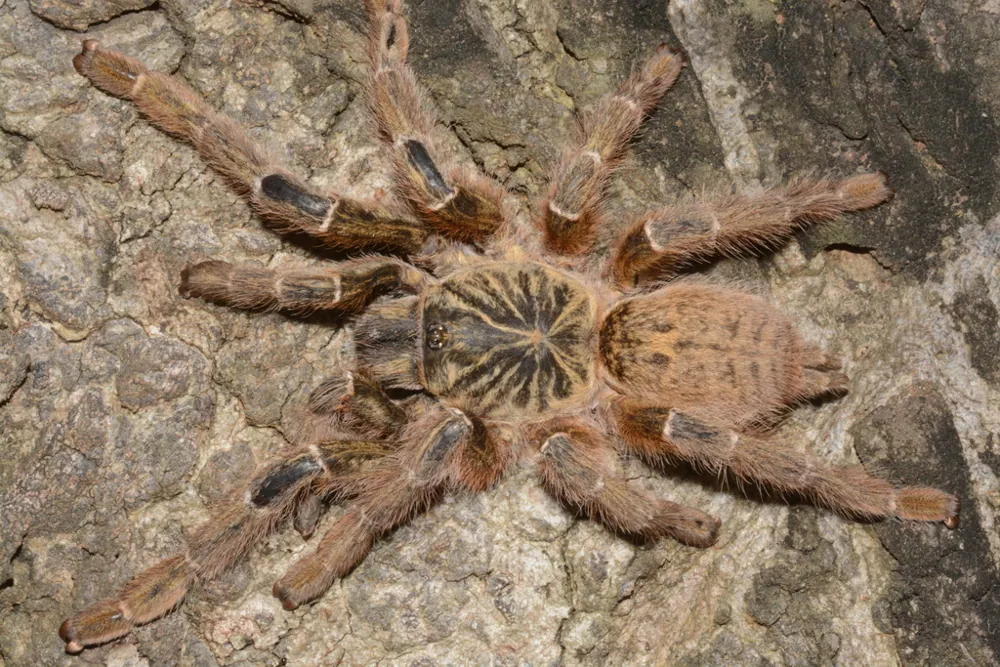
Orange baboon tarantula
 Byte
ByteThe orange baboon tarantula is a large, nocturnal spider, so it is most active at night. It lives in parts of Africa, including Angola, central and southern Africa and the island of Zanzibar. Its bite is not known to be deadly, but it is very painful, so it should be left alone.1



 Hoe om dit te herken
Gifkrag
Gif kom deur sy giftande of tande uit wanneer dit byt.
Wat doen sy gif as dit byt of steek?
The venom is not known to be lethal to humans, but the bite is considered medically significant. The bite is extremely painful.1
Hoe gevaarlik is dit vir mense?
Gevaar vir mense: PynlikDit kan regtig seermaak, maar dit is amper nooit ernstig nie.The bite is not thought to be serious, but it is extremely painful. It is considered medically significant, so handling this species is advised against.1
Wat doen dit as dit bang is?
It is very defensive and will bite if provoked, often without first showing its typical threat display.1
 As dit byt
- Was die byt en koel dit af. Kry mediese hulp as die pyn erg is of die persoon sleg voel.
Bel altyd eers jou noodnommer (112, 000, 911). Dit is algemene noodhulpraad, nie mediese advies nie. Noodhulp-basiese beginsels
 Bly veilig
- Moet nooit aan 'n wilde dier raak, dit vang of terg nie, selfs nie 'n kleintjie nie, en selfs nie as dit lyk of dit slaap of dood is nie.
- Gee dit spasie. As jy een raakloop, bly kalm, stap stadig terug en laat dit sy eie pad gaan.
- As een jou byt: bly kalm, bly stil, bel jou noodnommer (112, 000, 911) of kom vinnig by 'n hospitaal uit. Onthou hoe dit gelyk het, 'n foto help.
Dit is nie uit om jou te kry nie. Dit gebruik sy gif om kos te vang of om homself te beskerm, en kruip baie eerder weg. Meer oor veilig bly
Waar in die wêreld?
Hoe groot is dit?
Hoe lank is dit?
 so lank soos 5 speelgoed-boublokke in 'n ry
 kan 100 meter in 200 sekondes aflê (die vinnigste mens het 9,6 nodig)
Hoe groot is Orange baboon tarantula in vergelyking met JOU?
Net wiskunde in jou blaaier. Niks word gestoor of enige plek heen gestuur nie.
Hoe vinnig is dit?


Feite
Hobbyists nickname it OBT, short for orange baboon tarantula or orange bitey thing, and call it the pterror, a pun on its genus name.1
It can be found in five known colour forms, and the colour is thought to be linked to the type of soil where each form lives.1
Unlike some New World tarantulas, it has no urticating hairs to irritate the skin.1
It builds a tunnel-shaped web.1
It is a nocturnal spider, so it is most active at night.1
Waar die feite vandaan kom
- Pterinochilus murinus (Wikipedia (CC BY-SA 4.0))
- Pterinochilus murinus (iNaturalist): name en klassifikasie.
- Venom Wiki: die gevaarvlak, die tipiese grootte en die spoedskatting is ons eie. Kyk hoe ons dit uitwerk: Hoe ons gevaar gradeer.
Elke feit op hierdie bladsy het 'n nommer wat na sy bron wys. As ons iets verkeerd het, jammer, ons is dierfanatici, nie 'n wetenskaplike joernaal nie. Laat weet ons by [email protected] en ons maak dit reg.
 Die skerpioen is honger! Venom Wiki is 'n eenmanprojek: gratis, sonder advertensies en sonder spoorsnyers. 'n Klein fooitjie help om dit aanlyn te hou.Voer die skerpioen
Meer uit dieselfde groep: Tarantulas & tregterwebspinnekoppe
 King baboon spiderTarantulas & tregterwebspinnekoppeMaak net seer
 Featherleg baboon spiderTarantulas & tregterwebspinnekoppeMoet 'n dokter sien
 Togo starburst tarantulaTarantulas & tregterwebspinnekoppeMoet 'n dokter sien
 Cameroon red baboon spiderTarantulas & tregterwebspinnekoppeMaak net seer
 Golden blue-leg baboon spiderTarantulas & tregterwebspinnekoppeMaak net seer
 Horned baboon spiderTarantulas & tregterwebspinnekoppeMaak net seer
 Black mamba
 Deathstalker
 Egyptian cobra
 Puff adder
 Boomslang
 Fat-tailed scorpion