
 Afrika
 Asië
Asië Europa
 Suid-Amerika
 Australië & Oseanië
 Antarktika
 Stille Oseaan
 Atlantiese Oseaan
 Indiese Oseaan
 Arktiese Oseaan
 Middellandse See
 Rooi See
 Karibiese See
 Koraalsee
 Suid-Chinese See
 Filippynse See
 Andamansee
 Noordsee
 Timorsee & Arafurasee
 Baai van Bengale
 Golf van Kalifornië
Southern blue-ringed octopus
 Byte
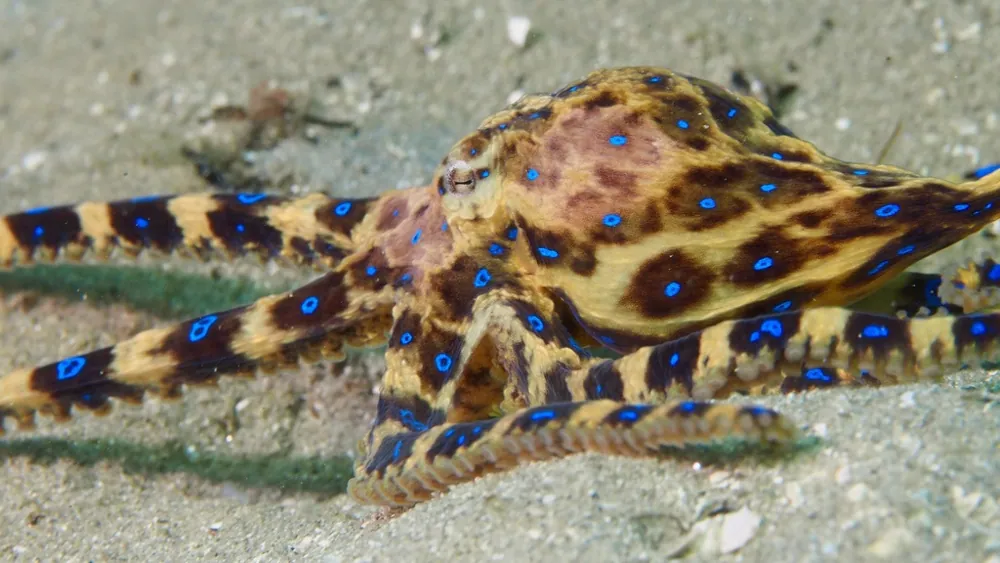
ByteThe southern blue-ringed octopus is a small octopus that lives in tidal rock pools and rocky reefs along the south coast of Australia. It is one of four extremely venomous blue-ringed octopus species. Its body is usually drab, but its blue rings flash when it feels threatened.1



 Hoe om dit te herken
Gifkrag
Gif kom deur sy giftande of tande uit wanneer dit byt.
Wat doen sy gif as dit byt of steek?
Its venom contains maculotoxin, a deadly neurotoxin (a poison that attacks the nerves), and tetrodotoxin (TTX), also a neurotoxin. Without immediate medical attention, a bite is often fatal to humans.1
Hoe gevaarlik is dit vir mense?
Gevaar vir mense: DodelikEen van die gevaarlikste diere in die wêreld.The octopus is normally docile, but its venom can kill a human. A bite is often fatal without immediate medical attention. No cases of unprovoked aggression towards humans are known.1
Wat doen dit as dit bang is?
When threatened, its drab colouring gives way to flashing blue-green rings.1
 As dit byt
- Get immediate medical attention, because a bite is often fatal without it. No antivenom exists.1
- Drukimmobilisasie: draai 'n stewige elastiese verband oor die byt en dan op oor die hele arm of been, spalk dit en hou die persoon heeltemal stil totdat hulp opdaag.
- 'n Blouring-seekat of keëlslak kan 'n mens se asemhaling laat stop terwyl hy nog wakker is: roep hulp en wees gereed om asemhaling (mond-tot-mond) te gee totdat die ambulans oorneem.
Bel altyd eers jou noodnommer (112, 000, 911). Dit is algemene noodhulpraad, nie mediese advies nie. Noodhulp-basiese beginsels
 Bly veilig
- Moet nooit aan 'n wilde dier raak, dit vang of terg nie, selfs nie 'n kleintjie nie, en selfs nie as dit lyk of dit slaap of dood is nie.
- Gee dit spasie. As jy een raakloop, bly kalm, stap stadig terug en laat dit sy eie pad gaan.
- As een jou byt: bly kalm, bly stil, bel jou noodnommer (112, 000, 911) of kom vinnig by 'n hospitaal uit. Onthou hoe dit gelyk het, 'n foto help.
Dit is nie uit om jou te kry nie. Dit gebruik sy gif om kos te vang of om homself te beskerm, en kruip baie eerder weg. Meer oor veilig bly
Waar in die wêreld?
Hoe groot is dit?
Hoe lank is dit?
 so lank soos 6 speelgoed-boublokke in 'n ry
 kan die lengte van 'n groot swembad (50 m) in 7,2 sekondes swem
Hoe groot is Southern blue-ringed octopus in vergelyking met JOU?
Net wiskunde in jou blaaier. Niks word gestoor of enige plek heen gestuur nie.
Hoe vinnig is dit?

Feite
Females only reproduce once in their lifetime. After the eggs hatch, the mother dies shortly afterwards, as she does not eat while guarding them.1
Young blue-ringed octopuses have no planktonic stage. They begin hunting at around one month old.1
The average lifespan is around seven months. The octopus reaches sexual maturity at about four months old.1
Females are choosy about mates. They are more willing to mate with larger males, and larger males try to mate more often than smaller ones.1
Mite-breker
Mite: Popular culture portrays the southern blue-ringed octopus as a sea devil that lies in wait to attack humans.
Waarheid: Its venom is mainly used for hunting or defence. There are no reported cases of unprovoked aggression towards humans.1
Vir gifkenners
- Wetenskaplike naam
- Hapalochlaena maculosa
- Groep
- Keëlslakke & seekatte
- Familie
- Octopodidae2
- Orde
- Octopoda
- Kontinente
- Indiese Oseaan, Stille Oseaan, Die oseane
- Babas
- The female carries her eggs with her instead of leaving them in one place, and the young hatch from them. The young are venomous from birth, and their blue rings appear about six weeks after hatching.1
- Lewensduur
- omtrent 0,6 jaar1
- Gevaar vir mense
- 5 / 5: Dodelik3
Waar die feite vandaan kom
- Southern blue-ringed octopus (Wikipedia (CC BY-SA 4.0))
- Hapalochlaena maculosa (iNaturalist): name en klassifikasie.
- Venom Wiki: die gevaarvlak, die tipiese grootte en die spoedskatting is ons eie. Kyk hoe ons dit uitwerk: Hoe ons gevaar gradeer.
Elke feit op hierdie bladsy het 'n nommer wat na sy bron wys. As ons iets verkeerd het, jammer, ons is dierfanatici, nie 'n wetenskaplike joernaal nie. Laat weet ons by [email protected] en ons maak dit reg.
 Die skerpioen is honger! Venom Wiki is 'n eenmanprojek: gratis, sonder advertensies en sonder spoorsnyers. 'n Klein fooitjie help om dit aanlyn te hou.Voer die skerpioen
Meer uit dieselfde groep: Keëlslakke & seekatte
 Geography cone
 Greater blue-ringed octopus
 Blue sea dragon
 Common octopus
 Giant Pacific octopus
 Blue-lined octopus
Leef ook in: Indiese Oseaan
 Australian box jellyfishJellievisse & see-steekdiereDodelikMoenie aanraak nie
 Hawksbill sea turtleAnder diere wat giftig is om aan te raak of te eetKan doodmaak
 Irukandji jellyfishJellievisse & see-steekdiereKan doodmaakMoenie aanraak nie
 Reef stonefishGiftige visseKan doodmaakMoenie aanraak nie
 Crown-of-thorns starfishSee-egels, seesterre & wurmsMoet 'n dokter sienMoenie aanraak nie
 Portuguese man o' warJellievisse & see-steekdiereMoet 'n dokter sienMoenie aanraak nie