
 Afrika
 Asië
Asië Europa
 Suid-Amerika
 Australië & Oseanië
 Antarktika
 Stille Oseaan
 Atlantiese Oseaan
 Indiese Oseaan
 Arktiese Oseaan
 Middellandse See
 Rooi See
 Karibiese See
 Koraalsee
 Suid-Chinese See
 Filippynse See
 Andamansee
 Noordsee
 Timorsee & Arafurasee
 Baai van Bengale
 Golf van Kalifornië
Spotted wolf spider
 Byte
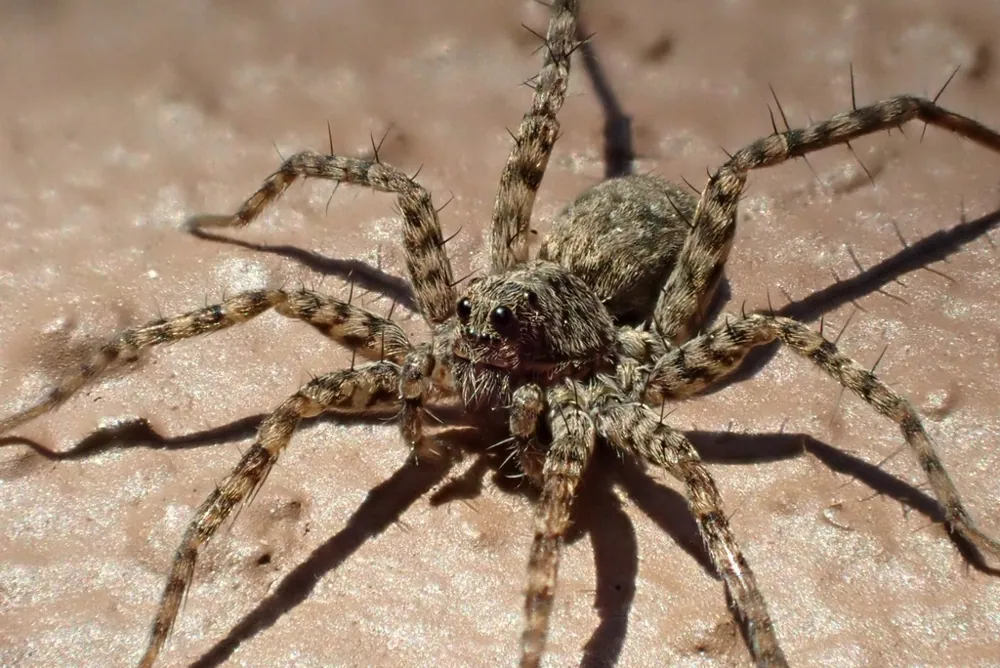
ByteThe spotted wolf spider is a small, brown ground spider that hunts on foot rather than in a web. It lives across central and north-western Europe and is common in the British Isles. It is a fast, active hunter that often hunts in daylight.1


 Hoe om dit te herken
- Adults are 5 mm to 8 mm long.1
- The body is brownish with darker brown markings or spots.1
- Females are usually slightly larger than males.1
- Eight eyes: two large and four smaller eyes face forward, and two more sit on top of the head.1
- It does not weave a web. It is often seen running in the open or on low plants.1
Gifkrag
Gif kom deur sy giftande of tande uit wanneer dit byt.
Hoe gevaarlik is dit vir mense?
Gevaar vir mense: LigSoos 'n bysteek of minder. Basies onskadelik vir mense. As dit byt
- Was die byt en sit 'n yspak daarop vir die pyn. Kry mediese hulp as die pyn erg is, versprei of die persoon sleg voel.
Bel altyd eers jou noodnommer (112, 000, 911). Dit is algemene noodhulpraad, nie mediese advies nie. Noodhulp-basiese beginsels
 Bly veilig
- Moet nooit aan 'n wilde dier raak, dit vang of terg nie, selfs nie 'n kleintjie nie, en selfs nie as dit lyk of dit slaap of dood is nie.
- Gee dit spasie. As jy een raakloop, bly kalm, stap stadig terug en laat dit sy eie pad gaan.
- As een jou byt: bly kalm, bly stil, bel jou noodnommer (112, 000, 911) of kom vinnig by 'n hospitaal uit. Onthou hoe dit gelyk het, 'n foto help.
Dit is nie uit om jou te kry nie. Dit gebruik sy gif om kos te vang of om homself te beskerm, en kruip baie eerder weg. Meer oor veilig bly
Waar in die wêreld?
Hoe groot is dit?
Hoe lank is dit?
 klein genoeg om op jou vingernael te sit
Hoe groot is Spotted wolf spider in vergelyking met JOU?
Net wiskunde in jou blaaier. Niks word gestoor of enige plek heen gestuur nie.
Hoe vinnig is dit?


Feite
Mothers carry their young on their backs after they hatch, until the young moult for the second time.1
During courtship, the male raises himself high on his hind legs, stretches out and waves his palps, and moves closer to the female bit by bit.1
If the female rejects him, she lunges forward and the smaller male backs off, then returns a few seconds later to display again.1
It relies heavily on its eyesight to locate and stalk prey.1
It is often active very early in spring and between March and July, and it warms itself in the sunshine on patches of bare soil.1
Vir gifkenners
- Wetenskaplike naam
- Pardosa amentata
- Groep
- Spinnekoppe
- Familie
- Lycosidae2
- Orde
- Araneae
- Kontinente
- Europa
- Babas
- The female carries her eggs in a round silk sac beneath her abdomen. After hatching, the spiderlings ride on her back until their second moult, when they can fend for themselves.1
- Gevaar vir mense
- 1 / 5: Lig3
Waar die feite vandaan kom
- Pardosa amentata (Wikipedia (CC BY-SA 4.0))
- Pardosa amentata (iNaturalist): name en klassifikasie.
- Venom Wiki: die gevaarvlak, die tipiese grootte en die spoedskatting is ons eie. Kyk hoe ons dit uitwerk: Hoe ons gevaar gradeer.
Elke feit op hierdie bladsy het 'n nommer wat na sy bron wys. As ons iets verkeerd het, jammer, ons is dierfanatici, nie 'n wetenskaplike joernaal nie. Laat weet ons by [email protected] en ons maak dit reg.
 Die skerpioen is honger! Venom Wiki is 'n eenmanprojek: gratis, sonder advertensies en sonder spoorsnyers. 'n Klein fooitjie help om dit aanlyn te hou.Voer die skerpioen
Meer uit dieselfde groep: Spinnekoppe
 Mediterranean black widow
 Diving bell spider
 European yellow sac spider
 Noble false widow
 Tarantula wolf spider
 Daddy long-legs spider
Leef ook in: Europa
 Common European adderAdders & vipersMoet 'n dokter sien
 Spanish flyAnder diere wat giftig is om aan te raak of te eetMoet 'n dokter sienMoenie aanraak nie
 Common waspBye, wespe & perdebyeMaak net seer
 European hornetBye, wespe & perdebyeMaak net seer
 Fire salamanderGifpaddas, skurwepaddas & salamandersMaak net seerMoenie aanraak nie
 Western honey beeBye, wespe & perdebyeMaak net seer