
 Afrika
 Asiya
Asiya Avropa
 Cənubi Amerika
 Avstraliya və Okeaniya
 Antarktida
 Sakit okean
 Atlantik okeanı
 Hind okeanı
 Şimal Buzlu okeanı
 Aralıq dənizi
 Qırmızı dəniz
 Karib dənizi
 Mərcan dənizi
 Cənubi Çin dənizi
 Filippin dənizi
 Andaman dənizi
 Şimal dənizi
 Timor və Arafura dənizləri
 Benqal körfəzi
 Kaliforniya körfəzi
Black-banded jumper ant
 Sancır
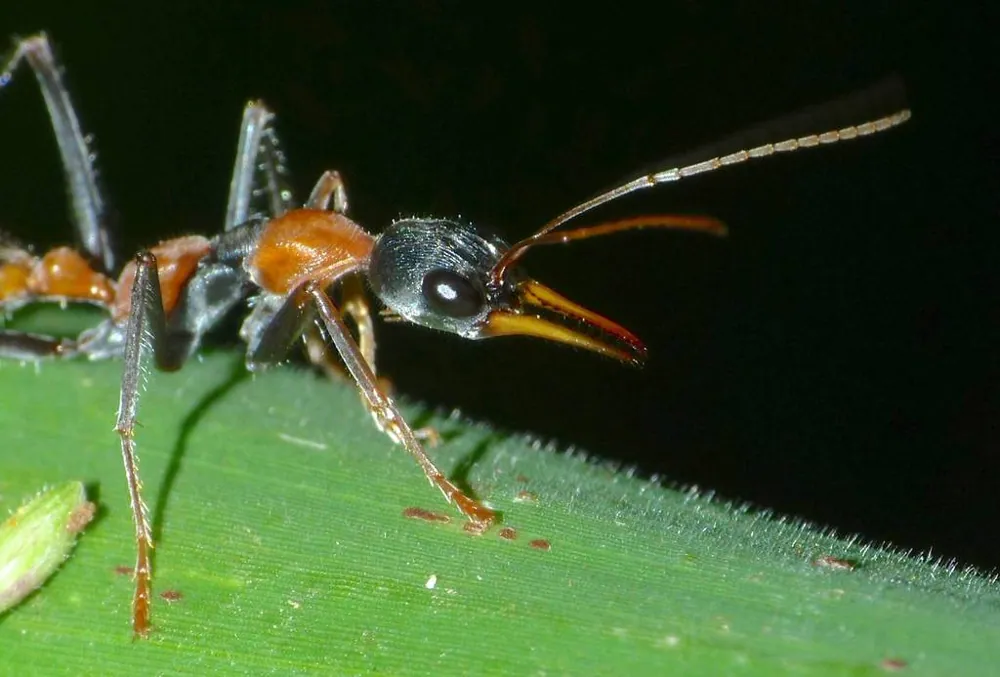
The black-banded jumper ant is a large ant that can leap up to 10 centimetres, which is far above its own body length. It lives in eastern Australia, including suburbs of Sydney and Brisbane. Its sting is painful and can cause serious allergic reactions in some people, so it is worth knowing how to recognise it.1



 Necə tanımalı
- Mostly black and orange-red in colour.1
- The gaster (rear body), head, legs and mesonotum (middle back) are black, while the pronotum, propodeum, petiole and post-petiole are red.1
- Mandibles (jaws) are either black or yellow, depending on where the ant lives.1
- Workers are 13 to 15 mm long, males 16 to 17 mm, and queens 17 to 19 mm.1
- It can leap 76 to 102 mm by suddenly extending its middle and hind legs.1
Tez-tez qarışdırılır: It is often confused with other Myrmecia species. It can be told apart by its bi-coloured thorax and post-petiole, which are yellowish-red and black, and by its yellowish-red node.1
Zəhər gücü
Zəhər iynədən çıxır.
Onun zəhəri nə edir?
Its sting is highly venomous and causes intense burning pain. The burning can last for many days, and the sting itches. If the sting is left untreated, it may develop into an ulcer (an open sore). The venom of a close relative, M. pilosula, is among the strongest of all ants and contains acids, enzymes and phospholipases.1
İnsanlar üçün nə qədər təhlükəlidir?
İnsanlar üçün təhlükə: AğrılıÇox ağrıda bilər, amma demək olar ki, heç vaxt ciddi olmur.A 2011 study of Australian ant allergies found that 265 of 376 participants reacted to the stings of several Myrmecia species, which can cause anaphylaxis (a severe, whole-body allergic reaction). Of these, 15 reacted to this species, while 176 reacted to M. pilosula. The study concluded that Myrmecia species were among four main groups of Australian ants responsible for anaphylaxis.1
Qorxanda nə edir?
When threatened, workers and scouts quickly defend the nest and may react aggressively even to a shadow crossing it, bursting out in short hops to attack.1
 Sancsa
- Sancılan yerləri yu və soyut.
- İnsan çətinliklə nəfəs alırsa, üzü və ya boğazı şişirsə və ya huşunu itirəcək kimi olursa, bu, təcili allergik vəziyyətdir: təcili yardım nömrənə zəng et.
Həmişə əvvəlcə təcili yardım nömrənə zəng et (112, 000, 911). Bu, ümumi ilk yardım tövsiyəsidir, tibbi məsləhət deyil. İlk yardımın əsasları
 Təhlükəsiz qal
- Vəhşi heyvana heç vaxt toxunma, onu tutma və ya ona sataşma, hətta kiçik olsa belə, hətta yatmış və ya ölü görünsə belə.
- Ona yer ver. Rast gəlsən, sakit ol, yavaşca geri çəkil və qoy öz yolu ilə getsin.
- Biri səni sancsa: sakit ol, hərəkət etmə, təcili yardım nömrənə (112, 000, 911) zəng et və ya tez xəstəxanaya get. Onun necə göründüyünü yadda saxla, şəkil kömək edir.
O, sənin dalınca düşməyib. Zəhərini yem tutmaq və ya özünü qorumaq üçün istifadə edir və gizlənməyi daha çox sevir. Təhlükəsizlik haqqında daha çox
Dünyanın harasında?
Nə qədər böyükdür?
Nə qədər uzundur?
 sənin çeçələ barmağından qısa
Black-banded jumper ant SƏNİNLƏ müqayisədə nə qədər böyükdür?
Sadəcə brauzerində riyaziyyat. Heç nə yadda saxlanmır və heç yerə göndərilmir.
Nə qədər sürətlidir?


Faktlar
It can jump between 76 and 102 mm, which is far more than its own body length.1
Colonies can continue without a queen, because workers can lay fertile eggs.1
It often forages in trees, where it visits the flowers of some eucalyptus and senna plants and may help pollinate them.1
A worker can live for over a year, with a maximum of about 1.3 years.1
Its nests are camouflaged with twigs, leaves, gravel and other plant material.1
Zəhər ekspertləri üçün
Faktlar haradan gəlir
- Myrmecia nigrocincta (Wikipedia (CC BY-SA 4.0))
- Myrmecia nigrocincta (iNaturalist): adlar və təsnifat.
- Venom Wiki: təhlükə səviyyəsi, tipik ölçü və sürət təxmini bizimdir. Onları necə hesabladığımıza bax: Təhlükəni necə qiymətləndiririk.
Bu səhifədəki hər faktın yanında mənbəyini göstərən nömrə var. Səhv bir şey yazmışıqsa, bağışla, biz elmi jurnal yox, sadəcə heyvan həvəskarlarıyıq. [email protected] ünvanına yaz, düzəldək.
 Əqrəb acdır! Venom Wiki bir nəfərin layihəsidir: pulsuz, reklamsız və izləyicisiz. Kiçik bəxşiş onun onlayn qalmasına kömək edir.Əqrəbi yemlə
 Bulldog ant
 Jack jumper ant
 Green weaver ant
 Giant bull ant
 Green-head ant
 Inchman ant
 Coastal taipan
 Common death adder
 Eastern brown snake
 Daxili taypan
 Sydney funnel-web spider
 Pələng ilanı