
 Афрыка
 Азія
Азія Еўропа
 Паўднёвая Амерыка
 Аўстралія і Акіянія
 Антарктыда
 Ціхі акіян
 Атлантычны акіян
 Індыйскі акіян
 Паўночны Ледавіты акіян
 Міжземнае мора
 Чырвонае мора
 Карыбскае мора
 Каралавае мора
 Паўднёва-Кітайскае мора
 Філіпінскае мора
 Андаманскае мора
 Паўночнае мора
 Тыморскае і Арафурскае моры
 Бенгальскі заліў
 Каліфарнійскі заліў
Flower urchin
 Уджаленні
The flower urchin is a sea urchin with flower-shaped claws that can sting. It lives on coral reefs, in seagrass beds and on rocky or sandy sea floors across the Indo-West Pacific. It is one of the sea urchins most likely to cause a painful and medically significant sting.1
 Як яе пазнаць
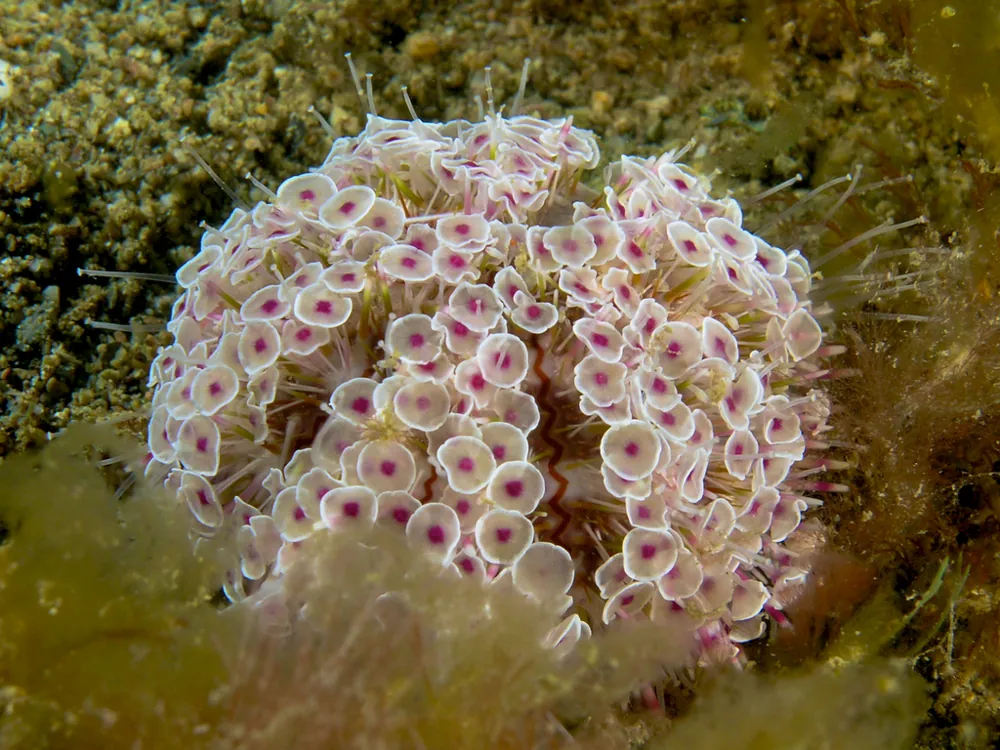
- Flower-like claws (globiferous pedicellariae) that are pinkish-white to yellowish-white, with a central purple dot and a bright white rim1
- A rigid shell (test) that is deep red and grey, with a purple zigzag pattern along each of the five ambulacral segments; rarely it is greenish or pale purple1
- Short, blunt spines, usually hidden beneath the flower-like claws1
- A body diameter of about 15 to 20 cm1
Часта блытаюць з: Other Toxopneustes urchins look similar. Toxopneustes roseus has a uniform pink, brown or purple test and lives only in the eastern Pacific. Toxopneustes elegans, found only around Japan, has a dark stripe just below the tips of its spines. Toxopneustes maculatus is very rare, known from Réunion, Christmas Island and Palmyra Atoll, and has bright violet on its underside and a violet band around its middle.1
Сіла яду
Яд выходзіць праз джала.
Што робіць яе яд?
Its venom is made in glands at the base of the flower-like claws, not in the spines. The claws have sharp fang-like tips that can penetrate human skin, and when touched they snap shut and inject venom. The sting is described as extremely painful and medically significant.1
Наколькі яна небяспечная для людзей?
Небяспека для людзей: Вельмі небяспечнаяМожа забіць чалавека, які не атрымаў лячэння.It is considered highly dangerous to people. Its stings are extremely painful and medically significant. Larger individuals with bigger claws are thought to be more dangerous, because the strength of the venom is linked to claw size.1
Што яна робіць, калі напалохана?
When touched or brushed against, its flower-like claws snap shut and inject venom. The claws can break off and stay attached to the skin, continuing to inject venom for several hours.1
 Калі джаліць
- Апусці рану ў гарачую ваду, такую гарачую, якую чалавек можа цярпець без апёку, і звярніся па медыцынскую дапамогу, каб выдаліць шыпы. Не спрабуй выкалупваць іх сам.
Заўсёды спачатку тэлефануй на нумар экстраннай службы (112, 000, 911). Гэта агульныя парады па першай дапамозе, а не медыцынская кансультацыя. Асновы першай дапамогі
 Будзь у бяспецы
- Ніколі не чапай, не лаві і не дражні дзікую жывёлу, нават маленькую, і нават калі здаецца, што яна спіць ці мёртвая.
- Трымайся ад яе далей. Калі сустрэнеш такую жывёлу, захоўвай спакой, павольна адыдзі назад і дай ёй пайсці сваёй дарогай.
- Калі такая жывёла ўджаліць цябе: захоўвай спакой, не рухайся, тэлефануй на нумар экстраннай службы (112, 000, 911) або хутка дабірайся да бальніцы. Запомні, як яна выглядала, фота дапаможа.
Яна не палюе на цябе. Яд патрэбны ёй, каб лавіць ежу ці абараняцца, і яна з большай ахвотай схаваецца. Яшчэ пра бяспеку
Дзе ў свеце?
Якога яна памеру?
Якой яна даўжыні?
 даўжынёй як 6 цаглінак канструктара ў рад
 павольней за садовага слімака
Flower urchin і ТЫ: хто большы?
Проста матэматыка ў тваім браўзеры. Нічога не захоўваецца і нікуды не адпраўляецца.
Як хутка яна рухаецца?

Факты
Unlike most venomous sea urchins, it does not sting through its spines. Its venom is delivered through the claws.1
A zebra crab, Zebrida adamsii, often lives attached to its shell. The crab is thought to be immune to its venom.1
Its flower-like claws are the source of its common name and are its most striking feature.1
Tiny shrimp, Athanas areteformis, sometimes live among its spines.1
In the seashell trade, its empty shells are called "mushroom urchins" because they look like mushroom caps.1
Разбуральнік міфаў
Міф: Sea urchins sting with their spines.
Праўда: Flower urchins do not deliver venom through their spines. Their venom comes from the flower-like claws, which snap shut and inject it.1
Для знаўцаў яду
- Навуковая назва
- Toxopneustes pileolus
- Група
- Вожыкі, зоркі і чэрві
- Сям'я
- Toxopneustidae2
- Парадак
- Camarodonta
- Кантыненты
- Індыйскі акіян, Ціхі акіян, Чырвонае мора, Каралавае мора, Філіпінскае мора, Тыморскае і Арафурскае моры, Бенгальскі заліў, Акіяны
- Дзіцяняты
- Eggs and sperm are released into the water during mass spawning events, and fertilisation happens outside the body.1
- Небяспека для людзей
- 4 / 5: Вельмі небяспечная3
Адкуль узятыя факты
- Toxopneustes pileolus (Wikipedia (CC BY-SA 4.0))
- Toxopneustes pileolus (iNaturalist): назвы і класіфікацыя.
- Venom Wiki: узровень небяспекі, звычайны памер і прыблізную хуткасць мы ацэньваем самі. Паглядзі, як мы гэта робім: Як мы ацэньваем небяспеку.
У кожнага факта на гэтай старонцы ёсць нумар, які вядзе да яго крыніцы. Калі мы недзе памыліліся, прабач, мы аматары жывёл, а не навуковы часопіс. Напішы нам на [email protected], і мы ўсё выправім.
 Скарпіён галодны! Venom Wiki робіць адзін чалавек: праект бясплатны, без рэкламы і без трэкераў. Невялікія чаявыя дапамагаюць яму працаваць далей.Пакармі скарпіёна
Яшчэ з гэтай групы: Вожыкі, зоркі і чэрві
 Crown-of-thorns starfishВожыкі, зоркі і чэрвіПатрэбны лекарНе чапаць
 Fire urchinВожыкі, зоркі і чэрвіПатрэбны лекарНе чапаць
 Bearded firewormВожыкі, зоркі і чэрвіПроста балючаНе чапаць
 Black long-spined urchinВожыкі, зоркі і чэрвіПроста балючаНе чапаць
 BloodwormВожыкі, зоркі і чэрвіПроста балюча
 Bobbit wormВожыкі, зоркі і чэрвіПроста балюча
Таксама жыве ў: Індыйскі акіян
 Australian box jellyfishМедузы і пякучыя марскія жыхарыСмяротна небяспечнаяНе чапаць
 Geography coneКонусы і васьміногіСмяротна небяспечная
 Greater blue-ringed octopusКонусы і васьміногіСмяротна небяспечная
 Southern blue-ringed octopusКонусы і васьміногіСмяротна небяспечная
 Hawksbill sea turtleІншыя атрутныя жывёлыМожа забіць
 Irukandji jellyfishМедузы і пякучыя марскія жыхарыМожа забіцьНе чапаць