
 Àfrica
 Àsia
Àsia Europa
 Amèrica del Sud
 Austràlia i Oceania
 Antàrtida
 Oceà Pacífic
 Oceà Atlàntic
 Oceà Índic
 Oceà Àrtic
 Mar Mediterrània
 Mar Roja
 Mar Carib
 Mar del Corall
 Mar de la Xina Meridional
 Mar de les Filipines
 Mar d'Andaman
 Mar del Nord
 Mar de Timor i d'Arafura
 Golf de Bengala
 Golf de Califòrnia
Egyptian cobra
 Mossegades
The Egyptian cobra is one of the most venomous snakes in Northern Africa. It lives across much of North Africa and the savannas of West Africa, and it often lives close to people, sometimes entering villages and houses. Its bite is dangerous, so it is important to know what it looks like.1



 Com reconèixer-lo
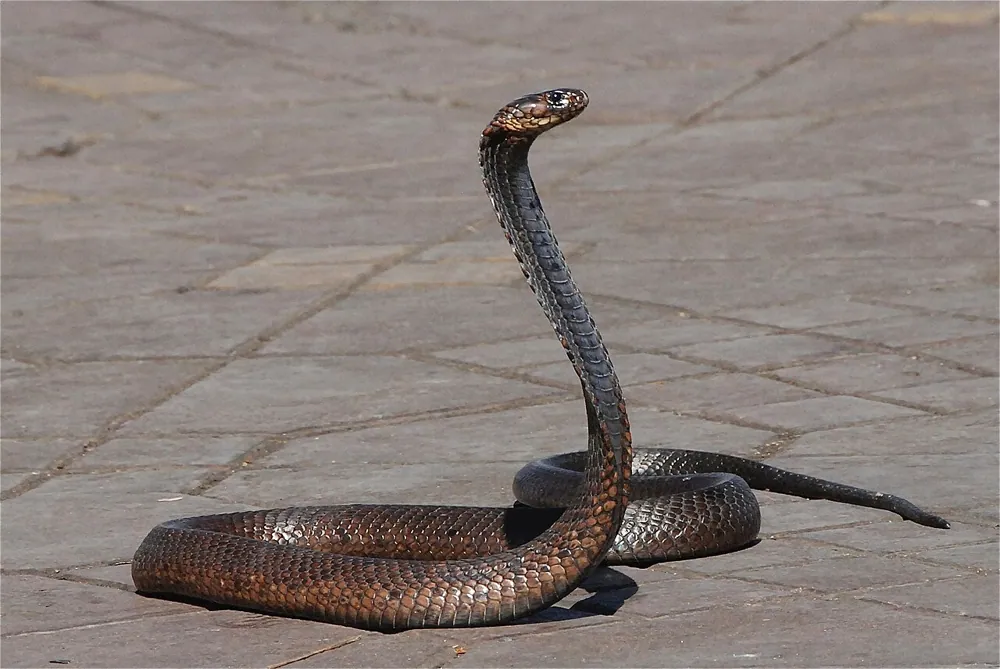
- Its large, flattened head is slightly distinct from its neck, and it can spread a hood like other cobras.1
- Most individuals are some shade of brown, often with a tear-drop mark below the eye.1
- Some are copper-red or grey-brown, and those from Morocco are almost entirely black.1
- The belly is mostly creamy white, yellow brown, grey, blue grey, dark brown or black, often with dark spots.1
- It is a large snake, with an average length of roughly 1.4 metres.1
Poder del verí
El verí surt pels ullals o les dents quan mossega.
Què fa el seu verí?
Its venom is mainly made of neurotoxins, which attack the nerves, and cytotoxins, which damage cells. The venom stops nerve signals reaching the muscles, and in later stages it also affects the heart and lungs, which can lead to death from respiratory failure. A bite causes local pain, severe swelling, bruising, blistering and tissue death, and may also cause headache, vomiting, dizziness, convulsions or paralysis.1
Com de perillós és per a les persones?
Perill per a les persones: MortalUn dels animals més perillosos del món.The venom is strong enough to kill a person. A single bite can release an average of 175 to 300 mg of venom. Its venom is slow-acting and does not always cause death. Venom from northern African populations, especially from Egypt, Tunisia, Algeria and Libya, is more potent than venom from southern and western populations.1
 Bona notícia: els metges tenen un medicament (l'antiverí) o un tractament per a això.1
Què fa quan té por?
When approached, it usually tries to escape, but if threatened it rises up with its hood spread and strikes.1
 Si mossega
- Get to a hospital fast: antivenom is the treatment. In a 2018 case, a bitten man was evacuated to Egypt, treated with antivenom and made a full recovery.1
- Mantén la persona quieta i tranquil·la, treu-li anells i coses que estrenyin i porta-la de pressa a un hospital: el tractament és l'antiverí.
Truca sempre primer al número d'emergències (112, 000, 911). Això són pautes generals de primers auxilis, no consells mèdics. Primers auxilis bàsics
 Estigues segur
- No toquis, atrapis ni molestis mai un animal salvatge, encara que sigui petit i encara que sembli adormit o mort.
- Deixa-li espai. Si en trobes un, mantén la calma, recula a poc a poc i deixa que segueixi el seu camí.
- Si te'n mossega un: mantén la calma, no et moguis, truca al número d'emergències (112, 000, 911) o ves de pressa a un hospital. Recorda com era, una foto ajuda.
No va a per tu. Fa servir el verí per caçar o per defensar-se, i prefereix mil vegades amagar-se. Més sobre com estar segur
Que gran és?
Quant fa de llarg?
 fa de llarg com 2,5 gossos del nas a la cua
 fa de llarg com 14 plàtans en fila
 podria recórrer 100 metres en 44 segons (l'humà més ràpid necessita 9,6)
Que gran és Egyptian cobra comparat amb TU?
Només càlculs al teu navegador. No es desa ni s'envia res enlloc.
Com de ràpid va?


Dades
Most ancient sources blame an Egyptian cobra for the death of Cleopatra and her two handmaidens, though recent researchers have questioned this.1
Ancient Egyptian pharaohs wore a stylised cobra, the uraeus, on their diadem as a symbol of sovereignty.1
In 2006, a pet cobra escaped in Toronto and forced the evacuation of a house for more than five months.1
In 2011, a venomous female cobra went missing from the Bronx Zoo and was found in a dark corner of the reptile house six days later. Staff named her "Mia", for "missing in action".1
It is often found in water, and there are records of it swimming in the Mediterranean Sea.1
Desmuntamites
Mite: Egyptian cobras spit venom, like some other African cobras.
Veritat: This species does not spit venom. It delivers its venom by biting.1
D'on surten les dades
- Egyptian cobra (Wikipedia (CC BY-SA 4.0))
- Naja haje (iNaturalist): noms i classificació.
- Venom Wiki: el nivell de perill, la mida típica i la velocitat estimada són nostres. Mira com els calculem: Com valorem el perill.
Cada dada d'aquesta pàgina té un número que porta a la seva font. Si ens hem equivocat en alguna cosa, perdona, som fans dels animals, no una revista científica. Escriu-nos a [email protected] i ho arreglarem.
 L'escorpí té gana! Venom Wiki és un projecte d'una sola persona: gratuït, sense anuncis i sense rastrejadors. Una petita propina ajuda a mantenir-lo en línia.Dona menjar a l'escorpí
 Black mamba
 Cape cobra
 Eastern green mamba
 Jameson's mamba
 Western green mamba
 Ashe's spitting cobra
 Deathstalker
 Puff adder
 Boomslang
 Fat-tailed scorpion
 Gaboon viper
 Western honey bee