
 Àfrica
 Àsia
Àsia Europa
 Amèrica del Sud
 Austràlia i Oceania
 Antàrtida
 Oceà Pacífic
 Oceà Atlàntic
 Oceà Índic
 Oceà Àrtic
 Mar Mediterrània
 Mar Roja
 Mar Carib
 Mar del Corall
 Mar de la Xina Meridional
 Mar de les Filipines
 Mar d'Andaman
 Mar del Nord
 Mar de Timor i d'Arafura
 Golf de Bengala
 Golf de Califòrnia
Greater blue-ringed octopus
 Mossegades
The greater blue-ringed octopus is a small sea creature that lives in the warm shallow waters of the Indo-West Pacific, including around Australia. It is one of the most venomous marine animals in the world, so knowing what it looks like matters.1



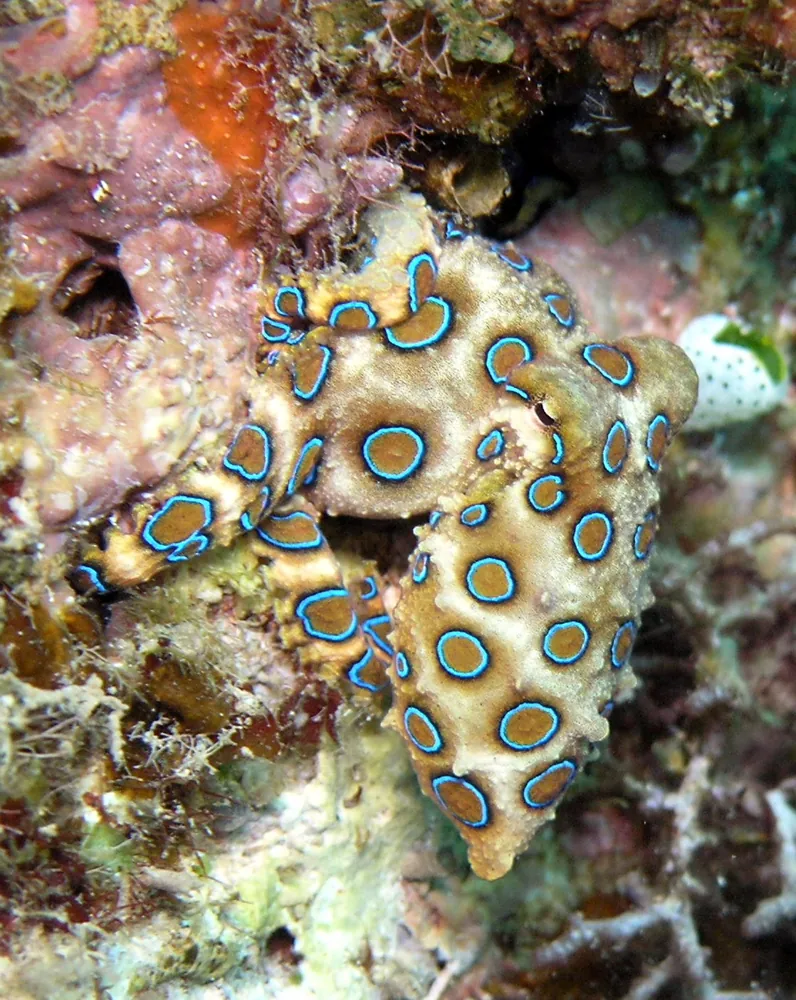
 Com reconèixer-lo
- A small octopus, up to 10 cm with its arms included, weighing about 80 grams on average.1
- Electric blue rings, about 7 to 8 mm across, roughly 60 of them, spread over its whole skin.1
- The rings flash iridescent blue as a warning signal, each flash lasting about a third of a second.1
- Its body colour varies from yellow ochre to light brown, or whitish when inactive.1
- Blue lines run through its eyes.1
Poder del verí
El verí surt pels ullals o les dents quan mossega.
Què fa el seu verí?
Its venom contains tetrodotoxin (TTX), a powerful neurotoxin, which is a poison that attacks the nerves. It paralyses the muscles needed for movement, and in people it can lead to death through respiratory paralysis, which means the breathing muscles stop working. Symptoms include tingling and numbness of the face and lips, sweating, severe headaches, dizziness, speech problems, weakness and vomiting. Symptoms can appear between 15 minutes and four hours after a bite, and the victim stays conscious throughout.1
Com de perillós és per a les persones?
Perill per a les persones: MortalUn dels animals més perillosos del món.The bite is capable of being fatal to humans. The bite is painless, so a person may not notice it. Children are more sensitive to the toxin. Death can occur between 20 minutes and 24 hours after symptoms begin.1
Què fa quan té por?
It flashes its blue rings as a warning to predators, and it uses its venom to defend itself.1
 Si mossega
- Immobilització amb pressió: embolica amb una bena elàstica ferma la mossegada i després tota l'extremitat, posa-hi una fèrula i mantén la persona completament quieta fins que arribi l'ajuda.
- Un pop d'anells blaus o un cargol con poden aturar la respiració d'una persona mentre encara està desperta: demana ajuda i prepara't per fer respiracions de rescat fins que l'ambulància se'n faci càrrec.
Truca sempre primer al número d'emergències (112, 000, 911). Això són pautes generals de primers auxilis, no consells mèdics. Primers auxilis bàsics
 Estigues segur
- No toquis, atrapis ni molestis mai un animal salvatge, encara que sigui petit i encara que sembli adormit o mort.
- Deixa-li espai. Si en trobes un, mantén la calma, recula a poc a poc i deixa que segueixi el seu camí.
- Si te'n mossega un: mantén la calma, no et moguis, truca al número d'emergències (112, 000, 911) o ves de pressa a un hospital. Recorda com era, una foto ajuda.
No va a per tu. Fa servir el verí per caçar o per defensar-se, i prefereix mil vegades amagar-se. Més sobre com estar segur
On del món?
Que gran és?
Quant fa de llarg?
 fa de llarg com 3 peces de construcció de joguina en fila
 podria nedar la llargada d'una piscina gran (50 m) en 7,2 segons
Que gran és Greater blue-ringed octopus comparat amb TU?
Només càlculs al teu navegador. No es desa ni s'envia res enlloc.
Com de ràpid va?

Dades
The greater blue-ringed octopus is one of the most venomous marine animals in the world, despite being small.1
Its venom contains tetrodotoxin, the same toxin found in pufferfish.1
There is no known antidote or antitoxin for tetrodotoxin, and the toxin does not break down when heated or boiled.1
Its blue rings are a warning signal to predators, showing that it is highly venomous.1
Males die after mating, and females die after guarding their eggs because they refuse to eat.1
Desmuntamites
Mite: A small octopus is harmless.
Veritat: Despite its small size, its bite can be deadly to humans.1
Per a experts en verins
- Nom científic
- Hapalochlaena lunulata
- Grup
- Cargols con i pops
- Família
- Octopodidae2
- Ordre
- Octopoda
- Continents
- Oceà Índic, Oceà Pacífic, Mar del Corall, Mar de les Filipines, Mar de Timor i d'Arafura, Els oceans
- Cries
- The female lays 50 to 100 eggs, which she carries under her arms for about a month. The young hatch as tiny planktonic paralarvae, about the size of a pea.1
- Esperança de vida
- uns 2 anys1
- Perill per a les persones
- 5 / 5: Mortal3
D'on surten les dades
- Greater blue-ringed octopus (Wikipedia (CC BY-SA 4.0))
- Hapalochlaena lunulata (iNaturalist): noms i classificació.
- Venom Wiki: el nivell de perill, la mida típica i la velocitat estimada són nostres. Mira com els calculem: Com valorem el perill.
Cada dada d'aquesta pàgina té un número que porta a la seva font. Si ens hem equivocat en alguna cosa, perdona, som fans dels animals, no una revista científica. Escriu-nos a [email protected] i ho arreglarem.
 L'escorpí té gana! Venom Wiki és un projecte d'una sola persona: gratuït, sense anuncis i sense rastrejadors. Una petita propina ajuda a mantenir-lo en línia.Dona menjar a l'escorpí
Més del mateix grup: Cargols con i pops
 Geography cone
 Southern blue-ringed octopus
 Blue sea dragon
 Common octopus
 Giant Pacific octopus
 Blue-lined octopus
També viu a: Oceà Índic
 Australian box jellyfishMeduses i altres urticants marinsMortalNo ho toquis
 Hawksbill sea turtleAltres animals tòxicsPot matar
 Irukandji jellyfishMeduses i altres urticants marinsPot matarNo ho toquis
 Reef stonefishPeixos verinososPot matarNo ho toquis
 Crown-of-thorns starfishEriçons, estrelles i cucsCal anar al metgeNo ho toquis
 Portuguese man o' warMeduses i altres urticants marinsCal anar al metgeNo ho toquis