
 Àfrica
 Àsia
Àsia Europa
 Amèrica del Sud
 Austràlia i Oceania
 Antàrtida
 Oceà Pacífic
 Oceà Atlàntic
 Oceà Índic
 Oceà Àrtic
 Mar Mediterrània
 Mar Roja
 Mar Carib
 Mar del Corall
 Mar de la Xina Meridional
 Mar de les Filipines
 Mar d'Andaman
 Mar del Nord
 Mar de Timor i d'Arafura
 Golf de Bengala
 Golf de Califòrnia
Rusty-winged tarantula hawk
 Picades
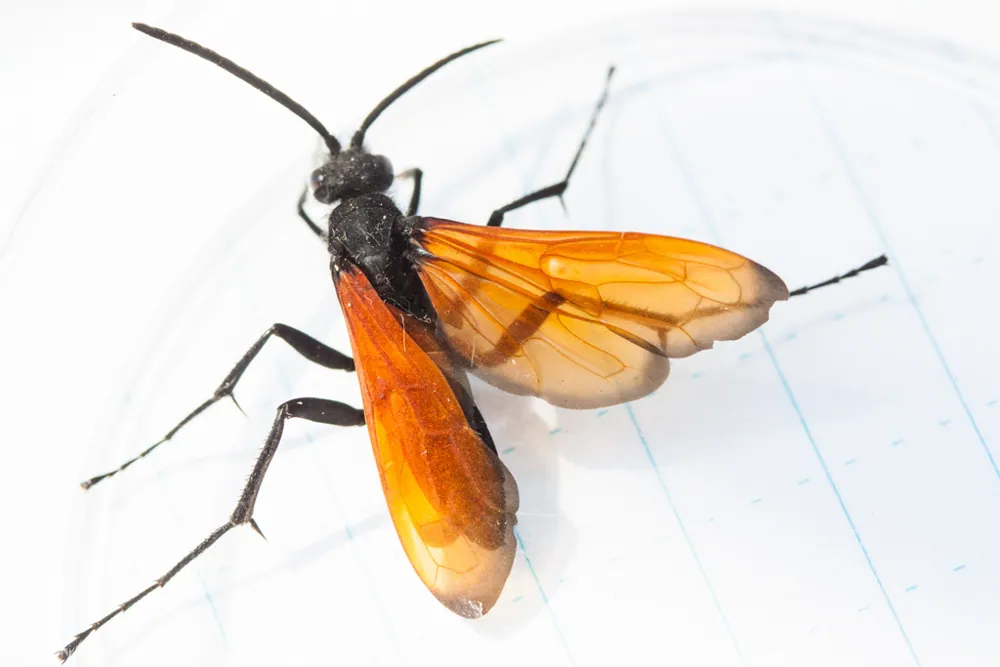
The rusty-winged tarantula hawk is a large wasp, with a matte black body and rust-orange wings. It lives in the dry Southwestern United States. Its sting is strong enough to paralyse a tarantula, which the wasp then uses to feed its young.1


 Com reconèixer-lo
- Matte black body with rust-orange wings1
- Grows up to 5 cm long, among the largest wasps of its order1
- Long legs, used to grapple with prey1
- Males are smaller and more slender than females, with a more vibrant wing colour1
- The antenna has twelve segments1
Sovint es confon amb: Its relatives in the genus Pepsis look very similar. Pepsis wasps are more metallic black, with deep-blue striped patterns. The only reliable way to tell them apart is by the pattern of veins in their wings.1
Poder del verí
El verí surt per un fibló.
Què fa el seu verí?
Its sting paralyses a tarantula but keeps it alive, so the spider stays fresh food for the larva. The sting is described as powerful and debilitating. It is ranked among the most painful stings in the insect world on the Schmidt sting pain index.1
Com de perillós és per a les persones?
Perill per a les persones: DolorósPot fer molt de mal, però gairebé mai no és greu.Its sting is among the most painful known from insects and is described as debilitating. The sting deters nearly all predators, including birds and lizards.1
Què fa quan té por?
Its painful sting deters nearly all predators.1
 Si pica
- Rasca el fibló de l'abella per treure'l i refreda la zona.
- Si a la persona li costa respirar, se li infla la cara o la gola, o sent que es mareja, és una emergència al·lèrgica: truca al número d'emergències i fes servir el seu autoinjector d'adrenalina si en té.
Truca sempre primer al número d'emergències (112, 000, 911). Això són pautes generals de primers auxilis, no consells mèdics. Primers auxilis bàsics
 Estigues segur
- No toquis, atrapis ni molestis mai un animal salvatge, encara que sigui petit i encara que sembli adormit o mort.
- Deixa-li espai. Si en trobes un, mantén la calma, recula a poc a poc i deixa que segueixi el seu camí.
- Si te'n pica un: mantén la calma, no et moguis, truca al número d'emergències (112, 000, 911) o ves de pressa a un hospital. Recorda com era, una foto ajuda.
No va a per tu. Fa servir el verí per caçar o per defensar-se, i prefereix mil vegades amagar-se. Més sobre com estar segur
Que gran és?
Quant fa de llarg?
 més curt que el teu dit petit
 podria travessar volant un camp de futbol sencer en 9 segons
Que gran és Rusty-winged tarantula hawk comparat amb TU?
Només càlculs al teu navegador. No es desa ni s'envia res enlloc.
Com de ràpid va?


Dades
The larva eats its living host from the inside. It hollows out the tarantula until the spider dies, once feeding reaches the bases of its legs.1
After paralysing a tarantula, the female may drag it up to 100 m to a burrow or cavity, where she seals it in with her egg.1
Males fight for territory in mid-air. The two wasps clash wings and spiral upwards, and larger males usually win and push smaller males off the best perches.1
Males gather on mountain ridges in great numbers during the breeding season, while females are rarely seen.1
Adult wasps do not grow after they emerge, so smaller males are at a permanent disadvantage when competing with larger ones.1
Per a experts en verins
- Nom científic
- Hemipepsis ustulata
- Grup
- Abelles, vespes i vesparrons
- Família
- Pompilidae2
- Ordre
- Hymenoptera
- Continents
- Amèrica del Nord
- Cries
- The female lays one egg on each tarantula she has paralysed. The egg is about 5 mm long, and the larva that hatches from it feeds on the spider.1
- Perill per a les persones
- 2 / 5: Dolorós3
D'on surten les dades
- Hemipepsis ustulata (Wikipedia (CC BY-SA 4.0))
- Hemipepsis ustulata (iNaturalist): noms i classificació.
- Venom Wiki: el nivell de perill, la mida típica i la velocitat estimada són nostres. Mira com els calculem: Com valorem el perill.
Cada dada d'aquesta pàgina té un número que porta a la seva font. Si ens hem equivocat en alguna cosa, perdona, som fans dels animals, no una revista científica. Escriu-nos a [email protected] i ho arreglarem.
 L'escorpí té gana! Venom Wiki és un projecte d'una sola persona: gratuït, sense anuncis i sense rastrejadors. Una petita propina ajuda a mantenir-lo en línia.Dona menjar a l'escorpí
Més del mateix grup: Abelles, vespes i vesparrons
 Tarantula hawkAbelles, vespes i vesparronsNomés fa mal
 Executioner waspAbelles, vespes i vesparronsCal anar al metge
 Warrior waspAbelles, vespes i vesparronsCal anar al metge
 Bald-faced hornetAbelles, vespes i vesparronsNomés fa mal
 Cow killer velvet antAbelles, vespes i vesparronsNomés fa mal
 Eastern cicada killerAbelles, vespes i vesparronsInofensiu
 Terciopelo
 Eastern coral snake
 Eastern diamondback rattlesnake
 Eyelash viper
 Timber rattlesnake
 Western diamondback rattlesnake