
 Afrika
 Asie
Asie Evropa
 Jižní Amerika
 Austrálie a Oceánie
 Antarktida
 Tichý oceán
 Atlantský oceán
 Indický oceán
 Severní ledový oceán
 Středozemní moře
 Rudé moře
 Karibské moře
 Korálové moře
 Jihočínské moře
 Filipínské moře
 Andamanské moře
 Severní moře
 Timorské a Arafurské moře
 Bengálský záliv
 Kalifornský záliv
Black-banded jumper ant
 Bodnutí
The black-banded jumper ant is a large ant that can leap up to 10 centimetres, which is far above its own body length. It lives in eastern Australia, including suburbs of Sydney and Brisbane. Its sting is painful and can cause serious allergic reactions in some people, so it is worth knowing how to recognise it.1



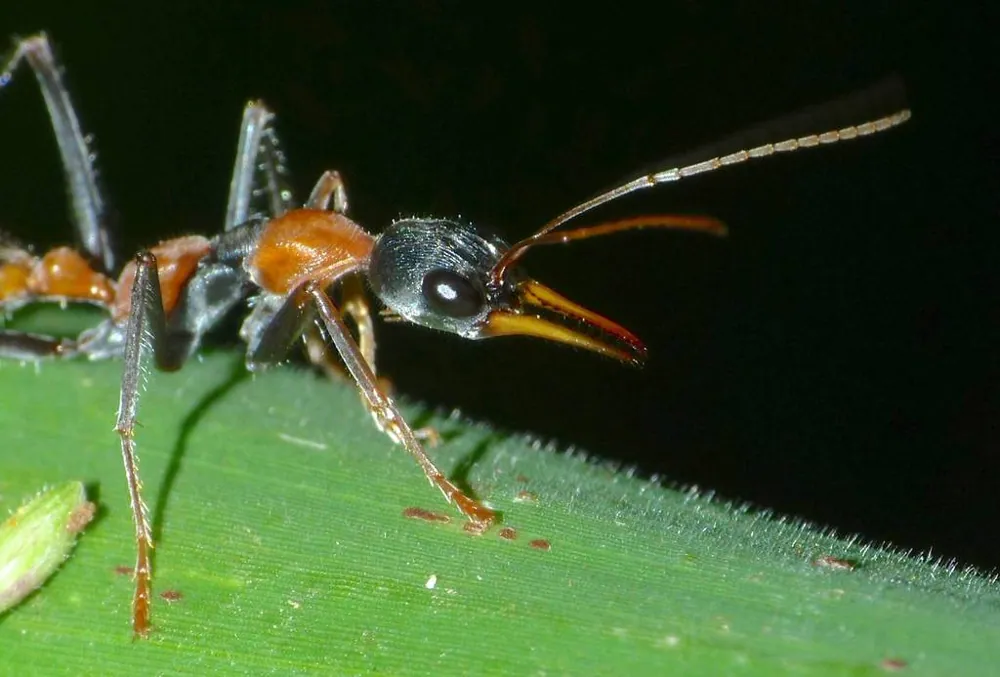
 Jak ho poznat
- Mostly black and orange-red in colour.1
- The gaster (rear body), head, legs and mesonotum (middle back) are black, while the pronotum, propodeum, petiole and post-petiole are red.1
- Mandibles (jaws) are either black or yellow, depending on where the ant lives.1
- Workers are 13 to 15 mm long, males 16 to 17 mm, and queens 17 to 19 mm.1
- It can leap 76 to 102 mm by suddenly extending its middle and hind legs.1
Často se plete s: It is often confused with other Myrmecia species. It can be told apart by its bi-coloured thorax and post-petiole, which are yellowish-red and black, and by its yellowish-red node.1
Síla jedu
Jed vychází žihadlem.
Co dělá jeho jed?
Its sting is highly venomous and causes intense burning pain. The burning can last for many days, and the sting itches. If the sting is left untreated, it may develop into an ulcer (an open sore). The venom of a close relative, M. pilosula, is among the strongest of all ants and contains acids, enzymes and phospholipases.1
Jak je nebezpečné pro lidi?
Nebezpečí pro lidi: BolestivéMůže to hodně bolet, ale skoro nikdy to není vážné.A 2011 study of Australian ant allergies found that 265 of 376 participants reacted to the stings of several Myrmecia species, which can cause anaphylaxis (a severe, whole-body allergic reaction). Of these, 15 reacted to this species, while 176 reacted to M. pilosula. The study concluded that Myrmecia species were among four main groups of Australian ants responsible for anaphylaxis.1
Co dělá, když se bojí?
When threatened, workers and scouts quickly defend the nest and may react aggressively even to a shadow crossing it, bursting out in short hops to attack.1
 Když bodne
- Umyj a zchlaď místa bodnutí.
- Pokud má postižený potíže s dýcháním, otok obličeje nebo krku nebo se cítí na omdlení, jde o alergickou pohotovost: zavolej na tísňovou linku.
Vždy nejdřív zavolej na tísňovou linku (112, 000, 911). Jde o obecné rady k první pomoci, ne o lékařskou radu. Základy první pomoci
 Buď v bezpečí
- Nikdy se nedotýkej divokého zvířete, nechytej ho a neprovokuj, ani malé, a ani když vypadá, že spí nebo je mrtvé.
- Nech mu prostor. Když ho potkáš, zůstaň v klidu, pomalu couvej a nech ho jít svou cestou.
- Když tě bodne: zůstaň v klidu, nehýbej se, zavolej na tísňovou linku (112, 000, 911) nebo se rychle dostaň do nemocnice. Zapamatuj si, jak vypadalo, fotka pomůže.
Nejde po tobě. Jed používá k lovu potravy nebo k obraně a mnohem radši se schová. Víc o bezpečí
Jak je velké?
Jak je dlouhé?
 kratší než tvůj malíček
Black-banded jumper ant: jak je velké ve srovnání s TEBOU?
Jen matematika ve tvém prohlížeči. Nic se neukládá ani nikam neposílá.
Jak je rychlé?


Fakta
It can jump between 76 and 102 mm, which is far more than its own body length.1
Colonies can continue without a queen, because workers can lay fertile eggs.1
It often forages in trees, where it visits the flowers of some eucalyptus and senna plants and may help pollinate them.1
A worker can live for over a year, with a maximum of about 1.3 years.1
Its nests are camouflaged with twigs, leaves, gravel and other plant material.1
Pro znalce jedů
- Vědecký název
- Myrmecia nigrocincta
- Skupina
- Mravenci
- Rodina
- Formicidae2
- Pořadí
- Hymenoptera
- Kontinenty
- Austrálie a Oceánie
- Mláďata
- Worker-laid eggs can be reared into males in colonies with no queen. Colonies typically have between 400 and 1200 individuals.1
- Délka života
- asi 1,3 let1
- Nebezpečí pro lidi
- 2 / 5: Bolestivé3
Odkud fakta pocházejí
- Myrmecia nigrocincta (Wikipedia (CC BY-SA 4.0))
- Myrmecia nigrocincta (iNaturalist): jména a zařazení.
- Venom Wiki: úroveň nebezpečí, typická velikost a odhad rychlosti jsou naše vlastní. Podívej se, jak je určujeme: Jak hodnotíme nebezpečí.
Každý fakt na této stránce má číslo, které odkazuje na jeho zdroj. Pokud jsme se spletli, promiň, jsme fanoušci zvířat, ne vědecký časopis. Napiš nám na [email protected] a opravíme to.
 Štír má hlad! Venom Wiki je projekt jednoho člověka: zdarma, bez reklam a bez sledování. Malé spropitné pomáhá udržet ho online.Nakrm štíra
 Bulldog ant
 Jack jumper ant
 Green weaver ant
 Giant bull ant
 Green-head ant
 Inchman ant
 Taipan velký
 Zmijovec smrtonosný
 Hnědý had východní
 Taipan menší
 Sklípkan jedovatý
 Tygří had