
 Afrika
 Asie
Asie Evropa
 Jižní Amerika
 Austrálie a Oceánie
 Antarktida
 Tichý oceán
 Atlantský oceán
 Indický oceán
 Severní ledový oceán
 Středozemní moře
 Rudé moře
 Karibské moře
 Korálové moře
 Jihočínské moře
 Filipínské moře
 Andamanské moře
 Severní moře
 Timorské a Arafurské moře
 Bengálský záliv
 Kalifornský záliv
Cow killer velvet ant
 Bodnutí
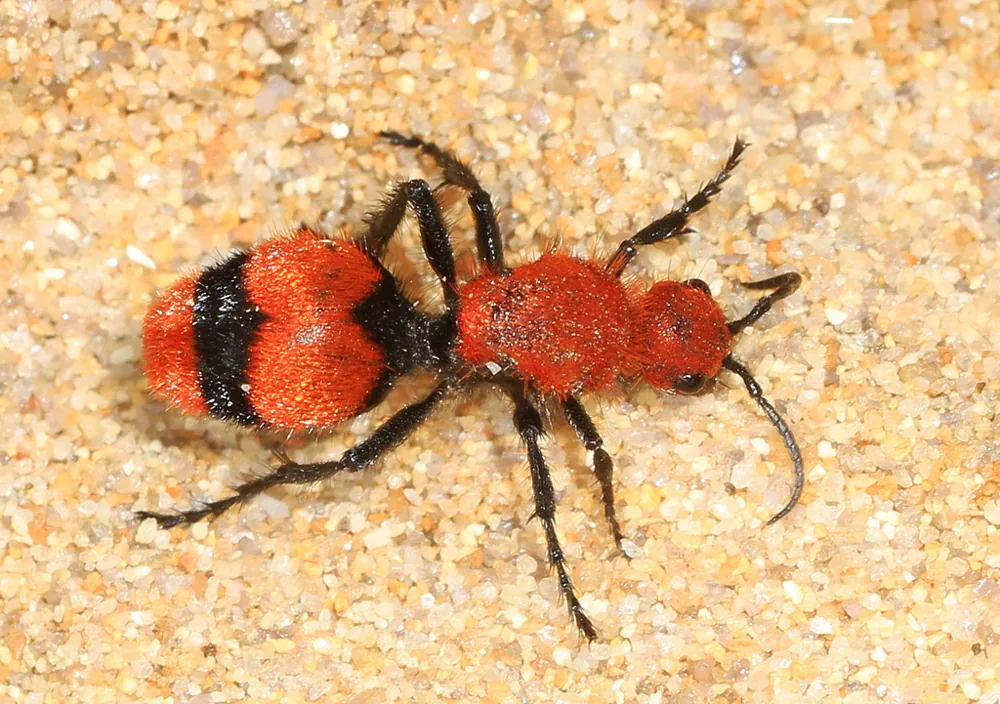
The cow killer velvet ant is a wasp that looks like a black and red ant. It lives in the eastern United States, from Connecticut and Kansas in the north to Florida and Texas in the south. It is known for a sting so painful that it earned the nickname cow killer.1

 Jak ho poznat
- Black overall, with bright red on the upper side of the head, thorax and abdomen.1
- Females have no wings. Males have dark, translucent wings and no stinger.1
- Adults reach about 1.9 cm long, the largest velvet ant in the eastern United States.1
- Quick-moving, and often takes a defensive posture when threatened.1
- Adults are mostly seen in the summer months.1
Často se plete s: It is often mistaken for an ant because of its appearance and its common name. It is actually a wasp, and only the males have wings.1
Síla jedu
Jed vychází žihadlem.
Co dělá jeho jed?
Its sting is among the most painful of any insect, ranked 3 out of 4 on the Schmidt sting pain index. The venom contains a peptide called Do6a, which triggers a pain response in fruit fly larvae in laboratory studies.1
Jak je nebezpečné pro lidi?
Nebezpečí pro lidi: BolestivéMůže to hodně bolet, ale skoro nikdy to není vážné.The sting is extremely painful, ranked 3 out of 4 on the Schmidt sting pain index. This is the reason for the nickname cow killer.1
Co dělá, když se bojí?
It has a thickened exoskeleton, runs fast and evasively, shows warning colours, makes a squeaking sound by rubbing its abdominal segments together, releases a chemical secretion and uses its venom.1
 Když bodne
- Vyškrábni včelí žihadlo a zchlaď to místo.
- Pokud má postižený potíže s dýcháním, otok obličeje nebo krku nebo se cítí na omdlení, jde o alergickou pohotovost: zavolej na tísňovou linku a použij jeho adrenalinový autoinjektor, pokud ho má.
Vždy nejdřív zavolej na tísňovou linku (112, 000, 911). Jde o obecné rady k první pomoci, ne o lékařskou radu. Základy první pomoci
 Buď v bezpečí
- Nikdy se nedotýkej divokého zvířete, nechytej ho a neprovokuj, ani malé, a ani když vypadá, že spí nebo je mrtvé.
- Nech mu prostor. Když ho potkáš, zůstaň v klidu, pomalu couvej a nech ho jít svou cestou.
- Když tě bodne: zůstaň v klidu, nehýbej se, zavolej na tísňovou linku (112, 000, 911) nebo se rychle dostaň do nemocnice. Zapamatuj si, jak vypadalo, fotka pomůže.
Nejde po tobě. Jed používá k lovu potravy nebo k obraně a mnohem radši se schová. Víc o bezpečí
Jak je velké?
Jak je dlouhé?
 kratší než tvůj malíček
Cow killer velvet ant: jak je velké ve srovnání s TEBOU?
Jen matematika ve tvém prohlížeči. Nic se neukládá ani nikam neposílá.
Jak je rychlé?


Fakta
Both sexes squeak to warn predators. Velvet ants rub their abdominal segments together, while crickets rub their legs against their abdomen.1
North American velvet ant species form one of the most intricate mimicry rings in the natural world, split into eight separate rings of mimicry.1
Males find females by smelling pheromones and by following their squeaking sounds. They carry the female in their jaws to a shaded, safe spot to mate.1
Females are wingless, a feature shared by all females in the family Mutillidae.1
Females are believed to mate only once in their lifetime.1
Lovec mýtů
Mýtus: It is an ant because it looks like one and has the name ant.
Pravda: It is a parasitoid wasp. It is only commonly mistaken for an ant.1
Pro znalce jedů
- Vědecký název
- Dasymutilla occidentalis
- Skupina
- Včely, vosy a sršně
- Rodina
- Mutillidae2
- Pořadí
- Hymenoptera
- Kontinenty
- Severní Amerika
- Mláďata
- A female lays a single egg onto a host larva, such as one of the eastern cicada killer or horse guard wasp, and the grub that hatches eats the host larva.1
- Nebezpečí pro lidi
- 2 / 5: Bolestivé3
Odkud fakta pocházejí
- Dasymutilla occidentalis (Wikipedia (CC BY-SA 4.0))
- Dasymutilla occidentalis (iNaturalist): jména a zařazení.
- Venom Wiki: úroveň nebezpečí, typická velikost a odhad rychlosti jsou naše vlastní. Podívej se, jak je určujeme: Jak hodnotíme nebezpečí.
Každý fakt na této stránce má číslo, které odkazuje na jeho zdroj. Pokud jsme se spletli, promiň, jsme fanoušci zvířat, ne vědecký časopis. Napiš nám na [email protected] a opravíme to.
 Štír má hlad! Venom Wiki je projekt jednoho člověka: zdarma, bez reklam a bez sledování. Malé spropitné pomáhá udržet ho online.Nakrm štíra
 Tarantula hawk
 Executioner wasp
 Warrior wasp
 Bald-faced hornet
 Eastern cicada killer
 Aerial yellowjacket
 Křovinář sametový
 Eastern coral snake
 Eastern diamondback rattlesnake
 Eyelash viper
 Timber rattlesnake
 Western diamondback rattlesnake