
 Afrika
 Asie
Asie Evropa
 Jižní Amerika
 Austrálie a Oceánie
 Antarktida
 Tichý oceán
 Atlantský oceán
 Indický oceán
 Severní ledový oceán
 Středozemní moře
 Rudé moře
 Karibské moře
 Korálové moře
 Jihočínské moře
 Filipínské moře
 Andamanské moře
 Severní moře
 Timorské a Arafurské moře
 Bengálský záliv
 Kalifornský záliv
Flower urchin
 Bodnutí
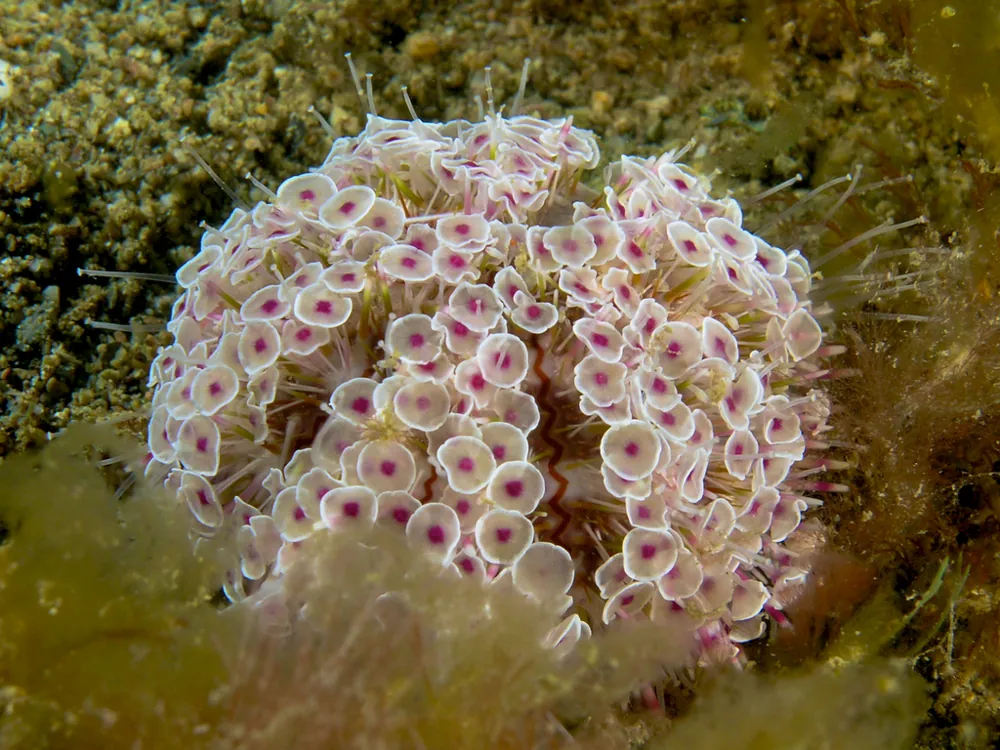
The flower urchin is a sea urchin with flower-shaped claws that can sting. It lives on coral reefs, in seagrass beds and on rocky or sandy sea floors across the Indo-West Pacific. It is one of the sea urchins most likely to cause a painful and medically significant sting.1
 Jak ho poznat
- Flower-like claws (globiferous pedicellariae) that are pinkish-white to yellowish-white, with a central purple dot and a bright white rim1
- A rigid shell (test) that is deep red and grey, with a purple zigzag pattern along each of the five ambulacral segments; rarely it is greenish or pale purple1
- Short, blunt spines, usually hidden beneath the flower-like claws1
- A body diameter of about 15 to 20 cm1
Často se plete s: Other Toxopneustes urchins look similar. Toxopneustes roseus has a uniform pink, brown or purple test and lives only in the eastern Pacific. Toxopneustes elegans, found only around Japan, has a dark stripe just below the tips of its spines. Toxopneustes maculatus is very rare, known from Réunion, Christmas Island and Palmyra Atoll, and has bright violet on its underside and a violet band around its middle.1
Síla jedu
Jed vychází žihadlem.
Co dělá jeho jed?
Its venom is made in glands at the base of the flower-like claws, not in the spines. The claws have sharp fang-like tips that can penetrate human skin, and when touched they snap shut and inject venom. The sting is described as extremely painful and medically significant.1
Jak je nebezpečné pro lidi?
Nebezpečí pro lidi: Velmi nebezpečnéMůže zabít člověka, který nedostane léčbu.It is considered highly dangerous to people. Its stings are extremely painful and medically significant. Larger individuals with bigger claws are thought to be more dangerous, because the strength of the venom is linked to claw size.1
Co dělá, když se bojí?
When touched or brushed against, its flower-like claws snap shut and inject venom. The claws can break off and stay attached to the skin, continuing to inject venom for several hours.1
 Když bodne
- Ponoř ránu do horké vody, tak horké, jakou postižený vydrží, aniž by se spálil, a vyhledej lékařskou pomoc, aby trny odstranil lékař. Nesnaž se je vydloubnout.
Vždy nejdřív zavolej na tísňovou linku (112, 000, 911). Jde o obecné rady k první pomoci, ne o lékařskou radu. Základy první pomoci
 Buď v bezpečí
- Nikdy se nedotýkej divokého zvířete, nechytej ho a neprovokuj, ani malé, a ani když vypadá, že spí nebo je mrtvé.
- Nech mu prostor. Když ho potkáš, zůstaň v klidu, pomalu couvej a nech ho jít svou cestou.
- Když tě bodne: zůstaň v klidu, nehýbej se, zavolej na tísňovou linku (112, 000, 911) nebo se rychle dostaň do nemocnice. Zapamatuj si, jak vypadalo, fotka pomůže.
Nejde po tobě. Jed používá k lovu potravy nebo k obraně a mnohem radši se schová. Víc o bezpečí
Kde na světě?
Jak je velké?
Jak je dlouhé?
 dlouhé jako 6 stavebnicových kostek v řadě
 pomalejší než hlemýžď zahradní
Flower urchin: jak je velké ve srovnání s TEBOU?
Jen matematika ve tvém prohlížeči. Nic se neukládá ani nikam neposílá.
Jak je rychlé?

Fakta
Unlike most venomous sea urchins, it does not sting through its spines. Its venom is delivered through the claws.1
A zebra crab, Zebrida adamsii, often lives attached to its shell. The crab is thought to be immune to its venom.1
Its flower-like claws are the source of its common name and are its most striking feature.1
Tiny shrimp, Athanas areteformis, sometimes live among its spines.1
In the seashell trade, its empty shells are called "mushroom urchins" because they look like mushroom caps.1
Lovec mýtů
Mýtus: Sea urchins sting with their spines.
Pravda: Flower urchins do not deliver venom through their spines. Their venom comes from the flower-like claws, which snap shut and inject it.1
Pro znalce jedů
- Vědecký název
- Toxopneustes pileolus
- Skupina
- Ježovky, hvězdice a červi
- Rodina
- Toxopneustidae2
- Pořadí
- Camarodonta
- Kontinenty
- Indický oceán, Tichý oceán, Rudé moře, Korálové moře, Filipínské moře, Timorské a Arafurské moře, Bengálský záliv, Oceány
- Mláďata
- Eggs and sperm are released into the water during mass spawning events, and fertilisation happens outside the body.1
- Nebezpečí pro lidi
- 4 / 5: Velmi nebezpečné3
Odkud fakta pocházejí
- Toxopneustes pileolus (Wikipedia (CC BY-SA 4.0))
- Toxopneustes pileolus (iNaturalist): jména a zařazení.
- Venom Wiki: úroveň nebezpečí, typická velikost a odhad rychlosti jsou naše vlastní. Podívej se, jak je určujeme: Jak hodnotíme nebezpečí.
Každý fakt na této stránce má číslo, které odkazuje na jeho zdroj. Pokud jsme se spletli, promiň, jsme fanoušci zvířat, ne vědecký časopis. Napiš nám na [email protected] a opravíme to.
 Štír má hlad! Venom Wiki je projekt jednoho člověka: zdarma, bez reklam a bez sledování. Malé spropitné pomáhá udržet ho online.Nakrm štíra
Víc ze stejné skupiny: Ježovky, hvězdice a červi
 Crown-of-thorns starfishJežovky, hvězdice a červiPotřebuje lékařeNedotýkat se
 Fire urchinJežovky, hvězdice a červiPotřebuje lékařeNedotýkat se
 Bearded firewormJežovky, hvězdice a červiJen to bolíNedotýkat se
 Black long-spined urchinJežovky, hvězdice a červiJen to bolíNedotýkat se
 BloodwormJežovky, hvězdice a červiJen to bolí
 Bobbit wormJežovky, hvězdice a červiJen to bolí
Žije také v: Indický oceán
 Australian box jellyfishMedúzy a žahaví mořští tvorovéSmrtelně nebezpečnéNedotýkat se
 Geography coneHomolice a chobotniceSmrtelně nebezpečné
 Greater blue-ringed octopusHomolice a chobotniceSmrtelně nebezpečné
 Southern blue-ringed octopusHomolice a chobotniceSmrtelně nebezpečné
 Hawksbill sea turtleDalší toxická zvířataMůže zabít
 Irukandji jellyfishMedúzy a žahaví mořští tvorovéMůže zabítNedotýkat se