
 Afrika
 Asie
Asie Evropa
 Jižní Amerika
 Austrálie a Oceánie
 Antarktida
 Tichý oceán
 Atlantský oceán
 Indický oceán
 Severní ledový oceán
 Středozemní moře
 Rudé moře
 Karibské moře
 Korálové moře
 Jihočínské moře
 Filipínské moře
 Andamanské moře
 Severní moře
 Timorské a Arafurské moře
 Bengálský záliv
 Kalifornský záliv
Mediterranean box jellyfish
 Žahavá chapadla
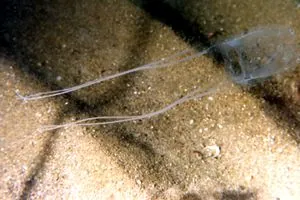
The Mediterranean box jellyfish is a small, see-through jellyfish with a box-shaped body about 3 cm across. It lives only in the Mediterranean Sea, where it is the only box jellyfish, and its sting can hurt people who swim in shallow water.1

 Jak ho poznat
- Transparent, box-shaped bell about 3 cm across1
- Four long tentacles at the lower corners of the bell, up to 30 cm long1
- Red banding on the tentacles1
- Small white or yellowish warts on the bell that carry stinging cells1
- Often found in small groups1
Často se plete s: Other box jellyfish of the genus Carybdea look similar, but they live in warm oceans elsewhere. The red banding on the tentacles is the feature that separates this species from them.1
Síla jedu
Tisíce malinkých žahavých buněk vystřelí, když se jich něco dotkne.
Co dělá jeho jed?
Its sting is venomous to humans, but some swimmers feel no painful sensation at all. In severe cases the symptoms spread through the body, with pain at the sting site and elsewhere, paresthesia (abnormal prickling or tingling sensations), hyperesthesia (over-sensitive skin) and skin lesions. These symptoms can take a few months to fully disappear.1
Jak je nebezpečné pro lidi?
Nebezpečí pro lidi: BolestivéMůže to hodně bolet, ale skoro nikdy to není vážné.It is far less dangerous than some box jellyfish species from other parts of the world. It is still considered the second-most significant stinging jellyfish in the Mediterranean, after Pelagia noctiluca.1
 Když bodne
- Vylez z vody a odstraň zbylá chapadla (v rukavicích nebo přes látku).
- U tropických čtyřhranek: lij na zasažená místa ocet aspoň 30 sekund, zavolej pomoc a připrav se na resuscitaci (KPR). U měchýřovek a většiny ostatních: opláchni mořskou vodou a pak dej na bolest horkou vodu.
Vždy nejdřív zavolej na tísňovou linku (112, 000, 911). Jde o obecné rady k první pomoci, ne o lékařskou radu. Základy první pomoci
 Buď v bezpečí
- Nikdy se nedotýkej divokého zvířete, nechytej ho a neprovokuj, ani malé, a ani když vypadá, že spí nebo je mrtvé.
- Nech mu prostor. Když ho potkáš, zůstaň v klidu, pomalu couvej a nech ho jít svou cestou.
- Když tě bodne: zůstaň v klidu, nehýbej se, zavolej na tísňovou linku (112, 000, 911) nebo se rychle dostaň do nemocnice. Zapamatuj si, jak vypadalo, fotka pomůže.
Nejde po tobě. Jed používá k lovu potravy nebo k obraně a mnohem radši se schová. Víc o bezpečí
Kde na světě?
Jak je velké?
Jak je dlouhé?
 zhruba tak dlouhé jako kancelářská sponka
 délka velkého bazénu (50 m) plaváním za 36 s
Mediterranean box jellyfish: jak je velké ve srovnání s TEBOU?
Jen matematika ve tvém prohlížeči. Nic se neukládá ani nikam neposílá.
Jak je rychlé?
Fakta
It has comparatively sophisticated eyes with lenses, which help it detect and avoid obstacles such as posts or a ship's rudder.1
After a free-swimming larva forms, it develops into a polyp that can reproduce by budding, and it can regenerate missing parts within 72 hours.1
It swims by making rapid contractions of its bell, moving between 3 and 6 metres per minute.1
Its tentacles can grow up to 30 cm long, many times the width of its box-shaped bell.1
It is the only box jellyfish found in the Mediterranean Sea.1
Pro znalce jedů
- Vědecký název
- Carybdea marsupialis
- Skupina
- Medúzy a žahaví mořští tvorové
- Rodina
- Carybdeidae2
- Pořadí
- Carybdeida
- Kontinenty
- Atlantský oceán, Středozemní moře, Oceány
- Mláďata
- The sexes are separate, and eggs and sperm (gametes) are released into the open water to fuse; the young develop into a free-swimming larva and then a small polyp stage before becoming jellyfish.1
- Nebezpečí pro lidi
- 2 / 5: Bolestivé3
Odkud fakta pocházejí
- Carybdea marsupialis (Wikipedia (CC BY-SA 4.0))
- Carybdea marsupialis (iNaturalist): jména a zařazení.
- Venom Wiki: úroveň nebezpečí, typická velikost a odhad rychlosti jsou naše vlastní. Podívej se, jak je určujeme: Jak hodnotíme nebezpečí.
Každý fakt na této stránce má číslo, které odkazuje na jeho zdroj. Pokud jsme se spletli, promiň, jsme fanoušci zvířat, ne vědecký časopis. Napiš nám na [email protected] a opravíme to.
 Štír má hlad! Venom Wiki je projekt jednoho člověka: zdarma, bez reklam a bez sledování. Malé spropitné pomáhá udržet ho online.Nakrm štíra
Víc ze stejné skupiny: Medúzy a žahaví mořští tvorové
 Čtyřhranka FleckerovaMedúzy a žahaví mořští tvorovéSmrtelně nebezpečnéNedotýkat se
 Irukandji jellyfishMedúzy a žahaví mořští tvorovéMůže zabítNedotýkat se
 Portuguese man o' warMedúzy a žahaví mořští tvorovéPotřebuje lékařeNedotýkat se
 Lion's mane jellyfishMedúzy a žahaví mořští tvorovéJen to bolíNedotýkat se
 Moon jellyfishMedúzy a žahaví mořští tvorovéNeškodné
 Common kingslayerMedúzy a žahaví mořští tvorovéMůže zabítNedotýkat se
 Hawksbill sea turtle
 Blue sea dragon
 Greenland shark
 Common octopus
 Common stingray
 Greater weever