
 Afrika
 Asien
Asien Europa
 Südamerika
 Australien & Ozeanien
 Antarktis
 Pazifischer Ozean
 Atlantischer Ozean
 Indischer Ozean
 Nordpolarmeer
 Mittelmeer
 Rotes Meer
 Karibisches Meer
 Korallenmeer
 Südchinesisches Meer
 Philippinensee
 Andamanensee
 Nordsee
 Timorsee & Arafurasee
 Golf von Bengalen
 Golf von Kalifornien
African crested rat
 Gift in der Haut
The African crested rat is a large, nocturnal rodent with long hair and a bushy tail. It looks a little like a porcupine. It lives in East Africa, where it is the world's only known poisonous rodent, coating itself in plant toxins to keep predators away.1



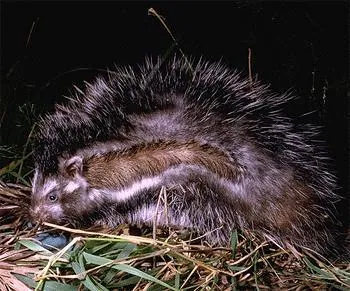
 So erkennst du es
- Large, nocturnal rodent with long, silver and black-tipped guard hairs over a woolly grey and white undercoat1
- A mane of longer black-and-white banded hairs runs from the top of the head to just beyond the base of the tail1
- A broad, white-bordered strip of glandular skin sits beside the mane, and it becomes visible when the animal is threatened1
- Bushy tail and short black fur on the face and limbs1
- Superficially resembles a porcupine1
Giftkraft
Seine Haut ist giftig. Es ist gefährlich, es anzufassen, abzulecken oder zu essen.
Was macht sein Gift, wenn man es anfasst oder isst?
This animal is poisonous rather than venomous, so it does not bite or sting to inject poison. It smears poison from the bark of the poison arrow tree onto the hairs of its glandular skin patch. A predator that bites it can be sickened or even killed by this poison.1
Wie gefährlich ist es für Menschen?
Gefahr für Menschen: ErnstWenn jemand es anfasst oder isst, ab zum Arzt. Todesfälle sind sehr selten.Its poison is a risk to predators that try to bite it. The rat itself is not harmed by the toxins it stores.1
Was macht es, wenn es Angst hat?
When threatened or excited, the mane stands up and the glandular strip parts, exposing the skin that carries the poison.1
 Wenn jemand es angefasst oder gegessen hat
- Wenn jemand es gegessen hat oder nach dem Essen Beschwerden hat: Ruf sofort deine Notrufnummer oder den Giftnotruf an.
Ruf immer zuerst deine Notrufnummer an (112, 000, 911). Das sind allgemeine Erste-Hilfe-Hinweise, keine ärztliche Beratung. Erste-Hilfe-Grundlagen
 Bleib sicher
- Fass ein wildes Tier niemals an, fang es nicht und ärgere es nicht, auch kein kleines, und auch nicht, wenn es schlafend aussieht oder tot.
- Halte Abstand. Wenn du einem begegnest, bleib ruhig, geh langsam zurück und lass es seiner Wege gehen.
- Wenn du es angefasst oder gegessen hast: Reib dir nicht die Augen oder den Mund, wasch dir die Hände und hol ärztliche Hilfe.
Es hat es nicht auf dich abgesehen. Sein Gift ist nur dazu da, dass es niemand frisst. Mehr über Sicherheit
Wo auf der Welt?
Wie groß ist es?
Wie lang ist es?
Wie schwer ist es?

 so lang wie 10 Bausteine in einer Reihe
 könnte 100 Meter in 72 Sekunden schaffen (der schnellste Mensch braucht 9,6)
Wie groß ist African crested rat im Vergleich zu DIR?
Nur Rechnen in deinem Browser. Nichts wird gespeichert oder irgendwohin geschickt.
Wie schnell ist es?


Fakten
It is the world's only known poisonous rodent.1
It is the only rodent known to use and store toxins from a different species in nature to protect itself, and it suffers no known harm from them.1
Its stomach has five anatomically distinct sections, a feature found in very few rodents.1
The skull is covered with small bony projections that give it a pebbled look.1
Its large size may allow microbes in its foregut to break down cellulose from plants by fermentation.1
Mythen-Check
Mythos: The maned rat was believed to be solitary.
Wahrheit: It is now known to be somewhat sociable. Several animals are found in the same territory, and they purr and groom one another, so they may form family groups of a male, a female and their young.1
Für Giftexperten
- Wissenschaftlicher Name
- Lophiomys imhausi
- Gruppe
- Andere passiv giftige Tiere
- Familie
- Muridae2
- Ordnung
- Rodentia
- Kontinente
- Afrika
- Babys
- Litters have 1 to 3 young. The young are slightly haired at birth, their eyes open by day 13, and they are weaned by day 40.1
- Wie es ihm in der Natur geht
- Least Concern1
- Gefahr für Menschen
- 3 / 5: Ernst3
Woher die Fakten kommen
- Maned rat (Wikipedia (CC BY-SA 4.0))
- Lophiomys imhausi (iNaturalist): Namen und Klassifikation.
- Venom Wiki: die Gefahrenstufe, die typische Größe und die geschätzte Geschwindigkeit sind von uns. So berechnen wir sie: So bewerten wir die Gefahr.
Jeder Fakt auf dieser Seite hat eine Nummer, die auf seine Quelle zeigt. Wenn wir etwas falsch haben: Entschuldigung, wir sind Tierfans, keine Fachzeitschrift. Schreib uns an [email protected] und wir korrigieren es.
 Der Skorpion hat Hunger! Venom Wiki ist ein Ein-Mann-Projekt: kostenlos, ohne Werbung und ohne Tracker. Ein kleines Trinkgeld hilft, es online zu halten.Füttere den Skorpion
Mehr aus derselben Gruppe: Andere passiv giftige Tiere
 Common quailAndere passiv giftige TiereTut nur weh
 Spur-winged gooseAndere passiv giftige TiereTut nur weh
 Fahaka pufferfishAndere passiv giftige TiereKann töten
 Red-striped oil beetleAndere passiv giftige TiereTut nur wehNicht anfassen
 TigerkugelfischAndere passiv giftige TiereTödlich
 Hawksbill sea turtleAndere passiv giftige TiereKann töten
 Schwarze Mamba
 Gelber Mittelmeerskorpion
 Uräusschlange
 Puffotter
 Boomslang
 Fat-tailed scorpion