
 Afrika
 Asien
Asien Europa
 Südamerika
 Australien & Ozeanien
 Antarktis
 Pazifischer Ozean
 Atlantischer Ozean
 Indischer Ozean
 Nordpolarmeer
 Mittelmeer
 Rotes Meer
 Karibisches Meer
 Korallenmeer
 Südchinesisches Meer
 Philippinensee
 Andamanensee
 Nordsee
 Timorsee & Arafurasee
 Golf von Bengalen
 Golf von Kalifornien
Climbing mantella
 Gift in der Haut
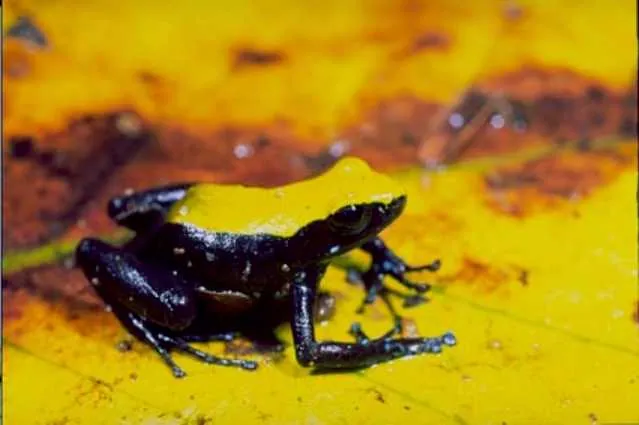
The climbing mantella is a small, brightly coloured frog that lives in the lowland rainforests of northeast Madagascar. It is a poison frog, so its skin holds chemicals that can harm predators. It is special because it is one of the few frogs whose parents care for their tadpoles by feeding them eggs.1



 So erkennst du es
- Adults are 24–30 mm long and weigh 1.2–2.0 g1
- Front of the back is bright yellow or pale green1
- Arms, legs, belly and rear are black, with blue spots on the limbs1
- Eyes are completely black1
- Has discs at the tips of its fingers and toes, and the toes are webbed1
Oft verwechselt mit: M. betsileo, M. viridis and M. expectata look similar but are differently coloured. They often have blue spots on the throat rather than the limbs, and they have a faint line along the upper lip, which the climbing mantella lacks.1
Giftkraft
Seine Haut ist giftig. Es ist gefährlich, es anzufassen, abzulecken oder zu essen.
Was macht sein Gift, wenn man es anfasst oder isst?
This frog is poisonous rather than venomous. Its skin glands contain lipophilic alkaloids, the chemicals that make up its poison, which it gets from the arthropods it eats. Researchers have found 41 different potent alkaloids in its skin. Captive frogs lose their toxicity over time.1
Wie gefährlich ist es für Menschen?
Gefahr für Menschen: LeichtWie ein Bienenstich oder weniger. Für Menschen praktisch harmlos.Was macht es, wenn es Angst hat?
Its bright colours warn predators that its skin is toxic.1
 Wenn jemand es angefasst oder gegessen hat
- Wenn jemand eines angefasst hat: Hände gründlich waschen und nicht an Augen oder Mund fassen. Wenn ein Kind oder Haustier eines abgeleckt oder gegessen hat: Ruf den Giftnotruf oder deine Notrufnummer an.
Ruf immer zuerst deine Notrufnummer an (112, 000, 911). Das sind allgemeine Erste-Hilfe-Hinweise, keine ärztliche Beratung. Erste-Hilfe-Grundlagen
 Bleib sicher
- Fass ein wildes Tier niemals an, fang es nicht und ärgere es nicht, auch kein kleines, und auch nicht, wenn es schlafend aussieht oder tot.
- Halte Abstand. Wenn du einem begegnest, bleib ruhig, geh langsam zurück und lass es seiner Wege gehen.
- Wenn du es angefasst oder gegessen hast: Reib dir nicht die Augen oder den Mund, wasch dir die Hände und hol ärztliche Hilfe.
Es hat es nicht auf dich abgesehen. Sein Gift ist nur dazu da, dass es niemand frisst. Mehr über Sicherheit
Wo auf der Welt?
Wie groß ist es?
Wie lang ist es?
Wie schwer ist es?
 etwa so lang wie eine Büroklammer
 so leicht, dass du es auf deiner Hand nicht spüren würdest
 könnte 100 Meter in 100 Sekunden schaffen (der schnellste Mensch braucht 9,6)
Wie groß ist Climbing mantella im Vergleich zu DIR?
Nur Rechnen in deinem Browser. Nichts wird gespeichert oder irgendwohin geschickt.
Wie schnell ist es?


Fakten
Its tadpoles eat only the eggs of their own species, and the parents feed them unfertilized eggs.1
Males defend territories of about 2 square metres and fight by wrestling, chasing and leaping, sometimes for over 1.5 hours.1
Female frogs choose a mate based on the quality of the male's well, not on his call.1
The climbing mantella is the only member of the Mantella genus that breeds in water-filled wells in trees, tree holes or broken bamboo stalks.1
Its chemical defence has developed in a similar way to that of the dart frogs of Dendrobatidae, although the two families are only distantly related.1
Für Giftexperten
- Wissenschaftlicher Name
- Mantella laevigata
- Gruppe
- Pfeilgiftfrösche, Kröten & Molche
- Familie
- Mantellidae2
- Ordnung
- Anura
- Kontinente
- Afrika
- Babys
- Usually lays only one large egg, 3–3.5 mm across, at the side of a water-filled well or above the water line. The parents feed tadpoles unfertilized eggs.1
- Wie es ihm in der Natur geht
- Least Concern (IUCN Red List, 2016), though its population is suspected to be decreasing1
- Gefahr für Menschen
- 1 / 5: Leicht3
Woher die Fakten kommen
- Climbing mantella (Wikipedia (CC BY-SA 4.0))
- Mantella laevigata (iNaturalist): Namen und Klassifikation.
- Venom Wiki: die Gefahrenstufe, die typische Größe und die geschätzte Geschwindigkeit sind von uns. So berechnen wir sie: So bewerten wir die Gefahr.
Jeder Fakt auf dieser Seite hat eine Nummer, die auf seine Quelle zeigt. Wenn wir etwas falsch haben: Entschuldigung, wir sind Tierfans, keine Fachzeitschrift. Schreib uns an [email protected] und wir korrigieren es.
 Der Skorpion hat Hunger! Venom Wiki ist ein Ein-Mann-Projekt: kostenlos, ohne Werbung und ohne Tracker. Ein kleines Trinkgeld hilft, es online zu halten.Füttere den Skorpion
Mehr aus derselben Gruppe: Pfeilgiftfrösche, Kröten & Molche
 Golden mantellaPfeilgiftfrösche, Kröten & MolcheHarmlos
 Iberian ribbed newtPfeilgiftfrösche, Kröten & MolcheHarmlos
 Tomato frogPfeilgiftfrösche, Kröten & MolcheHarmlos
 African common toadPfeilgiftfrösche, Kröten & MolcheTut nur wehNicht anfassen
 Baron's mantellaPfeilgiftfrösche, Kröten & MolcheHarmlos
 Blue-legged mantellaPfeilgiftfrösche, Kröten & MolcheHarmlos
 Schwarze Mamba
 Gelber Mittelmeerskorpion
 Uräusschlange
 Puffotter
 Boomslang
 Fat-tailed scorpion