
 Afrika
 Asien
Asien Europa
 Südamerika
 Australien & Ozeanien
 Antarktis
 Pazifischer Ozean
 Atlantischer Ozean
 Indischer Ozean
 Nordpolarmeer
 Mittelmeer
 Rotes Meer
 Karibisches Meer
 Korallenmeer
 Südchinesisches Meer
 Philippinensee
 Andamanensee
 Nordsee
 Timorsee & Arafurasee
 Golf von Bengalen
 Golf von Kalifornien
Gaboon viper
 Bisse
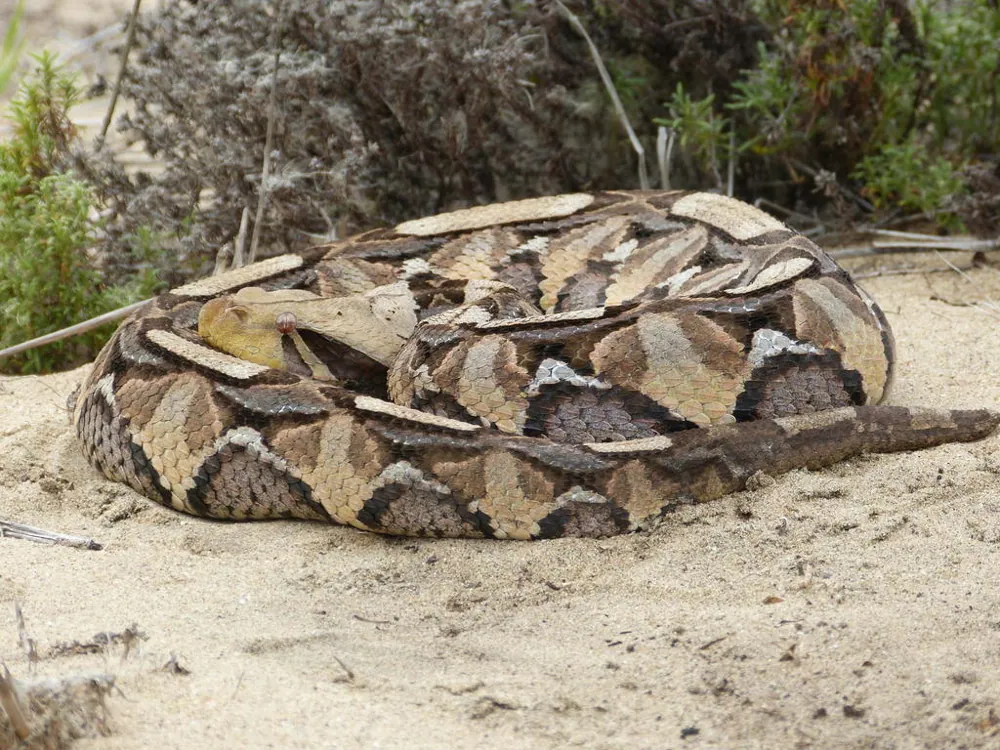
BisseThe Gaboon viper is a large, heavy snake with a striking pattern of pale and dark markings. It lives in the rainforests and savannas of sub-Saharan Africa. It is one of the most venomous snakes in the world, so knowing what it looks like matters.1


 So erkennst du es
- A large, heavy, stout body, with a large triangular head and a neck much narrower than the head1
- A series of pale, rectangular blotches down the centre of the back, with dark hourglass markings edged in yellow1
- A white or cream head with a fine dark central line and a dark blue-black triangle behind and below each eye1
- Small raised 'horns' between the nostrils, which are tiny in this species1
- Its camouflage works well among dead leaves under trees, so it can be hard to see1
Oft verwechselt mit: The Congolese giant toad (Sclerophrys channingi) may be a mimic of this snake. Its head appears to resemble the viper's head, while its body is darker.1
Giftkraft
Das Gift kommt beim Beißen durch die Giftzähne oder Zähne heraus.
Was macht sein Gift, wenn es beißt oder sticht?
The venom is cytotoxic, which means it damages cells, and cardiotoxic, which means it harms the heart. Each bite can deliver a large amount of venom, because the snake does not release its grip after biting.1
Wie gefährlich ist es für Menschen?
Gefahr für Menschen: Sehr gefährlichEs kann einen Menschen töten, der keine Behandlung bekommt.Bites are extremely rare, because the snake is seldom aggressive and lives mostly in rainforest areas. Most bites happen when people accidentally step on it. Even an average bite from an average-sized snake is potentially fatal.1
 Gute Nachricht: Ärzte haben dafür ein Medikament (Gegengift) oder eine Behandlung.1
Was macht es, wenn es Angst hat?
When threatened it hisses loudly in a deep, steady rhythm and flattens its head slightly with each breath. It is unlikely to strike unless it is severely provoked.1
 Wenn es beißt
- Any bite should be treated as a serious medical emergency. Antivenom should be given as soon as possible to save the limb or the person's life.1
- Halte die Person still und ruhig, halte den gebissenen Arm oder das Bein auf Herzhöhe, nimm Ringe und alles Enge ab und bring sie schnell in ein Krankenhaus.
Ruf immer zuerst deine Notrufnummer an (112, 000, 911). Das sind allgemeine Erste-Hilfe-Hinweise, keine ärztliche Beratung. Erste-Hilfe-Grundlagen
 Bleib sicher
- Fass ein wildes Tier niemals an, fang es nicht und ärgere es nicht, auch kein kleines, und auch nicht, wenn es schlafend aussieht oder tot.
- Halte Abstand. Wenn du einem begegnest, bleib ruhig, geh langsam zurück und lass es seiner Wege gehen.
- Wenn dich eines beißt: Bleib ruhig, halt still, ruf deine Notrufnummer an (112, 000, 911) oder fahr schnell in ein Krankenhaus. Merk dir, wie es aussah, ein Foto hilft.
Es hat es nicht auf dich abgesehen. Es benutzt sein Gift, um Futter zu fangen oder sich zu schützen, und versteckt sich viel lieber. Mehr über Sicherheit
Wo auf der Welt?
Wie groß ist es?
Wie lang ist es?
Wie schwer ist es?
 so lang wie 4 Hauskatzen von Nase bis Schwanz
 so lang wie 10 Bananen hintereinander
 könnte 100 Meter in 90 Sekunden schaffen (der schnellste Mensch braucht 9,6)
Wie groß ist Gaboon viper im Vergleich zu DIR?
Nur Rechnen in deinem Browser. Nichts wird gespeichert oder irgendwohin geschickt.
Wie schnell ist es?


Fakten
A 1.8 m specimen caught in 1973 weighed 11.3 kg with an empty stomach. It is the heaviest venomous snake in Africa.1
Its eyes can move in unusual ways. If its head is turned 360°, one eye tilts up and the other tilts down.1
Although it is one of the fastest-striking snakes in the world, it usually tolerates handling and rarely bites or hisses.1
Unlike many African vipers, such as the puff adder, it does not release its grip after biting.1
Males fight by intertwining their necks and pushing. The winner pushes the other's head to the ground and raises his own head by 20–30 cm.1
Mythen-Check
Mythos: Because it is calm and tolerant, it is safe to handle.
Wahrheit: Some writers have described it as so docile it can be handled as freely as a harmless snake. This is absolutely not recommended: it is one of the fastest-striking snakes, and bites by bad-tempered individuals do occur.1
Woher die Fakten kommen
- Gaboon viper (Wikipedia (CC BY-SA 4.0))
- Bitis gabonica (iNaturalist): Namen und Klassifikation.
- Venom Wiki: die Gefahrenstufe, die typische Größe und die geschätzte Geschwindigkeit sind von uns. So berechnen wir sie: So bewerten wir die Gefahr.
Jeder Fakt auf dieser Seite hat eine Nummer, die auf seine Quelle zeigt. Wenn wir etwas falsch haben: Entschuldigung, wir sind Tierfans, keine Fachzeitschrift. Schreib uns an [email protected] und wir korrigieren es.
 Der Skorpion hat Hunger! Venom Wiki ist ein Ein-Mann-Projekt: kostenlos, ohne Werbung und ohne Tracker. Ein kleines Trinkgeld hilft, es online zu halten.Füttere den Skorpion
 Puff adder
 Northeast African carpet viper
 West African carpet viper
 Rhinoceros viper
 West African Gaboon viper
 Horned adder
 Black mamba
 Deathstalker
 Egyptian cobra
 Boomslang
 Fat-tailed scorpion
 Western honey bee