
 Afrika
 Asien
Asien Europa
 Südamerika
 Australien & Ozeanien
 Antarktis
 Pazifischer Ozean
 Atlantischer Ozean
 Indischer Ozean
 Nordpolarmeer
 Mittelmeer
 Rotes Meer
 Karibisches Meer
 Korallenmeer
 Südchinesisches Meer
 Philippinensee
 Andamanensee
 Nordsee
 Timorsee & Arafurasee
 Golf von Bengalen
 Golf von Kalifornien
Golden tree snake
 Bisse
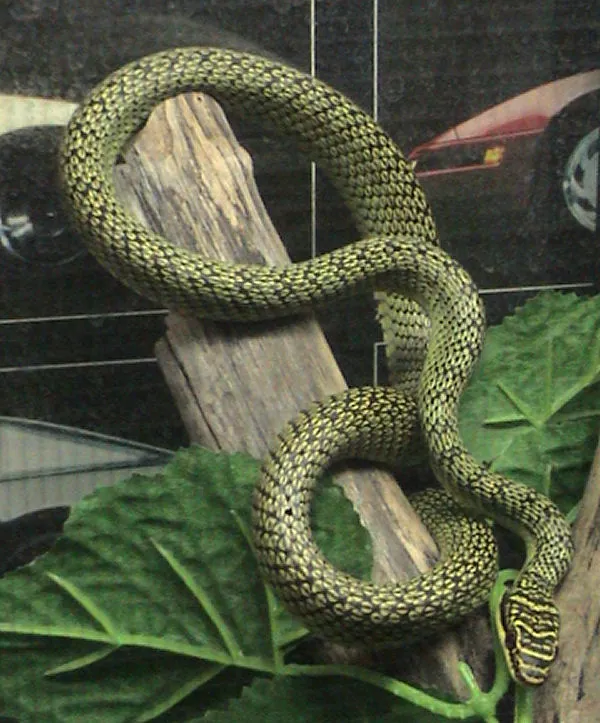
BisseThe golden tree snake is a slim, green snake with gold and black markings that lives in trees across South and Southeast Asia. It is famous for its ability to glide from tree to tree, which it does by launching itself into the air and steering with its body. It is mildly venomous, but it is not considered dangerous to people.1



 So erkennst du es
- Usually green, with black cross-hatching and yellow or gold accents1
- Slender body with a flattened head, a blunt nose and large eyes with round pupils1
- In Sri Lanka and southern India it is mainly greenish yellow or pale green, often with reddish or orange flower-shaped spots on its back1
- In Southeast Asia it lacks the reddish spots and has less prominent black crossbars1
- Nervous and fast-moving, it climbs trees and vertical rock faces in graceful curves1
Oft verwechselt mit: The paradise flying snake (C. paradisi) is a close relative that also glides. Its gliding is more impressive than that of the golden tree snake, which is still able to move easily from tree to tree.1
Giftkraft
Das Gift kommt beim Beißen durch die Giftzähne oder Zähne heraus.
Was macht sein Gift, wenn es beißt oder sticht?
It is mildly venomous. Its two small fangs are at the back of the upper jaw, so it must chew to get venom into prey. The venom is meant to subdue fast-moving tree-living animals and is not considered dangerous to humans.1
Wie gefährlich ist es für Menschen?
Gefahr für Menschen: LeichtWie ein Bienenstich oder weniger. Für Menschen praktisch harmlos.It is not considered dangerous to humans and is not of medical importance. It generally does not hesitate to bite if handled.1
Was macht es, wenn es Angst hat?
When disturbed it tries to flee, and it can glide away from predators such as birds or other reptiles.1
 Wenn es beißt
- Wasch den Biss, halte die Person ruhig und hol ärztliche Hilfe. Manche Arten (wie die Boomslang) können noch Stunden später tödlich sein.
Ruf immer zuerst deine Notrufnummer an (112, 000, 911). Das sind allgemeine Erste-Hilfe-Hinweise, keine ärztliche Beratung. Erste-Hilfe-Grundlagen
 Bleib sicher
- Fass ein wildes Tier niemals an, fang es nicht und ärgere es nicht, auch kein kleines, und auch nicht, wenn es schlafend aussieht oder tot.
- Halte Abstand. Wenn du einem begegnest, bleib ruhig, geh langsam zurück und lass es seiner Wege gehen.
- Wenn dich eines beißt: Bleib ruhig, halt still, ruf deine Notrufnummer an (112, 000, 911) oder fahr schnell in ein Krankenhaus. Merk dir, wie es aussah, ein Foto hilft.
Es hat es nicht auf dich abgesehen. Es benutzt sein Gift, um Futter zu fangen oder sich zu schützen, und versteckt sich viel lieber. Mehr über Sicherheit
Wo auf der Welt?
Wie groß ist es?
Wie lang ist es?
 so lang wie 2,5 Hauskatzen von Nase bis Schwanz
 so lang wie 7 Bananen hintereinander
 könnte 100 Meter in 64 Sekunden schaffen (der schnellste Mensch braucht 9,6)
Wie groß ist Golden tree snake im Vergleich zu DIR?
Nur Rechnen in deinem Browser. Nichts wird gespeichert oder irgendwohin geschickt.
Wie schnell ist es?


Fakten
It can glide, or parachute, across distances of as much as 100 m from tree to tree.1
To glide, it curves its belly into a U-shape that acts like a parachute, then undulates through the air like it is swimming.1
It balances in the air by twisting its tail from side to side, with the tail held rigidly upwards.1
Its striking looks and gliding have made it a sought-after choice for captivity, though it often struggles in captivity.1
It is sometimes cooked for food.1
Mythen-Check
Mythos: Many locals assume that all snakes are venomous and kill them on sight.
Wahrheit: The golden tree snake is only mildly venomous and is not considered dangerous to humans.1
Für Giftexperten
Woher die Fakten kommen
- Chrysopelea ornata (Wikipedia (CC BY-SA 4.0))
- Chrysopelea ornata (iNaturalist): Namen und Klassifikation.
- Venom Wiki: die Gefahrenstufe, die typische Größe und die geschätzte Geschwindigkeit sind von uns. So berechnen wir sie: So bewerten wir die Gefahr.
Jeder Fakt auf dieser Seite hat eine Nummer, die auf seine Quelle zeigt. Wenn wir etwas falsch haben: Entschuldigung, wir sind Tierfans, keine Fachzeitschrift. Schreib uns an [email protected] und wir korrigieren es.
 Der Skorpion hat Hunger! Venom Wiki ist ein Ein-Mann-Projekt: kostenlos, ohne Werbung und ohne Tracker. Ein kleines Trinkgeld hilft, es online zu halten.Füttere den Skorpion
 Brown tree snake
 Tiger keelback
 Red-necked keelback
 Green cat snake
 Mangrove snake
 Asian vine snake
 Deathstalker
 Indian cobra
 Indian saw-scaled viper
 King cobra
 Puff adder
 Kettenviper