
 Afrika
 Asien
Asien Europa
 Südamerika
 Australien & Ozeanien
 Antarktis
 Pazifischer Ozean
 Atlantischer Ozean
 Indischer Ozean
 Nordpolarmeer
 Mittelmeer
 Rotes Meer
 Karibisches Meer
 Korallenmeer
 Südchinesisches Meer
 Philippinensee
 Andamanensee
 Nordsee
 Timorsee & Arafurasee
 Golf von Bengalen
 Golf von Kalifornien
MacClelland's coral snake
 Bisse
BisseMacClelland's coral snake is a small venomous snake from southern and eastern Asia. It has a thin reddish-brown body with thin black cross bars, and it is mainly active at night. Its venom is strong, but the snake is shy and not likely to strike unless it is provoked.1


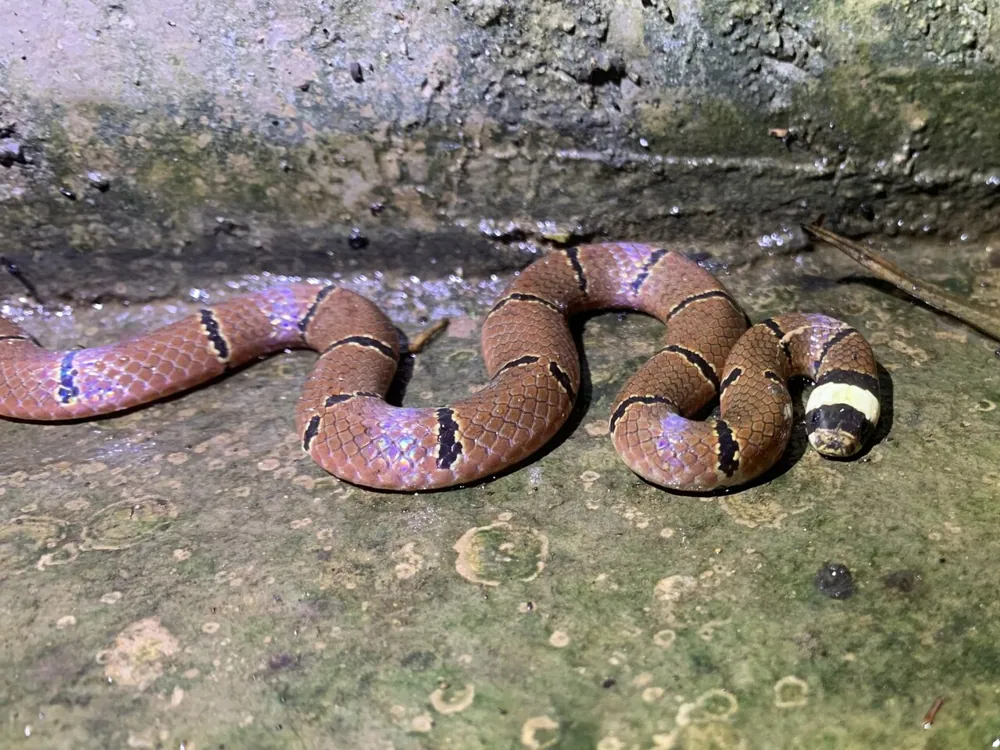
 So erkennst du es
Giftkraft
Das Gift kommt beim Beißen durch die Giftzähne oder Zähne heraus.
Was macht sein Gift, wenn es beißt oder sticht?
Like other elapids, it has a potent neurotoxic venom, which attacks the nerves and is capable of killing a person. Bite symptoms include numbness of the lips, difficulty speaking and breathing, and then blurred vision. Severe bite victims may die of sudden heart failure.1
Wie gefährlich ist es für Menschen?
Gefahr für Menschen: ErnstEin Biss gehört zum Arzt. Todesfälle sind sehr selten.Only a few human deaths have been recorded, all in Thailand. The snake is quite docile and is not likely to strike actively.1
Was macht es, wenn es Angst hat?
It is docile and not likely to strike actively.1
 Wenn es beißt
- Halte die Person still und ruhig, nimm Ringe und alles Enge ab und bring sie schnell in ein Krankenhaus: Gegengift (Antiserum) ist die Behandlung.
Ruf immer zuerst deine Notrufnummer an (112, 000, 911). Das sind allgemeine Erste-Hilfe-Hinweise, keine ärztliche Beratung. Erste-Hilfe-Grundlagen
 Bleib sicher
- Fass ein wildes Tier niemals an, fang es nicht und ärgere es nicht, auch kein kleines, und auch nicht, wenn es schlafend aussieht oder tot.
- Halte Abstand. Wenn du einem begegnest, bleib ruhig, geh langsam zurück und lass es seiner Wege gehen.
- Wenn dich eines beißt: Bleib ruhig, halt still, ruf deine Notrufnummer an (112, 000, 911) oder fahr schnell in ein Krankenhaus. Merk dir, wie es aussah, ein Foto hilft.
Es hat es nicht auf dich abgesehen. Es benutzt sein Gift, um Futter zu fangen oder sich zu schützen, und versteckt sich viel lieber. Mehr über Sicherheit
Wo auf der Welt?
Wie groß ist es?
Wie lang ist es?
 so lang wie 1,5 Hauskatzen von Nase bis Schwanz
 so lang wie 4 Bananen hintereinander
 könnte 100 Meter in 58 Sekunden schaffen (der schnellste Mensch braucht 9,6)
Wie groß ist MacClelland's coral snake im Vergleich zu DIR?
Nur Rechnen in deinem Browser. Nichts wird gespeichert oder irgendwohin geschickt.
Wie schnell ist es?


Fakten
Mythen-Check
Mythos: Venomous snakes always attack people on sight.
Wahrheit: This snake is quite docile and is not likely to strike actively, even though its venom is potent.1
Woher die Fakten kommen
- Sinomicrurus macclellandi (Wikipedia (CC BY-SA 4.0))
- Sinomicrurus macclellandi (iNaturalist): Namen und Klassifikation.
- Venom Wiki: die Gefahrenstufe, die typische Größe und die geschätzte Geschwindigkeit sind von uns. So berechnen wir sie: So bewerten wir die Gefahr.
Jeder Fakt auf dieser Seite hat eine Nummer, die auf seine Quelle zeigt. Wenn wir etwas falsch haben: Entschuldigung, wir sind Tierfans, keine Fachzeitschrift. Schreib uns an [email protected] und wir korrigieren es.
 Der Skorpion hat Hunger! Venom Wiki ist ein Ein-Mann-Projekt: kostenlos, ohne Werbung und ohne Tracker. Ein kleines Trinkgeld hilft, es online zu halten.Füttere den Skorpion
 Brillenschlange
 Königskobra
 Caspian cobra
 Common krait
 Malayan krait
 Many-banded krait
 Gelber Mittelmeerskorpion
 Indische Sandrasselotter
 Puffotter
 Kettenviper
 Asian giant hornet
 Komodo dragon
.jpg)