
 Afrika
 Asien
Asien Europa
 Südamerika
 Australien & Ozeanien
 Antarktis
 Pazifischer Ozean
 Atlantischer Ozean
 Indischer Ozean
 Nordpolarmeer
 Mittelmeer
 Rotes Meer
 Karibisches Meer
 Korallenmeer
 Südchinesisches Meer
 Philippinensee
 Andamanensee
 Nordsee
 Timorsee & Arafurasee
 Golf von Bengalen
 Golf von Kalifornien
Socotra Island blue baboon spider
 Bisse
BisseThe Socotra Island blue baboon tarantula is a large, vivid blue spider that lives on the ground. It is found only on Socotra Island, which is part of Yemen, and it is known for its unusual group behaviour, where mother spiders guard their young. Its venom has not been studied enough to know how strong it is.1
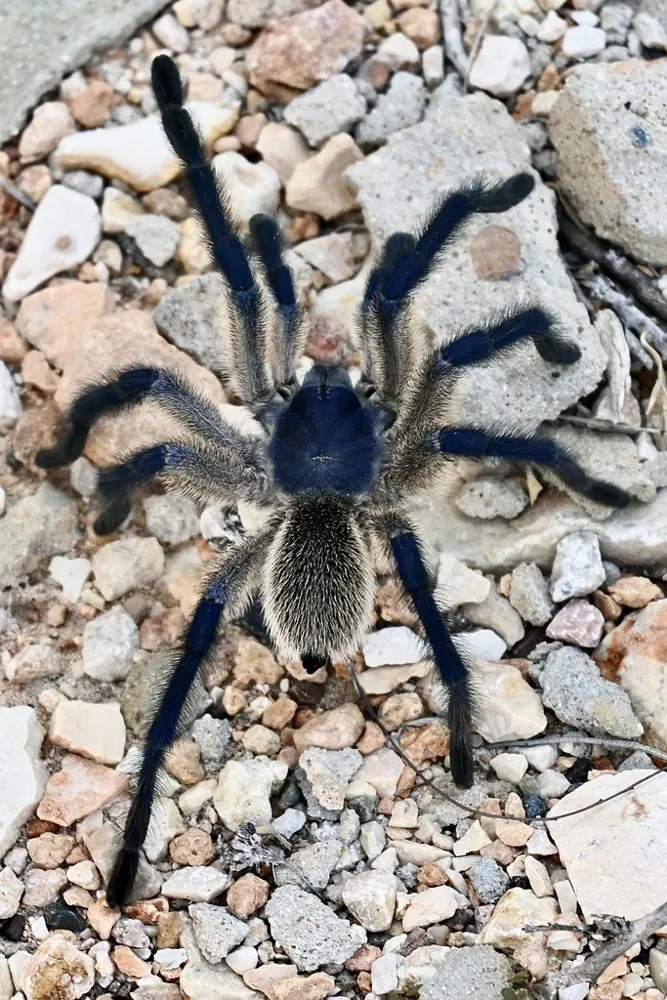
 So erkennst du es
Giftkraft
Das Gift kommt beim Beißen durch die Giftzähne oder Zähne heraus.
Was macht sein Gift, wenn es beißt oder sticht?
The potency of its venom is not known. Some people believe it can kill a dromedary (a one-humped camel), but this is most likely not the case.1
Wie gefährlich ist es für Menschen?
Gefahr für Menschen: SchmerzhaftEs kann richtig wehtun, ist aber fast nie gefährlich.How strong its venom is has not been established. When provoked, especially when a mother is protecting an egg sac, it will deliver a fast strike and bite.1
Was macht es, wenn es Angst hat?
When threatened, it rears up on its hind legs and bares its chelicerae (fang-bearing mouthparts) in a characteristic threat pose. Further provocation leads to a fast strike and bite.1
 Wenn es beißt
- Wasch den Biss und kühl ihn. Hol ärztliche Hilfe, wenn die Schmerzen stark sind oder es der Person schlecht geht.
Ruf immer zuerst deine Notrufnummer an (112, 000, 911). Das sind allgemeine Erste-Hilfe-Hinweise, keine ärztliche Beratung. Erste-Hilfe-Grundlagen
 Bleib sicher
- Fass ein wildes Tier niemals an, fang es nicht und ärgere es nicht, auch kein kleines, und auch nicht, wenn es schlafend aussieht oder tot.
- Halte Abstand. Wenn du einem begegnest, bleib ruhig, geh langsam zurück und lass es seiner Wege gehen.
- Wenn dich eines beißt: Bleib ruhig, halt still, ruf deine Notrufnummer an (112, 000, 911) oder fahr schnell in ein Krankenhaus. Merk dir, wie es aussah, ein Foto hilft.
Es hat es nicht auf dich abgesehen. Es benutzt sein Gift, um Futter zu fangen oder sich zu schützen, und versteckt sich viel lieber. Mehr über Sicherheit
Wo auf der Welt?
Wie groß ist es?
Wie lang ist es?
 so lang wie 4 Bausteine in einer Reihe
 könnte 100 Meter in 220 Sekunden schaffen (der schnellste Mensch braucht 9,6)
Wie groß ist Socotra Island blue baboon spider im Vergleich zu DIR?
Nur Rechnen in deinem Browser. Nichts wird gespeichert oder irgendwohin geschickt.
Wie schnell ist es?


Fakten
Its vivid blue colour is the striking feature of the adult, although red and amber forms have been seen very rarely.1
This tarantula is communal: mother spiders care for their young and will attack predators that get too close to their egg sac.1
In captivity, several males and females of different ages can live together without attacking one another, as long as they have enough food and proper care.1
Females live for about 10 to 14 years, while males tend to live for only about 3 to 4 years.1
Because it is an Old World tarantula, it does not have urticating hairs, the irritating hairs that some New World tarantulas flick at attackers.1
Mythen-Check
Mythos: It can kill a dromedary (one-humped camel).
Wahrheit: Some people believe this, but it is most likely not the case. Its venom potency is not known.1
Für Giftexperten
Woher die Fakten kommen
- Monocentropus balfouri (Wikipedia (CC BY-SA 4.0))
- Monocentropus balfouri (iNaturalist): Namen und Klassifikation.
- Venom Wiki: die Gefahrenstufe, die typische Größe und die geschätzte Geschwindigkeit sind von uns. So berechnen wir sie: So bewerten wir die Gefahr.
Jeder Fakt auf dieser Seite hat eine Nummer, die auf seine Quelle zeigt. Wenn wir etwas falsch haben: Entschuldigung, wir sind Tierfans, keine Fachzeitschrift. Schreib uns an [email protected] und wir korrigieren es.
 Der Skorpion hat Hunger! Venom Wiki ist ein Ein-Mann-Projekt: kostenlos, ohne Werbung und ohne Tracker. Ein kleines Trinkgeld hilft, es online zu halten.Füttere den Skorpion
Mehr aus derselben Gruppe: Vogelspinnen & Trichternetzspinnen
 Gooty sapphire tarantulaVogelspinnen & TrichternetzspinnenBraucht einen Arzt
 Indian ornamental tarantulaVogelspinnen & TrichternetzspinnenBraucht einen Arzt
 Cobalt blue tarantulaVogelspinnen & TrichternetzspinnenTut nur weh
 Chinese bird spiderVogelspinnen & TrichternetzspinnenBraucht einen Arzt
 Chinese black earth tiger tarantulaVogelspinnen & TrichternetzspinnenBraucht einen Arzt
 Fringed ornamental tarantulaVogelspinnen & TrichternetzspinnenBraucht einen Arzt
 Gelber Mittelmeerskorpion
 Brillenschlange
 Indische Sandrasselotter
 Königskobra
 Puffotter
 Kettenviper