
 África
 Asia
Asia Europa
 Sudamérica
 Australia y Oceanía
 Antártida
 Océano Pacífico
 Océano Atlántico
 Océano Índico
 Océano Ártico
 Mar Mediterráneo
 Mar Rojo
 Mar Caribe
 Mar del Coral
 Mar de China Meridional
 Mar de Filipinas
 Mar de Andamán
 Mar del Norte
 Mar de Timor y de Arafura
 Golfo de Bengala
 Golfo de California
Baron's mantella
 Veneno en la piel
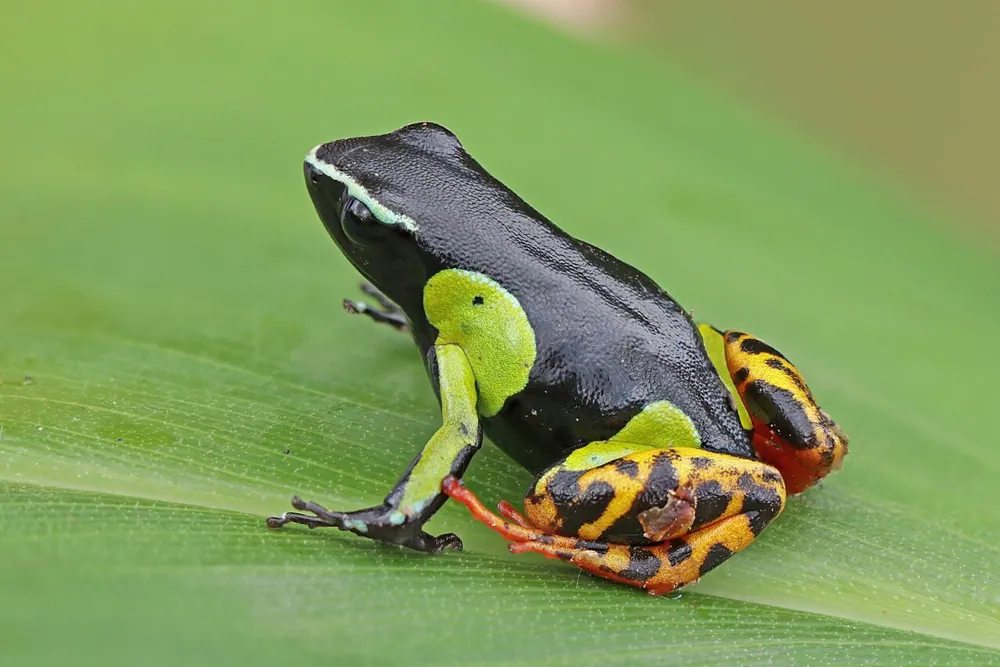
Baron's mantella is a small, brightly coloured frog that lives only on the island of Madagascar. Its skin contains toxic chemicals that make it harmful to predators, and its bright colours warn them to stay away.1



 Cómo reconocerlo
- Has a light line above the eyes, called a rostral line.1
- Hind limbs are orange with irregular black stripes, giving a tiger-like pattern.1
- Front limbs range from light green to bright orange or yellow, with a large rounded flank blotch.1
- Adults are 2.4 to 3.2 cm long, and females are slightly larger than males.1
- Males call during the day, and it is an active hunter in daylight.1
Se confunde a menudo con: It is often confused with the painted mantella (Mantella madagascariensis), which has a similar look. The painted mantella has a sky-blue, horseshoe-shaped marking on its throat. Baron's mantella does not have the flashmarks on its lower hind limbs.1
Poder tóxico
Su piel es venenosa. Es peligroso tocarlo, lamerlo o comerlo.
¿Qué hace su toxina?
It does not inject venom. Its skin contains alkaloids, which are toxic chemicals it gets from eating mites. These make it harmful to predators that eat it, and they can cause sickness. The strength of the toxin varies over time and by location, and frogs in remote populations may be more potent.1
¿Qué peligro tiene para las personas?
Peligro para las personas: LeveComo una picadura de abeja o menos. Prácticamente inofensivo para las personas.Its toxicity can vary, and careless handling is discouraged.1
¿Qué hace cuando se asusta?
Its bright colours warn predators that eating it could be dangerous and cause sickness.1
 Si alguien lo tocó o se lo comió
- Si alguien tocó uno: lávale bien las manos y que no se toque los ojos ni la boca. Si un niño o una mascota lo lamió o se lo comió: llama al centro de toxicología o a emergencias.
Llama siempre primero a tu número de emergencias (112, 000, 911). Esto son pautas generales de primeros auxilios, no consejo médico. Primeros auxilios básicos
 Mantente a salvo
- Nunca toques, atrapes ni molestes a un animal salvaje, aunque sea pequeño y aunque parezca dormido o muerto.
- Déjale espacio. Si te encuentras uno, mantén la calma, retrocede despacio y deja que siga su camino.
- Si lo tocaste o te lo comiste: no te frotes los ojos ni la boca, lávate las manos y busca ayuda médica.
No va a por ti. Su veneno solo está ahí para que nadie se lo coma. Más sobre cómo protegerte
¿En qué parte del mundo?
¿Qué tamaño tiene?
¿Cuánto mide?
 más o menos lo que mide un clip
 podría recorrer 100 metros en 100 segundos (el humano más rápido necesita 9,6)
¿Qué tamaño tiene Baron's mantella comparado contigo?
Solo cálculos en tu navegador. No se guarda ni se envía nada a ningún sitio.
¿Qué velocidad alcanza?


Datos
Its toxicity comes from the mites it eats, so its poison depends on its diet.1
Mantella frogs look like poison dart frogs from Latin America, but they are only distant relatives. The likeness is an example of convergent evolution.1
Unlike most frogs, which are active at night, it hunts during the day.1
Its bright colours and its toxins are a warning system, a pattern called aposematism.1
Its family arrived on Madagascar an estimated 76 to 87 million years ago.1
It is one of the largest species in the Mantella genus, with only some Mantella viridis individuals reaching a similar size.1
Cazamitos
Mito: Baron's mantella is the same as the painted mantella, and is sometimes called a painted mantella.
Verdad: The two are distinct species. They look alike, but the painted mantella has a sky-blue throat marking that Baron's mantella lacks.1
Para expertos en veneno
- Nombre científico
- Mantella baroni
- Grupo
- Ranas venenosas, sapos y tritones
- Familia
- Mantellidae2
- Orden
- Anura
- Continentes
- África
- Crías
- Females can lay up to 130 eggs in a single clutch, usually near water. Rain washes the tadpoles into the water.1
- Cómo le va en la naturaleza
- Least Concern (IUCN, 2016). It appears in CITES Appendix II.1
- Peligro para las personas
- 1 / 5: Leve3
De dónde salen los datos
- Mantella baroni (Wikipedia (CC BY-SA 4.0))
- Mantella baroni (iNaturalist): nombres y clasificación.
- Venom Wiki: el nivel de peligro, el tamaño típico y la velocidad estimada son nuestros. Mira cómo los calculamos: Cómo valoramos el peligro.
Cada dato de esta página tiene un número que lleva a su fuente. Si nos hemos equivocado en algo, perdón, somos fans de los animales, no una revista científica. Escríbenos a [email protected] y lo arreglamos.
 ¡El escorpión tiene hambre! Venom Wiki es un proyecto de una sola persona: gratis, sin anuncios y sin rastreadores. Una pequeña propina ayuda a mantenerlo en línea.Alimenta al escorpión
Más del mismo grupo: Ranas venenosas, sapos y tritones
 Golden mantellaRanas venenosas, sapos y tritonesInofensivo
 Iberian ribbed newtRanas venenosas, sapos y tritonesInofensivo
 Tomato frogRanas venenosas, sapos y tritonesInofensivo
 African common toadRanas venenosas, sapos y tritonesSolo dueleNo tocar
 Blue-legged mantellaRanas venenosas, sapos y tritonesInofensivo
 Climbing mantellaRanas venenosas, sapos y tritonesInofensivo
 Mamba negra
 Escorpión amarillo de Palestina
 Cobra egipcia
 Víbora bufadora
 Boomslang
 Fat-tailed scorpion
_Ranomafana.jpg)