
 África
 Asia
Asia Europa
 Sudamérica
 Australia y Oceanía
 Antártida
 Océano Pacífico
 Océano Atlántico
 Océano Índico
 Océano Ártico
 Mar Mediterráneo
 Mar Rojo
 Mar Caribe
 Mar del Coral
 Mar de China Meridional
 Mar de Filipinas
 Mar de Andamán
 Mar del Norte
 Mar de Timor y de Arafura
 Golfo de Bengala
 Golfo de California
Eastern green mamba
 Mordeduras
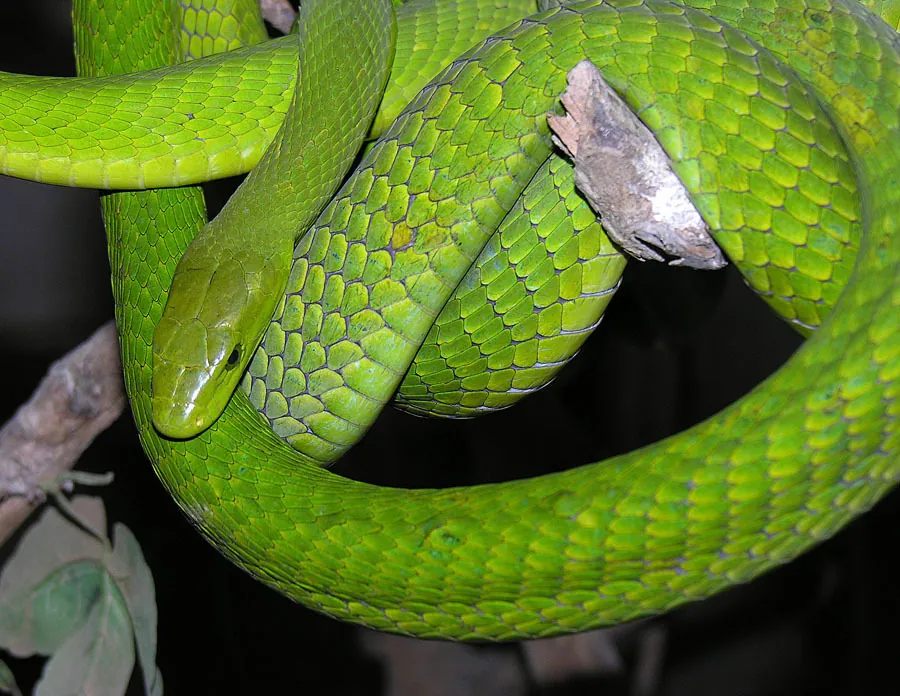
The eastern green mamba is a highly venomous snake with a slender body and bright green back. It lives in trees along the coasts of southern and East Africa. Although it is one of the most common green mambas, it is shy and usually hidden in leaves, so it is rarely seen.1



 Cómo reconocerlo
- Bright green upperparts, sometimes with a few isolated yellow scales.1
- Pale yellow-green belly.1
- Juveniles are blue-green and turn bright green at about 75 cm long.1
- Long, slender, coffin-shaped head. It can flatten its neck into a slight hood when threatened.1
- The inside of the mouth is white or bluish-white.1
Se confunde a menudo con: Green forms of the boomslang are often called green mambas in Southern Africa. They have larger eyes and shorter heads. Green bush snakes of the genus Philothamnus are often confused with smaller eastern green mambas. The boomslang is also venomous.1
Poder del veneno
El veneno sale por sus colmillos o dientes cuando muerde.
¿Qué hace su veneno?
Its venom contains neurotoxins, which attack the nerves, and cardiotoxins, which damage the heart. Symptoms include swelling at the bite, dizziness, nausea, dehydration, laboured breathing and difficulty swallowing. These can progress to irregular heartbeat, convulsions and respiratory paralysis, which stops breathing and can be fatal. Paralysis may be mild or absent.1
¿Qué peligro tiene para las personas?
Peligro para las personas: MortalUno de los animales más peligrosos del mundo.A survey in southern Africa from 1957 to 1979 recorded 17 bites confirmed as eastern green mambas. Ten of these caused systemic envenomation, and no victims died. Bites are most common from September to February, the breeding season, when the snake is most irritable. The average dose able to kill a human is about 18 to 20 mg of venom, and one bite can deliver 60 to 95 mg (dry weight). In 2024, a YouTuber died after being bitten, following anaphylactic shock.1
¿Qué hace cuando se asusta?
It is shy and avoids people and predators, attacking only when it feels threatened, and it can flatten its neck into a hood.1
 Si muerde
- Severe bites must be treated immediately on site, as they can quickly prove deadly.1
- Mantén a la persona quieta y tranquila, quítale anillos y cosas apretadas y llévala rápido a un hospital: el tratamiento es el antídoto.
Llama siempre primero a tu número de emergencias (112, 000, 911). Esto son pautas generales de primeros auxilios, no consejo médico. Primeros auxilios básicos
 Mantente a salvo
- Nunca toques, atrapes ni molestes a un animal salvaje, aunque sea pequeño y aunque parezca dormido o muerto.
- Déjale espacio. Si te encuentras uno, mantén la calma, retrocede despacio y deja que siga su camino.
- Si te muerde: mantén la calma, no te muevas, llama a tu número de emergencias (112, 000, 911) o ve rápido a un hospital. Recuerda cómo era, una foto ayuda.
No va a por ti. Usa su veneno para cazar o defenderse, y prefiere mil veces esconderse. Más sobre cómo protegerte
¿En qué parte del mundo?
¿Qué tamaño tiene?
¿Cuánto mide?
 mide como 2,5 perros de la nariz a la cola
 mide como 14 plátanos puestos en fila
 podría recorrer 100 metros en 43 segundos (el humano más rápido necesita 9,6)
¿Qué tamaño tiene Eastern green mamba comparado contigo?
Solo cálculos en tu navegador. No se guarda ni se envía nada a ningún sitio.
¿Qué velocidad alcanza?


Datos
Males fight each other during the breeding season, usually entwining and pushing to pin each other's heads down. These fights can last several hours, but the snakes do not bite each other.1
Unlike most elapid snakes, which hunt actively, it often waits in ambush for its prey, a style more common among vipers.1
On average, an individual moves only about 5.4 metres per day, and it can stay in the same place for days.1
It has the least toxic venom of the three green mamba species, but it is still highly venomous.1
The oldest recorded eastern green mamba was a captive snake that lived 18.8 years.1
Cazamitos
Mito: It is an aggressive, fast-moving 'people-chaser'.
Verdad: It is shy and elusive, usually hidden in trees, and it generally avoids people. It attacks only when it feels threatened.1
Para expertos en veneno
- Nombre científico
- Dendroaspis angusticeps
- Grupo
- Cobras, mambas y kraits
- Familia
- Elapidae2
- Orden
- Squamata
- Continentes
- África
- Crías
- The female lays 4 to 17 eggs, usually 10 to 15, in leaf litter in hollow trees, from October to November. The young measure about 30 to 45 cm in the wild.1
- Esperanza de vida
- unos 18,8 años1
- Peligro para las personas
- 5 / 5: Mortal3
De dónde salen los datos
- Eastern green mamba (Wikipedia (CC BY-SA 4.0))
- Dendroaspis angusticeps (iNaturalist): nombres y clasificación.
- Venom Wiki: el nivel de peligro, el tamaño típico y la velocidad estimada son nuestros. Mira cómo los calculamos: Cómo valoramos el peligro.
Cada dato de esta página tiene un número que lleva a su fuente. Si nos hemos equivocado en algo, perdón, somos fans de los animales, no una revista científica. Escríbenos a [email protected] y lo arreglamos.
 ¡El escorpión tiene hambre! Venom Wiki es un proyecto de una sola persona: gratis, sin anuncios y sin rastreadores. Una pequeña propina ayuda a mantenerlo en línea.Alimenta al escorpión
 Mamba negra
 Cobra egipcia
 Cape cobra
 Jameson's mamba
 Western green mamba
 Ashe's spitting cobra
 Escorpión amarillo de Palestina
 Víbora bufadora
 Boomslang
 Fat-tailed scorpion
 Gaboon viper
 Western honey bee