
 África
 Asia
Asia Europa
 Sudamérica
 Australia y Oceanía
 Antártida
 Océano Pacífico
 Océano Atlántico
 Océano Índico
 Océano Ártico
 Mar Mediterráneo
 Mar Rojo
 Mar Caribe
 Mar del Coral
 Mar de China Meridional
 Mar de Filipinas
 Mar de Andamán
 Mar del Norte
 Mar de Timor y de Arafura
 Golfo de Bengala
 Golfo de California
King cobra
 Mordeduras
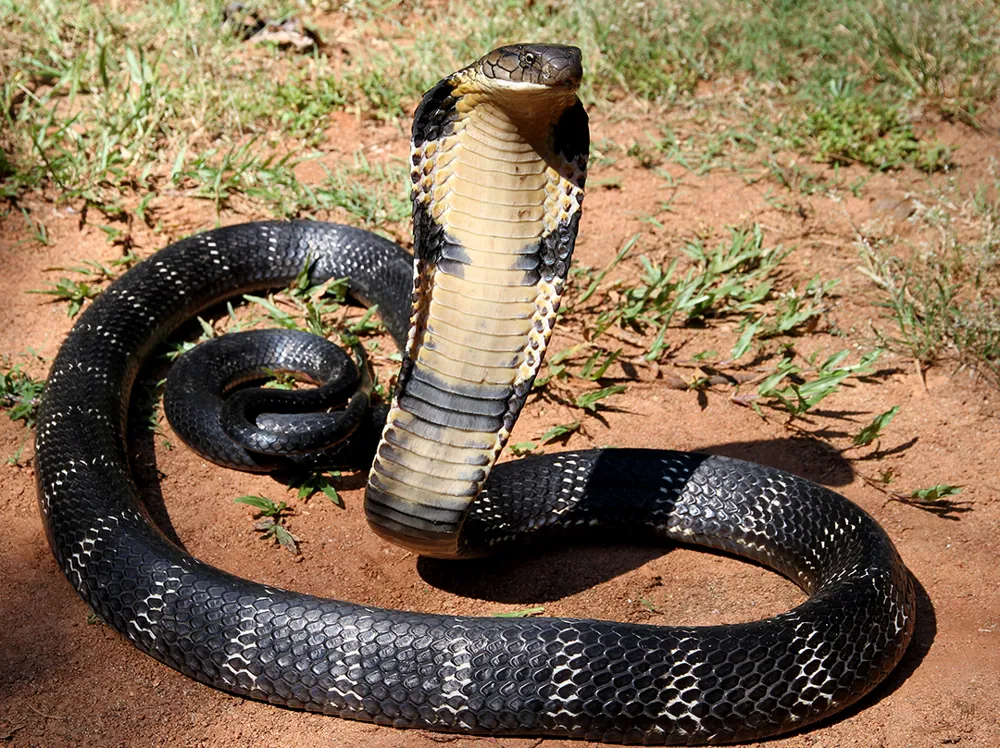
The king cobra is a large venomous snake of tropical Asia. It is the world's longest venomous snake, and it mostly eats other snakes. It is widely spread across its range, but people do not often see it.1



 Cómo reconocerlo
- Adults are olive green with black and white bands across the trunk that run towards the head.1
- The head has 15 drab-coloured shields that are edged in black.1
- The hood is oval, with two black spots between the two lowest scales.1
- Juveniles are black with chevron-shaped white, yellow or buff bars that point towards the head.1
- The tail is yellowish green and marked with black.1
Se confunde a menudo con: Despite its common name and some resemblance, it is not a true cobra: it belongs to its own genus.1
Poder del veneno
El veneno sale por sus colmillos o dientes cuando muerde.
¿Qué hace su veneno?
The venom is neurotoxic, which means it attacks the nerves, and cytotoxic, which means it damages cells. Symptoms can start rapidly after a bite. The cobra can strike at a considerable range and height, and it has an immense venom yield.1
¿Qué peligro tiene para las personas?
Peligro para las personas: MortalUno de los animales más peligrosos del mundo.The king cobra is not considered aggressive and usually avoids humans. Attacks usually happen when an individual is cornered or accidentally exposes itself, or when people come close by chance.1
 Buena noticia: los médicos tienen un medicamento (antídoto) o un tratamiento para esto.1
¿Qué hace cuando se asusta?
When threatened, it spreads its neck flap, raises its head, hisses or growls loudly, and sometimes charges.1
 Si muerde
- After a bite, prompt antivenom is needed, so get to medical care as fast as possible.1
- Mantén a la persona quieta y tranquila, quítale anillos y cosas apretadas y llévala rápido a un hospital: el tratamiento es el antídoto.
Llama siempre primero a tu número de emergencias (112, 000, 911). Esto son pautas generales de primeros auxilios, no consejo médico. Primeros auxilios básicos
 Mantente a salvo
- Nunca toques, atrapes ni molestes a un animal salvaje, aunque sea pequeño y aunque parezca dormido o muerto.
- Déjale espacio. Si te encuentras uno, mantén la calma, retrocede despacio y deja que siga su camino.
- Si te muerde: mantén la calma, no te muevas, llama a tu número de emergencias (112, 000, 911) o ve rápido a un hospital. Recuerda cómo era, una foto ayuda.
No va a por ti. Usa su veneno para cazar o defenderse, y prefiere mil veces esconderse. Más sobre cómo protegerte
¿En qué parte del mundo?
¿Qué tamaño tiene?
¿Cuánto mide?
¿Cuánto pesa?

 mide como 6 perros de la nariz a la cola
 mide como 32 plátanos puestos en fila
 podría recorrer 100 metros en 36 segundos (el humano más rápido necesita 9,6)
¿Qué tamaño tiene King cobra comparado contigo?
Solo cálculos en tu navegador. No se guarda ni se envía nada a ningún sitio.
¿Qué velocidad alcanza?


Datos
Its growl is much lower than most snakes' hisses, with a dominant frequency near 600 Hz, which is closer to a human voice.1
It is dominant over all other snakes except large pythons.1
It can swallow prey much larger than its head because of its flexible jaws.1
It can go many months without another meal after a large meal because its metabolism is slow.1
It is considered the national reptile of India and has an important place in the mythology and folk traditions of India, Bangladesh, Sri Lanka and Myanmar.1
Its common name 'hamadryad' is still used in older books.1
Cazamitos
Mito: King cobras are aggressive and attack people on sight.
Verdad: The king cobra is not considered aggressive and usually avoids humans. It defends its eggs fiercely and may strike if it is cornered or accidentally exposed.1
Para expertos en veneno
- Nombre científico
- Ophiophagus hannah
- Grupo
- Cobras, mambas y kraits
- Familia
- Elapidae2
- Orden
- Squamata
- Continentes
- Asia
- Crías
- It lays eggs. The female builds a nest of dry leaf litter and guards the eggs through the incubation period.1
- Cómo le va en la naturaleza
- Vulnerable (IUCN Red List, since 2010)1
- Peligro para las personas
- 5 / 5: Mortal3
De dónde salen los datos
- King cobra (Wikipedia (CC BY-SA 4.0))
- Ophiophagus hannah (iNaturalist): nombres y clasificación.
- Venom Wiki: el nivel de peligro, el tamaño típico y la velocidad estimada son nuestros. Mira cómo los calculamos: Cómo valoramos el peligro.
Cada dato de esta página tiene un número que lleva a su fuente. Si nos hemos equivocado en algo, perdón, somos fans de los animales, no una revista científica. Escríbenos a [email protected] y lo arreglamos.
 ¡El escorpión tiene hambre! Venom Wiki es un proyecto de una sola persona: gratis, sin anuncios y sin rastreadores. Una pequeña propina ayuda a mantenerlo en línea.Alimenta al escorpión
 Indian cobra
 Caspian cobra
 Common krait
 Malayan krait
 Many-banded krait
 Monocled cobra
 Deathstalker
 Indian saw-scaled viper
 Víbora bufadora
 Víbora de Russell
 Asian giant hornet
 Komodo dragon