
 África
 Asia
Asia Europa
 Sudamérica
 Australia y Oceanía
 Antártida
 Océano Pacífico
 Océano Atlántico
 Océano Índico
 Océano Ártico
 Mar Mediterráneo
 Mar Rojo
 Mar Caribe
 Mar del Coral
 Mar de China Meridional
 Mar de Filipinas
 Mar de Andamán
 Mar del Norte
 Mar de Timor y de Arafura
 Golfo de Bengala
 Golfo de California
Rhinoceros viper
 Mordeduras
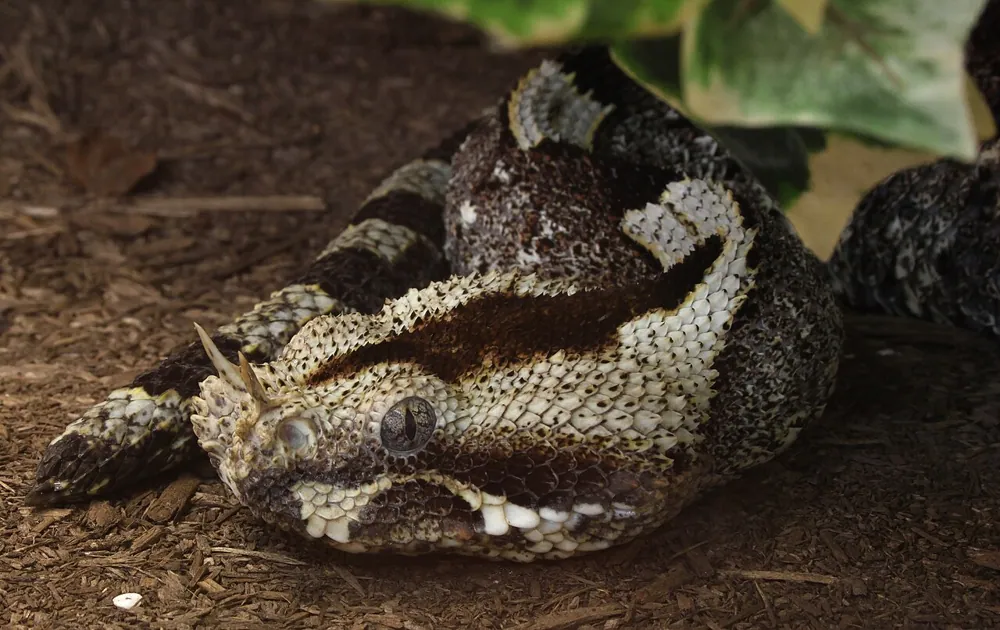
The rhinoceros viper is a large, stout snake with bright colours and two or three horn-like scales on its nose. It lives in forests across West and Central Africa. It is venomous, and its venom is mainly hemotoxic, meaning it attacks the blood and circulation.1



 Cómo reconocerlo
- Large and stout, with rough, heavily keeled scales1
- Two or three horn-like scales on the end of the nose, the front pair often long1
- Series of blue or blue-green oblong markings, each with a lemon-yellow line down the centre, set within black blotches1
- Dark crimson triangles down the flanks, bordered with green or blue1
- Top of the head blue or green, with a black arrow mark1
Se confunde a menudo con: The name horned puff adder is also used for Bitis caudalis (horned adder), which is a different species. Because of this, names can cause confusion, so the name butterfly viper is preferred.1
Poder del veneno
El veneno sale por sus colmillos o dientes cuando muerde.
¿Qué hace su veneno?
Its venom is mainly hemotoxic, which attacks the circulatory system, destroying tissue and blood vessels and causing internal bleeding. It also has a neurotoxic component, which attacks the nerves. Small doses of the venom can be deadly. In the few detailed reports of human bites, massive swelling was described, which may lead to necrosis (death of tissue).1
¿Qué peligro tiene para las personas?
Peligro para las personas: Muy peligrosoPuede matar a una persona que no recibe tratamiento.Because its range is restricted, few bites have been reported and no statistics are available. In 2003 a man in Dayton, Ohio, who kept one as a pet, was bitten and died.1
 Buena noticia: los médicos tienen un medicamento (antídoto) o un tratamiento para esto.1
¿Qué hace cuando se asusta?
When approached it often reveals its presence with a very loud hiss, almost a shriek, and it can strike quickly forwards or sideways without coiling first or giving a warning.1
 Si muerde
- Mantén a la persona quieta y tranquila, la extremidad mordida a la altura del corazón, quítale anillos y cosas apretadas y llévala rápido a un hospital.
Llama siempre primero a tu número de emergencias (112, 000, 911). Esto son pautas generales de primeros auxilios, no consejo médico. Primeros auxilios básicos
 Mantente a salvo
- Nunca toques, atrapes ni molestes a un animal salvaje, aunque sea pequeño y aunque parezca dormido o muerto.
- Déjale espacio. Si te encuentras uno, mantén la calma, retrocede despacio y deja que siga su camino.
- Si te muerde: mantén la calma, no te muevas, llama a tu número de emergencias (112, 000, 911) o ve rápido a un hospital. Recuerda cómo era, una foto ayuda.
No va a por ti. Usa su veneno para cazar o defenderse, y prefiere mil veces esconderse. Más sobre cómo protegerte
¿En qué parte del mundo?
¿Qué tamaño tiene?
¿Cuánto mide?
 mide como 2 gatos domésticos de la nariz a la cola
 mide como 6 plátanos puestos en fila
 podría recorrer 100 metros en 100 segundos (el humano más rápido necesita 9,6)
¿Qué tamaño tiene Rhinoceros viper comparado contigo?
Solo cálculos en tu navegador. No se guarda ni se envía nada a ningún sitio.
¿Qué velocidad alcanza?


Datos
Its scales are so rough that they can cut people who handle a snake that is struggling.1
Its vivid colours break up its outline in the dappled light of the forest floor, so it is very hard to see.1
Its fangs are not large, rarely more than 1.5 cm long, and when not in use they fold up into the roof of its mouth.1
Its bright colours fade quickly after it sheds its skin, as silt from its moist habitat builds up on its rough scales.1
At least one antivenom, called India Antiserum Africa Polyvalent, protects specifically against bites from this species.1
Cazamitos
Mito: Its bright colours make it easy to spot in the forest.
Verdad: Its colours give it excellent camouflage in the dappled light of the forest floor, which can make it almost invisible.1
De dónde salen los datos
- Bitis nasicornis (Wikipedia (CC BY-SA 4.0))
- Bitis nasicornis (iNaturalist): nombres y clasificación.
- Venom Wiki: el nivel de peligro, el tamaño típico y la velocidad estimada son nuestros. Mira cómo los calculamos: Cómo valoramos el peligro.
Cada dato de esta página tiene un número que lleva a su fuente. Si nos hemos equivocado en algo, perdón, somos fans de los animales, no una revista científica. Escríbenos a [email protected] y lo arreglamos.
 ¡El escorpión tiene hambre! Venom Wiki es un proyecto de una sola persona: gratis, sin anuncios y sin rastreadores. Una pequeña propina ayuda a mantenerlo en línea.Alimenta al escorpión
 Víbora bufadora
 Gaboon viper
 Northeast African carpet viper
 West African carpet viper
 West African Gaboon viper
 Horned adder
 Mamba negra
 Escorpión amarillo de Palestina
 Cobra egipcia
 Boomslang
 Fat-tailed scorpion
 Western honey bee
.jpg)