
 Afrika
 Asia
Asia Europa
 Hego Amerika
 Australia eta Ozeania
 Antartika
 Ozeano Barea
 Ozeano Atlantikoa
 Ozeano Indikoa
 Ozeano Artikoa
 Mediterraneo itsasoa
 Itsaso Gorria
 Karibe itsasoa
 Koralen itsasoa
 Hego Txinako itsasoa
 Filipinetako itsasoa
 Andaman itsasoa
 Ipar itsasoa
 Timor eta Arafura itsasoak
 Bengalako golkoa
 Kaliforniako golkoa
Black sea nettle
 Tentakulu ziztatzaileak
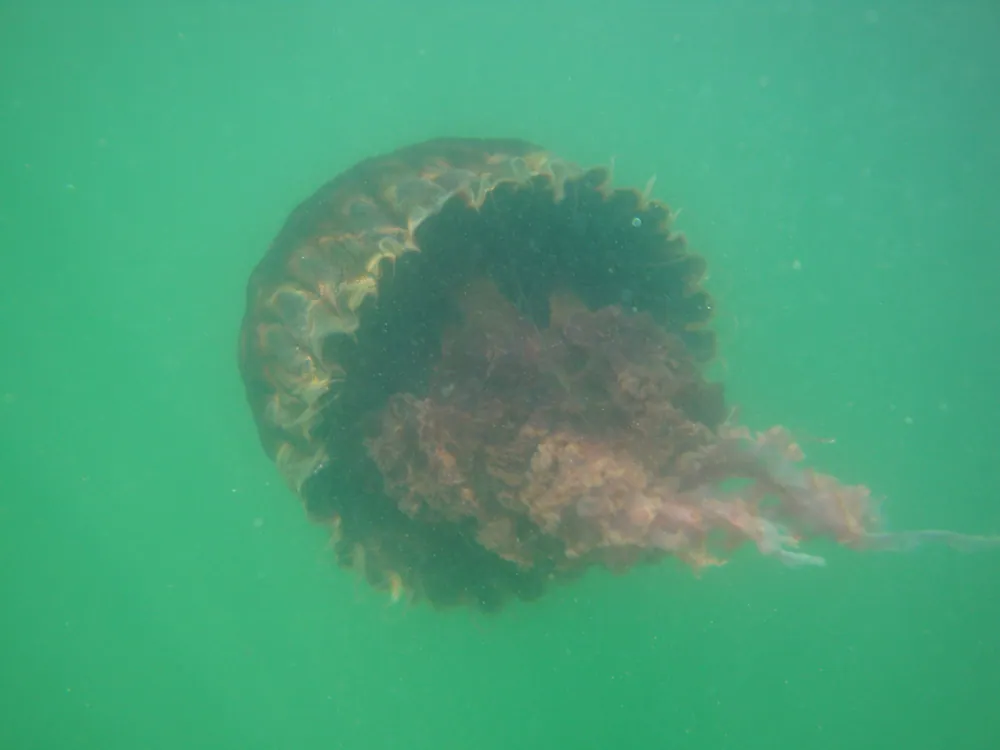
The black sea nettle is a large jellyfish with a dark purple to nearly black bell. It lives in the Pacific Ocean off western North America, and it is rare to see except in big swarms that appear in some years. Its stinging tentacles can cause a painful sting to people.1


 Nola ezagutu
- The bell is an opaque dark purple to nearly black colour.1
- The edge of the bell has a lighter brown, net-like (reticulated) pattern.1
- The bell can reach about 1 metre across, and the oral arms can extend 5 or 6 metres.1
- There are marginal sense organs around the bell edge, one after every set of 3 tentacles, 8 in total.1
Askotan honekin nahasten da: No other West Coast jelly that visits nearshore waters has this dark pigmentation, so the very dark colour is the main way to tell it apart.1
Pozoi-ahalmena
Milaka zelula ziztatzaile txikik tiro egiten dute zerbaitek ukitzen dituenean.
Zer egiten du bere pozoiak?
Each tentacle is covered in thousands of microscopic stinging cells called nematocysts. When touched, they fire a filament that injects toxins, which can kill smaller prey or stun predators. In people, the sting is usually not lethal but is painful and can last for forty minutes.1
Zein arriskutsua da pertsonentzat?
Arriskua pertsonentzat: MingarriaBenetan min handia eman dezake, baina ia inoiz ez da larria.The sting is usually not lethal to people, but it is painful and can last for about forty minutes.1
Zer egiten du beldurtzen denean?
Its stinging tentacles fire venom-filled filaments on contact, which stun or deter anything that threatens it.1
 Ziztatzen badu
- Atera uretatik eta kendu tentakuluak (eskularruekin edo oihal batekin).
- Kubomedusa tropikalak: bota ozpina ziztadetan gutxienez 30 segundoz, eskatu laguntza eta egon prest BBS (bihotz-biriketako suspertzea) egiteko. Fisaliak eta beste gehienak: garbitu itsasoko urarekin, eta gero ur beroarekin minerako.
Deitu beti lehenik zure larrialdi-zenbakira (112, 000, 911). Lehen sorospenei buruzko orientabide orokorra da hau, ez mediku-aholkua. Lehen sorospenen oinarriak
 Egon seguru
- Ez ukitu, ez harrapatu eta ez zirikatu inoiz animalia basati bat, txikia izan arren, eta lo edo hilda dagoela badirudi ere.
- Utzi tartea. Bat aurkitzen baduzu, egon lasai, egin atzera poliki eta utzi bere bidetik joaten.
- Batek ziztatzen bazaitu: egon lasai, egon geldi, deitu zure larrialdi-zenbakira (112, 000, 911) edo joan ospitalera azkar. Gogoratu nolakoa zen, argazki batek laguntzen du.
Ez dabil zure atzetik. Pozoia janaria harrapatzeko edo bere burua babesteko erabiltzen du, eta askoz nahiago du ezkutatu. Seguru egoteari buruz gehiago
Munduko zein tokitan?
Zein handia da?
Zein luzea da?
 2 etxeko katu muturretik buztanera jarrita bezain luzea
 6 banana bata bestearen atzetik jarrita bezain luzea
 igerileku handi baten luzera (50 m) igerian egin lezake 95 segundotan
Zein handia da Black sea nettle ZUREKIN alderatuta?
Matematika hutsa zure nabigatzailean. Ez da ezer gordetzen, ezta inora bidaltzen ere.
Zein azkarra da?

Datuak
It is thought to be the largest invertebrate described in the 20th century.1
Its stomach is lined with fibrous vessels that attach to prey, and its mouth-like openings, called darkmaws, close when exposed to bright light.1
It was only officially described in 1997, after large groups were found on the Pacific coast.1
Its swarms seem to coincide with red tides, which are blooms of the zooplankton it feeds on.1
Datuak nondik datozen
- Chrysaora achlyos (Wikipedia (CC BY-SA 4.0))
- Chrysaora achlyos (iNaturalist): izenak eta sailkapena.
- Venom Wiki: arrisku-maila, ohiko tamaina eta abiadura-kalkulua geureak dira. Ikusi nola kalkulatzen ditugun: Nola baloratzen dugun arriskua.
Orrialde honetako datu bakoitzak zenbaki bat du, bere iturrira eramaten zaituena. Zerbait gaizki badugu, barkatu, animalien zaleak gara, ez zientzia-aldizkari bat. Esaiguzu [email protected] helbidean eta konponduko dugu.
 Eskorpioia gose da! Venom Wiki pertsona bakar baten proiektua da: doakoa, iragarkirik eta jarraitzailerik gabe. Eskupeko txiki batek sarean mantentzen laguntzen du.Elikatu eskorpioia
Talde bereko gehiago: Marmokak eta itsasoko izaki ziztatzaileak
 Australian box jellyfishMarmokak eta itsasoko izaki ziztatzaileakHilgarriaEz ukitu
 Irukandji jellyfishMarmokak eta itsasoko izaki ziztatzaileakHil dezakeEz ukitu
 Portuguese man o' warMarmokak eta itsasoko izaki ziztatzaileakMedikua behar duEz ukitu
 Lion's mane jellyfishMarmokak eta itsasoko izaki ziztatzaileakMin ematen du, besterik ezEz ukitu
 Moon jellyfishMarmokak eta itsasoko izaki ziztatzaileakKaltegabea
 Common kingslayerMarmokak eta itsasoko izaki ziztatzaileakHil dezakeEz ukitu
Hemen ere bizi da: Ozeano Atlantikoa
 Hawksbill sea turtleBeste animalia toxiko batzukHil dezake
 Blue sea dragonKono-barraskiloak eta olagarroakMin ematen du, besterik ez
 Greenland sharkBeste animalia toxiko batzukMin ematen du, besterik ez
 Common octopusKono-barraskiloak eta olagarroakKaltegabea
 Common stingrayArrain pozoitsuakMedikua behar du
 Greater weeverArrain pozoitsuakMedikua behar duEz ukitu