
 Afrikka
 Aasia
Aasia Eurooppa
 Etelä-Amerikka
 Australia ja Oseania
 Etelämanner
 Tyynimeri
 Atlantti
 Intian valtameri
 Pohjoinen jäämeri
 Välimeri
 Punainenmeri
 Karibianmeri
 Korallimeri
 Etelä-Kiinan meri
 Filippiinienmeri
 Andamaanienmeri
 Pohjanmeri
 Timorinmeri ja Arafuranmeri
 Bengalinlahti
 Kalifornianlahti
African crested rat
 Myrkkyä ihossaSyö: KasvitPassiivisesti myrkyllinen, ei aktiivisesti myrkyllinen
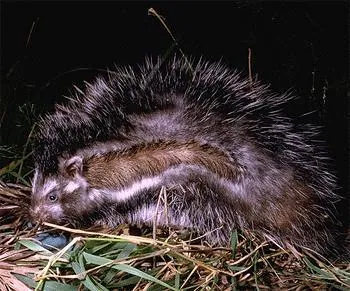
The African crested rat is a large, nocturnal rodent with long hair and a bushy tail. It looks a little like a porcupine. It lives in East Africa, where it is the world's only known poisonous rodent, coating itself in plant toxins to keep predators away.1



 Näin tunnistat sen
- Large, nocturnal rodent with long, silver and black-tipped guard hairs over a woolly grey and white undercoat1
- A mane of longer black-and-white banded hairs runs from the top of the head to just beyond the base of the tail1
- A broad, white-bordered strip of glandular skin sits beside the mane, and it becomes visible when the animal is threatened1
- Bushy tail and short black fur on the face and limbs1
- Superficially resembles a porcupine1
Myrkkyvoima
Sen iho on myrkyllinen. Siihen on vaarallista koskea, sitä on vaarallista nuolla tai syödä.
Mitä sen myrkky tekee, jos siihen koskee tai sen syö?
This animal is poisonous rather than venomous, so it does not bite or sting to inject poison. It smears poison from the bark of the poison arrow tree onto the hairs of its glandular skin patch. A predator that bites it can be sickened or even killed by this poison.1
Kuinka vaarallinen se on ihmisille?
Vaara ihmisille: VakavaJos joku koskee siihen tai syö sen, mene lääkäriin. Kuolemat ovat hyvin harvinaisia.Its poison is a risk to predators that try to bite it. The rat itself is not harmed by the toxins it stores.1
Mitä se tekee, kun se pelästyy?
When threatened or excited, the mane stands up and the glandular strip parts, exposing the skin that carries the poison.1
 Jos joku koski siihen tai söi sitä
- Jos joku on syönyt sitä tai saa oireita sen syömisen jälkeen: soita heti hätänumeroon tai Myrkytystietokeskukseen.
Soita aina ensin hätänumeroon (112, 000, 911). Nämä ovat yleisiä ensiapuohjeita, eivät lääketieteellisiä neuvoja. Ensiavun perusteet
 Pysy turvassa
- Älä koskaan koske villieläimeen, pyydystä sitä tai kiusaa sitä, ei edes pientä, eikä silloinkaan, kun se näyttää nukkuvan tai olevan kuollut.
- Anna sille tilaa. Jos kohtaat sellaisen, pysy rauhallisena, peräänny hitaasti ja anna sen mennä omaa tietään.
- Jos kosketit sitä tai söit sitä: älä hiero silmiäsi tai suutasi, pese kätesi ja hae lääkärin apua.
Se ei ole sinun perässäsi. Sen myrkky on olemassa vain siksi, ettei kukaan söisi sitä. Lisää turvallisuudesta
Missä päin maailmaa?
Kuinka iso se on?
Kuinka pitkä se on?
Kuinka painava se on?

 yhtä pitkä kuin 10 rakennuspalikkaa rivissä
 voisi juosta 100 metriä 72 sekunnissa (nopein ihminen tarvitsee 9,6)
Kuinka iso African crested rat on SINUUN verrattuna?
Pelkkää matematiikkaa selaimessasi. Mitään ei tallenneta eikä lähetetä minnekään.
Kuinka nopea se on?


Faktat
It is the world's only known poisonous rodent.1
It is the only rodent known to use and store toxins from a different species in nature to protect itself, and it suffers no known harm from them.1
Its stomach has five anatomically distinct sections, a feature found in very few rodents.1
The skull is covered with small bony projections that give it a pebbled look.1
Its large size may allow microbes in its foregut to break down cellulose from plants by fermentation.1
Myyttien murtaja
Myytti: The maned rat was believed to be solitary.
Totuus: It is now known to be somewhat sociable. Several animals are found in the same territory, and they purr and groom one another, so they may form family groups of a male, a female and their young.1
Myrkkyasiantuntijoille
- Tieteellinen nimi
- Lophiomys imhausi
- Ryhmä
- Muut passiivisesti myrkylliset eläimet
- Perhe
- Muridae2
- Järjestys
- Rodentia
- Maanosat
- Afrikka
- Vauvat
- Litters have 1 to 3 young. The young are slightly haired at birth, their eyes open by day 13, and they are weaned by day 40.1
- Miten sillä menee luonnossa
- Least Concern1
- Vaara ihmisille
- 3 / 5: Vakava3
Mistä tiedot ovat peräisin
- Maned rat (Wikipedia (CC BY-SA 4.0))
- Lophiomys imhausi (iNaturalist): nimet ja luokittelu.
- Venom Wiki: vaarataso, tyypillinen koko ja nopeusarvio ovat omia arvioitamme. Katso, miten laskemme ne: Näin arvioimme vaaran.
Jokaisella tämän sivun tiedolla on numero, joka viittaa sen lähteeseen. Jos jokin meni pieleen, anteeksi, olemme eläinfaneja emmekä tiedelehti. Kerro meille osoitteeseen [email protected], niin korjaamme sen.
 Skorpionilla on nälkä! Venom Wiki on yhden miehen projekti: ilmainen, ilman mainoksia ja ilman seurantaa. Pieni tippi auttaa pitämään sen verkossa.Ruoki skorpioni
Lisää samasta ryhmästä: Muut passiivisesti myrkylliset eläimet
 Common quailMuut passiivisesti myrkylliset eläimetSattuu vain
 Spur-winged gooseMuut passiivisesti myrkylliset eläimetSattuu vain
 Fahaka pufferfishMuut passiivisesti myrkylliset eläimetVoi tappaa
 Red-striped oil beetleMuut passiivisesti myrkylliset eläimetSattuu vainÄlä koske
 JapaninpallokalaMuut passiivisesti myrkylliset eläimetTappava
 Hawksbill sea turtleMuut passiivisesti myrkylliset eläimetVoi tappaa
 Musta mamba
 Keltainen skorpioni
 Egyptinkobra
 Puhkukyy
 Boomslang
 Fat-tailed scorpion