
 Afrikka
 Aasia
Aasia Eurooppa
 Etelä-Amerikka
 Australia ja Oseania
 Etelämanner
 Tyynimeri
 Atlantti
 Intian valtameri
 Pohjoinen jäämeri
 Välimeri
 Punainenmeri
 Karibianmeri
 Korallimeri
 Etelä-Kiinan meri
 Filippiinienmeri
 Andamaanienmeri
 Pohjanmeri
 Timorinmeri ja Arafuranmeri
 Bengalinlahti
 Kalifornianlahti
Asian hornet
 Pistot
The Asian hornet is a hornet from Southeast Asia that has spread to many other countries, including most of Europe, where it is an invasive species. It is a concern because it hunts honeybees and its stings can be serious for people.1


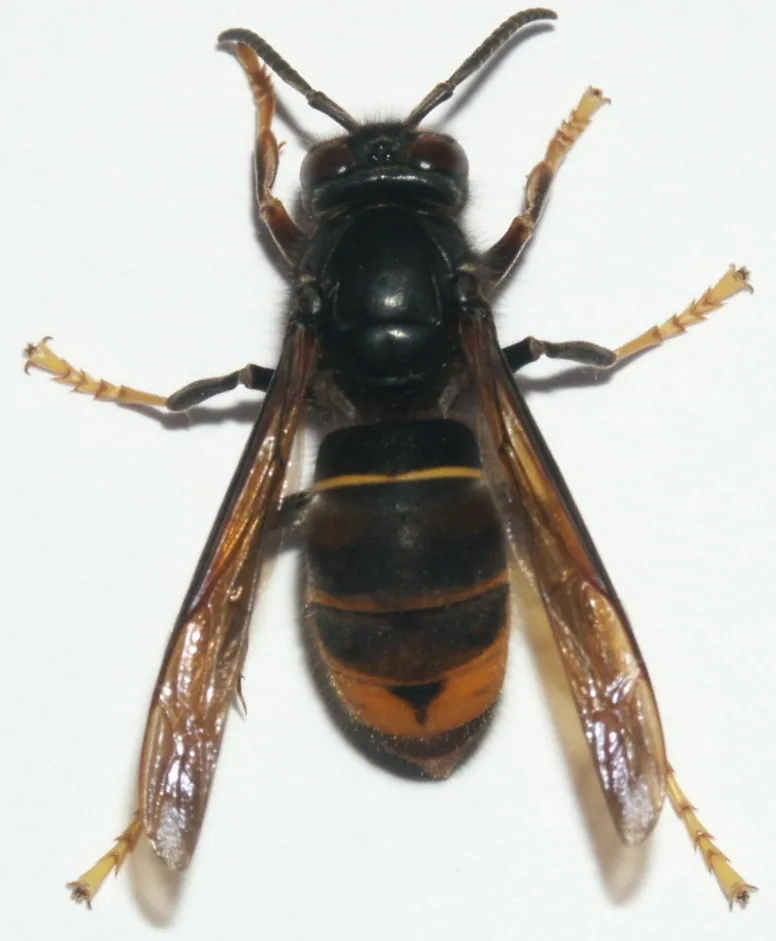
 Näin tunnistat sen
- Queens are about 3 cm long, males about 2.4 cm and workers about 2 cm, so it is significantly smaller than the European hornet.1
- Its legs (tarsi) are yellow, which gives it the name yellow-legged hornet.1
- The thorax is velvety brown or black, with a brown abdomen.1
- Each abdominal segment has a narrow yellow border at the back, except the fourth segment, which is orange.1
- The head is black and the face is yellow.1
Sekoitetaan usein: It looks like the European hornet (V. crabro), which is much larger. Its nest exit is usually on the side rather than at the bottom.1
Myrkkyvoima
Myrkky tulee ulos pistimestä.
Mitä sen myrkky tekee, kun se puree tai pistää?
Multiple stings have caused anaphylactic shock, a severe allergic reaction, in people who were hospitalised in France.1
Kuinka vaarallinen se on ihmisille?
Vaara ihmisille: KivuliasSe voi sattua tosi paljon, mutta se ei ole juuri koskaan vakavaa.Although the species is not aggressive, people have been attacked after disturbing nests. A man in Galicia, Spain, was killed in 2017 after being stung over 20 times while pruning an apple tree. Several people have died in south west France, including in 2019 and 2020. Because of its larger size, its stings are more serious than those of western honeybees.1
Mitä se tekee, kun se pelästyy?
When it feels its nest is threatened, it charges in a group.1
 Jos se pistää
- Raaputa mehiläisen pistin pois ja viilennä kohta.
- Jos henkilöllä on hengitysvaikeuksia, kasvojen tai kurkun turvotusta tai hän tuntee olevansa pyörtymäisillään, kyse on allergisesta hätätilanteesta: soita hätänumeroon ja käytä hänen adrenaliinikynäänsä, jos hänellä on sellainen.
Soita aina ensin hätänumeroon (112, 000, 911). Nämä ovat yleisiä ensiapuohjeita, eivät lääketieteellisiä neuvoja. Ensiavun perusteet
 Pysy turvassa
- Älä koskaan koske villieläimeen, pyydystä sitä tai kiusaa sitä, ei edes pientä, eikä silloinkaan, kun se näyttää nukkuvan tai olevan kuollut.
- Anna sille tilaa. Jos kohtaat sellaisen, pysy rauhallisena, peräänny hitaasti ja anna sen mennä omaa tietään.
- Jos sellainen pistää sinua: pysy rauhallisena, pysy paikallasi, soita hätänumeroon (112, 000, 911) tai mene nopeasti sairaalaan. Muista, miltä se näytti, valokuva auttaa.
Se ei ole sinun perässäsi. Se käyttää myrkkyään saadakseen ruokaa tai suojellakseen itseään, ja se piiloutuu paljon mieluummin. Lisää turvallisuudesta
Missä päin maailmaa?
Kuinka iso se on?
Kuinka pitkä se on?
 suunnilleen yhtä pitkä kuin paperiliitin
 voisi lentää kokonaisen jalkapallokentän yli 13 sekunnissa
Kuinka iso Asian hornet on SINUUN verrattuna?
Pelkkää matematiikkaa selaimessasi. Mitään ei tallenneta eikä lähetetä minnekään.
Kuinka nopea se on?


Faktat
In its native range, its main prey is the eastern honeybee, which defends the hive by balling hornets and raising the temperature inside the ball to a level that kills the hornet.1
A hornet hunting honeybees holds a territory of about 0.5 m² above a beehive and catches bees as they return to the hive.1
It is believed to have reached France in boxes of pottery from China in 2004.1
A colony often starts a nest in a low shrub, then abandons it after some months and builds a new one high in a tree, possibly to avoid parasites.1
Young queens leave the colony in late autumn and hibernate over winter.1
Myyttien murtaja
Myytti: Asian hornets are aggressive and will attack anyone who comes near.
Totuus: The species is not aggressive, but it will charge in a group when it feels its nest is threatened.1
Mistä tiedot ovat peräisin
- Asian hornet (Wikipedia (CC BY-SA 4.0))
- Vespa velutina (iNaturalist): nimet ja luokittelu.
- Venom Wiki: vaarataso, tyypillinen koko ja nopeusarvio ovat omia arvioitamme. Katso, miten laskemme ne: Näin arvioimme vaaran.
Jokaisella tämän sivun tiedolla on numero, joka viittaa sen lähteeseen. Jos jokin meni pieleen, anteeksi, olemme eläinfaneja emmekä tiedelehti. Kerro meille osoitteeseen [email protected], niin korjaamme sen.
 Skorpionilla on nälkä! Venom Wiki on yhden miehen projekti: ilmainen, ilman mainoksia ja ilman seurantaa. Pieni tippi auttaa pitämään sen verkossa.Ruoki skorpioni
Lisää samasta ryhmästä: Mehiläiset, ampiaiset ja herhiläiset
 Asian giant hornetMehiläiset, ampiaiset ja herhiläisetVoi tappaa
 Common waspMehiläiset, ampiaiset ja herhiläisetSattuu vain
 European hornetMehiläiset, ampiaiset ja herhiläisetSattuu vain
 Western honey beeMehiläiset, ampiaiset ja herhiläisetSattuu vain
 Giant honey beeMehiläiset, ampiaiset ja herhiläisetVaatii lääkäriä
 European paper waspMehiläiset, ampiaiset ja herhiläisetSattuu vain
 Keltainen skorpioni
 Silmälasikäärme
 Sahasuomukyy
 Kuningaskobra
 Puhkukyy
 Russellinkyy