
 Afrikka
 Aasia
Aasia Eurooppa
 Etelä-Amerikka
 Australia ja Oseania
 Etelämanner
 Tyynimeri
 Atlantti
 Intian valtameri
 Pohjoinen jäämeri
 Välimeri
 Punainenmeri
 Karibianmeri
 Korallimeri
 Etelä-Kiinan meri
 Filippiinienmeri
 Andamaanienmeri
 Pohjanmeri
 Timorinmeri ja Arafuranmeri
 Bengalinlahti
 Kalifornianlahti
Bengal slow loris
 Puremat
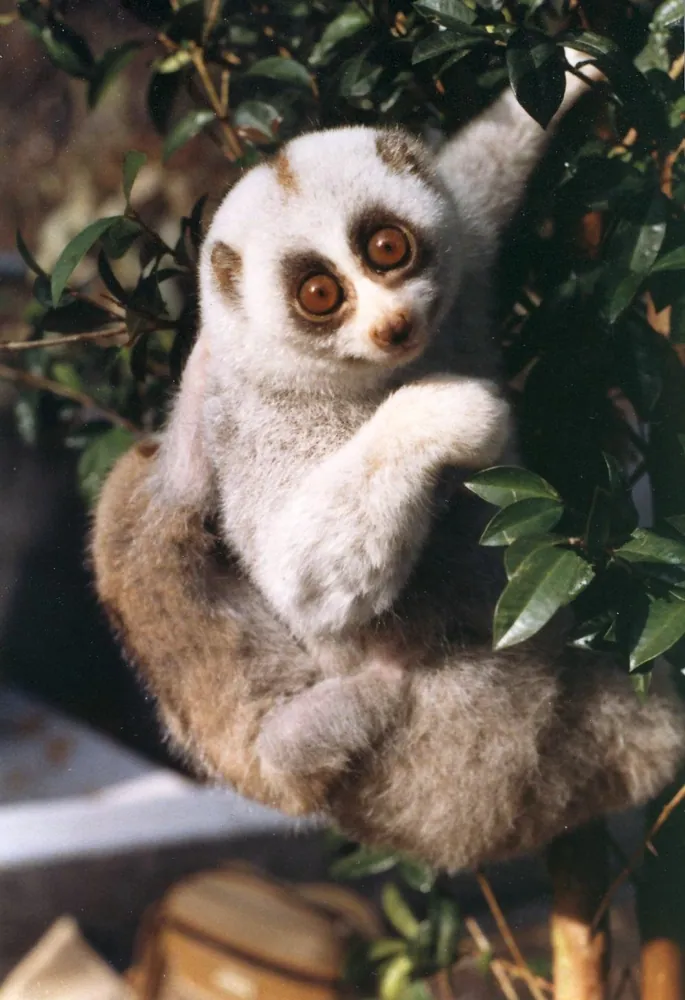
The Bengal slow loris is a small, nocturnal primate with big eyes and dense, woolly fur. It lives in forests across South and Southeast Asia, and it is the largest of the slow loris species. It is endangered, mainly because it is sold in animal markets and used in traditional medicine.1



 Näin tunnistat sen
- Dense, woolly brown-grey fur on its back, with white fur on its underside1
- A dark stripe running up to the top of its head, which does not reach the ears1
- Pale forearms and feet, with limbs that vary from brown to nearly white1
- A round head, flat face, large eyes that show a bright orange eye shine, and short ears1
- Body and head length of 26 to 38 cm1
Sekoitetaan usein: The Sunda slow loris is similar in size but is smaller and tawny- or golden-brown, without the pale head, nape and shoulders. The pygmy slow loris is much smaller, with dark brown fur, longer ears and no dark dorsal stripe.1
Myrkkyvoima
Myrkky tulee ulos myrkkyhampaista tai hampaista, kun se puree.
Mitä sen myrkky tekee, kun se puree tai pistää?
A small gland on the inside of the elbow produces a pungent, clear, oily toxin. The animal wipes this fluid onto its toothcomb as a defence. The main chemical in it is m-cresol, a phenolic compound, and the mixture contains several dozen volatile chemicals.1
Kuinka vaarallinen se on ihmisille?
Vaara ihmisille: KivuliasSe voi sattua tosi paljon, mutta se ei ole juuri koskaan vakavaa. Jos se puree
- Pese haava hyvin ja hae lääkärin apua.
Soita aina ensin hätänumeroon (112, 000, 911). Nämä ovat yleisiä ensiapuohjeita, eivät lääketieteellisiä neuvoja. Ensiavun perusteet
 Pysy turvassa
- Älä koskaan koske villieläimeen, pyydystä sitä tai kiusaa sitä, ei edes pientä, eikä silloinkaan, kun se näyttää nukkuvan tai olevan kuollut.
- Anna sille tilaa. Jos kohtaat sellaisen, pysy rauhallisena, peräänny hitaasti ja anna sen mennä omaa tietään.
- Jos sellainen puree sinua: pysy rauhallisena, pysy paikallasi, soita hätänumeroon (112, 000, 911) tai mene nopeasti sairaalaan. Muista, miltä se näytti, valokuva auttaa.
Se ei ole sinun perässäsi. Se käyttää myrkkyään saadakseen ruokaa tai suojellakseen itseään, ja se piiloutuu paljon mieluummin. Lisää turvallisuudesta
Missä päin maailmaa?
Kuinka iso se on?
Kuinka pitkä se on?
Kuinka painava se on?

 yhtä pitkä kuin 12 rakennuspalikkaa rivissä
 suunnilleen yhtä painava kuin kotikissa
 voisi juosta 100 metriä 180 sekunnissa (nopein ihminen tarvitsee 9,6)
Kuinka iso Bengal slow loris on SINUUN verrattuna?
Pelkkää matematiikkaa selaimessasi. Mitään ei tallenneta eikä lähetetä minnekään.
Kuinka nopea se on?


Faktat
Its toxin may carry information about a loris's sex, age, health and social status, so it may act as a form of scent communication.1
It is the largest species of slow loris.1
Its second hind toe has a curved toilet-claw that it uses for scratching and grooming, while its other nails are straight.1
It has an excellent night vision, helped by a tapetum lucidum, a reflective layer in the eye.1
Females can have a new offspring every 12 to 18 months, and could even become pregnant again when the previous young is about six months old.1
It is an important seed disperser and pollinator, and it is also prey for several carnivores.1
Myrkkyasiantuntijoille
- Tieteellinen nimi
- Nycticebus bengalensis
- Ryhmä
- Myrkylliset nisäkkäät
- Perhe
- Lorisidae2
- Järjestys
- Primates
- Maanosat
- Aasia
- Vauvat
- It usually gives birth to a single offspring after a six-month pregnancy, and twins are rare. The mother carries the young for about three months, and it becomes independent at around three months of age.1
- Elinikä
- noin 20 vuotta1
- Miten sillä menee luonnossa
- Endangered1
- Vaara ihmisille
- 2 / 5: Kivulias3
Mistä tiedot ovat peräisin
- Bengal slow loris (Wikipedia (CC BY-SA 4.0))
- Nycticebus bengalensis (iNaturalist): nimet ja luokittelu.
- Venom Wiki: vaarataso, tyypillinen koko ja nopeusarvio ovat omia arvioitamme. Katso, miten laskemme ne: Näin arvioimme vaaran.
Jokaisella tämän sivun tiedolla on numero, joka viittaa sen lähteeseen. Jos jokin meni pieleen, anteeksi, olemme eläinfaneja emmekä tiedelehti. Kerro meille osoitteeseen [email protected], niin korjaamme sen.
 Skorpionilla on nälkä! Venom Wiki on yhden miehen projekti: ilmainen, ilman mainoksia ja ilman seurantaa. Pieni tippi auttaa pitämään sen verkossa.Ruoki skorpioni
Lisää samasta ryhmästä: Myrkylliset nisäkkäät
 Javan slow lorisMyrkylliset nisäkkäätSattuu vain
 Pygmy slow lorisMyrkylliset nisäkkäätSattuu vain
 Sunda slow lorisMyrkylliset nisäkkäätSattuu vain
 Kayan River slow lorisMyrkylliset nisäkkäätSattuu vain
 Philippine slow lorisMyrkylliset nisäkkäätSattuu vain
 Eurasian water shrewMyrkylliset nisäkkäätVaaraton
 Keltainen skorpioni
 Silmälasikäärme
 Sahasuomukyy
 Kuningaskobra
 Puhkukyy
 Russellinkyy