
 Afrique
 Asie
Asie Europe
 Amérique du Sud
 Australie et Océanie
 Antarctique
 Océan Pacifique
 Océan Atlantique
 Océan Indien
 Océan Arctique
 Mer Méditerranée
 Mer Rouge
 Mer des Caraïbes
 Mer de Corail
 Mer de Chine méridionale
 Mer des Philippines
 Mer d'Andaman
 Mer du Nord
 Mer de Timor et d'Arafura
 Golfe du Bengale
 Golfe de Californie
African crested rat
 Poison dans la peau
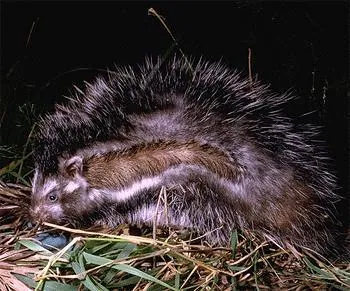
The African crested rat is a large, nocturnal rodent with long hair and a bushy tail. It looks a little like a porcupine. It lives in East Africa, where it is the world's only known poisonous rodent, coating itself in plant toxins to keep predators away.1



 Comment le reconnaître
- Large, nocturnal rodent with long, silver and black-tipped guard hairs over a woolly grey and white undercoat1
- A mane of longer black-and-white banded hairs runs from the top of the head to just beyond the base of the tail1
- A broad, white-bordered strip of glandular skin sits beside the mane, and it becomes visible when the animal is threatened1
- Bushy tail and short black fur on the face and limbs1
- Superficially resembles a porcupine1
Puissance du poison
Sa peau est toxique. Il est dangereux de le toucher, de le lécher ou de le manger.
Que fait son poison ?
This animal is poisonous rather than venomous, so it does not bite or sting to inject poison. It smears poison from the bark of the poison arrow tree onto the hairs of its glandular skin patch. A predator that bites it can be sickened or even killed by this poison.1
À quel point est-il dangereux pour l'homme ?
Danger pour l'homme: GraveSi quelqu'un le touche ou le mange, il faut voir un médecin. Les décès sont très rares.Its poison is a risk to predators that try to bite it. The rat itself is not harmed by the toxins it stores.1
Que fait-il quand il a peur ?
When threatened or excited, the mane stands up and the glandular strip parts, exposing the skin that carries the poison.1
 Si quelqu'un l'a touché ou mangé
- Si quelqu'un l'a mangé ou a des symptômes après en avoir mangé : appelle tout de suite ton numéro d'urgence ou le centre antipoison.
Appelle toujours d'abord ton numéro d'urgence (112, 000, 911). Ce sont des conseils généraux de premiers secours, pas un avis médical. Les bases des premiers secours
 Reste en sécurité
- Ne touche, n'attrape et n'embête jamais un animal sauvage, même petit, et même s'il a l'air endormi ou mort.
- Laisse-lui de la place. Si tu en croises un, reste calme, recule doucement et laisse-le passer son chemin.
- Si tu l'as touché ou mangé : ne frotte pas tes yeux ni ta bouche, lave-toi les mains et va voir un médecin.
Il ne t'en veut pas. Son poison ne sert qu'à ce que personne ne le mange. Plus d'infos pour rester en sécurité
Où dans le monde ?
Quelle taille fait-il ?
Quelle longueur fait-il ?
Combien pèse-t-il ?

 aussi long que 10 briques de construction en ligne
 pourrait parcourir 100 mètres en 72 secondes (l'humain le plus rapide met 9,6)
Quelle taille fait African crested rat comparé à TOI ?
Juste des calculs dans ton navigateur. Rien n'est enregistré ni envoyé nulle part.
À quelle vitesse va-t-il ?


Faits
It is the world's only known poisonous rodent.1
It is the only rodent known to use and store toxins from a different species in nature to protect itself, and it suffers no known harm from them.1
Its stomach has five anatomically distinct sections, a feature found in very few rodents.1
The skull is covered with small bony projections that give it a pebbled look.1
Its large size may allow microbes in its foregut to break down cellulose from plants by fermentation.1
Démêle le vrai du faux
Idée reçue : The maned rat was believed to be solitary.
Vérité : It is now known to be somewhat sociable. Several animals are found in the same territory, and they purr and groom one another, so they may form family groups of a male, a female and their young.1
Pour les experts en venin
- Nom scientifique
- Lophiomys imhausi
- Groupe
- Autres animaux vénéneux
- Famille
- Muridae2
- Ordre
- Rodentia
- Continents
- Afrique
- Petits
- Litters have 1 to 3 young. The young are slightly haired at birth, their eyes open by day 13, and they are weaned by day 40.1
- Comment il se porte dans la nature
- Least Concern1
- Danger pour l'homme
- 3 / 5: Grave3
D'où viennent les faits
- Maned rat (Wikipedia (CC BY-SA 4.0))
- Lophiomys imhausi (iNaturalist): noms et classification.
- Venom Wiki: le niveau de danger, la taille typique et la vitesse estimée sont les nôtres. Regarde comment on les calcule : Comment on évalue le danger.
Chaque fait sur cette page a un numéro qui renvoie à sa source. Si on s'est trompés, désolés, on est des fans d'animaux, pas une revue scientifique. Dis-le-nous à [email protected] et on corrigera.
 Le scorpion a faim ! Venom Wiki est le projet d'une seule personne : gratuit, sans pub et sans traceurs. Un petit pourboire aide à le garder en ligne.Nourris le scorpion
Plus du même groupe: Autres animaux vénéneux
 Common quailAutres animaux vénéneuxFait juste mal
 Spur-winged gooseAutres animaux vénéneuxFait juste mal
 Fahaka pufferfishAutres animaux vénéneuxPeut tuer
 Red-striped oil beetleAutres animaux vénéneuxFait juste malNe pas toucher
 Fugu tigreAutres animaux vénéneuxMortel
 Hawksbill sea turtleAutres animaux vénéneuxPeut tuer
 Mamba noir
 Scorpion jaune de Palestine
 Cobra égyptien
 Vipère heurtante
 Boomslang
 Fat-tailed scorpion