
 Afrique
 Asie
Asie Europe
 Amérique du Sud
 Australie et Océanie
 Antarctique
 Océan Pacifique
 Océan Atlantique
 Océan Indien
 Océan Arctique
 Mer Méditerranée
 Mer Rouge
 Mer des Caraïbes
 Mer de Corail
 Mer de Chine méridionale
 Mer des Philippines
 Mer d'Andaman
 Mer du Nord
 Mer de Timor et d'Arafura
 Golfe du Bengale
 Golfe de Californie
Ashe's spitting cobra
 Projette ou crache
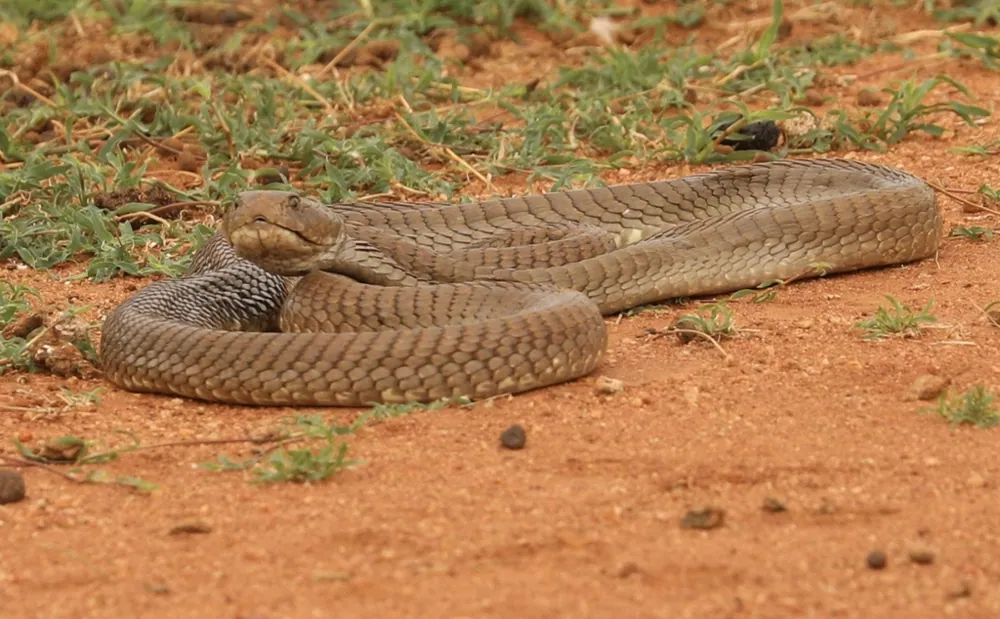
Ashe's spitting cobra is a large venomous snake from eastern and northeastern Africa. It is the largest of all the spitting cobras, and it can spray venom from a distance as well as bite. Its venom can cause blindness if it gets into the eyes and not treated at once.1
 Comment le reconnaître
- Very heavily built, with a big head1
- Colour ranges from light grey and pale mustard to dark brown1
- Pale along the belly, sometimes with slight speckling or blotches1
- A dark brown band across the throat1
- Average length about 1.3 to 2.0 m including the tail, making it the largest spitting cobra1
Souvent confondu avec : It was once thought to be a brown form of the black-necked spitting cobra. It was classed as a separate species in 2007.1
Puissance du venin
Il projette ou crache un liquide irritant sur ses attaquants.
Que fait son venin ?
Its venom is neurotoxic, meaning it attacks the nerves, and cytotoxic, meaning it destroys cells. It is very similar to the venom of other spitting cobras, but it can inject a much larger volume in one bite. Its venom also causes strong tissue death around a wound.1
À quel point est-il dangereux pour l'homme ?
Danger pour l'homme: Très dangereuxIl peut tuer une personne qui n'est pas soignée.The venom has low whole-body toxicity, so survival is very likely with proper treatment. Survivors may be left disfigured by tissue damage. If venom gets into the eyes and is not treated immediately, blindness is likely. Even with antivenom, amputation may be needed after a full dose from a large specimen.1
 Bonne nouvelle : les médecins ont un médicament (antivenin) ou un traitement pour ça.1
Que fait-il quand il a peur ?
It is very defensive and does not hesitate to spit when it feels cornered. It can keep spitting for hours without running out of venom straight away.1
 S'il mord ou crache
- If venom gets into the eyes, rinse them straight away with water or another bland liquid, as delay can cause permanent blindness. Whether the person has been bitten or spat at, they should see a doctor as soon as possible. Treatment is the appropriate antivenom, SAVP polyvalent from South African Vaccine Producers, and the dose may need to be higher than for the average black-necked spitting cobra bite.1
- Garde la personne immobile et calme, enlève bagues et objets serrés, et va vite à l'hôpital : le traitement, c'est l'antivenin.
- Si du venin a été craché dans les yeux, rince-les tout de suite avec beaucoup d'eau propre.
Appelle toujours d'abord ton numéro d'urgence (112, 000, 911). Ce sont des conseils généraux de premiers secours, pas un avis médical. Les bases des premiers secours
 Reste en sécurité
- Ne touche, n'attrape et n'embête jamais un animal sauvage, même petit, et même s'il a l'air endormi ou mort.
- Laisse-lui de la place. Si tu en croises un, reste calme, recule doucement et laisse-le passer son chemin.
- S'il te mord ou te crache du venin dans les yeux : reste calme, ne bouge pas, appelle ton numéro d'urgence (112, 000, 911) ou va vite à l'hôpital. Souviens-toi de quoi il avait l'air, une photo aide.
Il ne t'en veut pas. Il utilise son venin pour attraper sa nourriture ou se protéger, et il préfère de loin se cacher. Plus d'infos pour rester en sécurité
Où dans le monde ?
Quelle taille fait-il ?
Quelle longueur fait-il ?
 aussi long que 2,5 chiens du museau à la queue
 aussi long que 15 bananes mises bout à bout
 pourrait parcourir 100 mètres en 41 secondes (l'humain le plus rapide met 9,6)
Quelle taille fait Ashe's spitting cobra comparé à TOI ?
Juste des calculs dans ton navigateur. Rien n'est enregistré ni envoyé nulle part.
À quelle vitesse va-t-il ?


Faits
It is the world's largest species of spitting cobra.1
It can spit venom in large amounts for hours.1
The largest specimen recorded, caught in Kenya, measured 270 cm in total length.1
One milked specimen at the Bio-Ken Snake Farm in 2004 produced a wet venom yield of 6.2 ml.1
It is most closely related to the Mozambique spitting cobra.1
Démêle le vrai du faux
Idée reçue : It is just a brown form of the black-necked spitting cobra.
Vérité : It was classed as a separate species in 2007, after experts recognised its differences from other spitting cobras.1
D'où viennent les faits
- Naja ashei (Wikipedia (CC BY-SA 4.0))
- Naja ashei (iNaturalist): noms et classification.
- Venom Wiki: le niveau de danger, la taille typique et la vitesse estimée sont les nôtres. Regarde comment on les calcule : Comment on évalue le danger.
Chaque fait sur cette page a un numéro qui renvoie à sa source. Si on s'est trompés, désolés, on est des fans d'animaux, pas une revue scientifique. Dis-le-nous à [email protected] et on corrigera.
 Le scorpion a faim ! Venom Wiki est le projet d'une seule personne : gratuit, sans pub et sans traceurs. Un petit pourboire aide à le garder en ligne.Nourris le scorpion
 Mamba noir
 Cobra égyptien
 Cape cobra
 Eastern green mamba
 Jameson's mamba
 Western green mamba
 Scorpion jaune de Palestine
 Vipère heurtante
 Boomslang
 Fat-tailed scorpion
 Gaboon viper
 Western honey bee