
 Afrique
 Asie
Asie Europe
 Amérique du Sud
 Australie et Océanie
 Antarctique
 Océan Pacifique
 Océan Atlantique
 Océan Indien
 Océan Arctique
 Mer Méditerranée
 Mer Rouge
 Mer des Caraïbes
 Mer de Corail
 Mer de Chine méridionale
 Mer des Philippines
 Mer d'Andaman
 Mer du Nord
 Mer de Timor et d'Arafura
 Golfe du Bengale
 Golfe de Californie
Baja California bark scorpion
 Piqûres
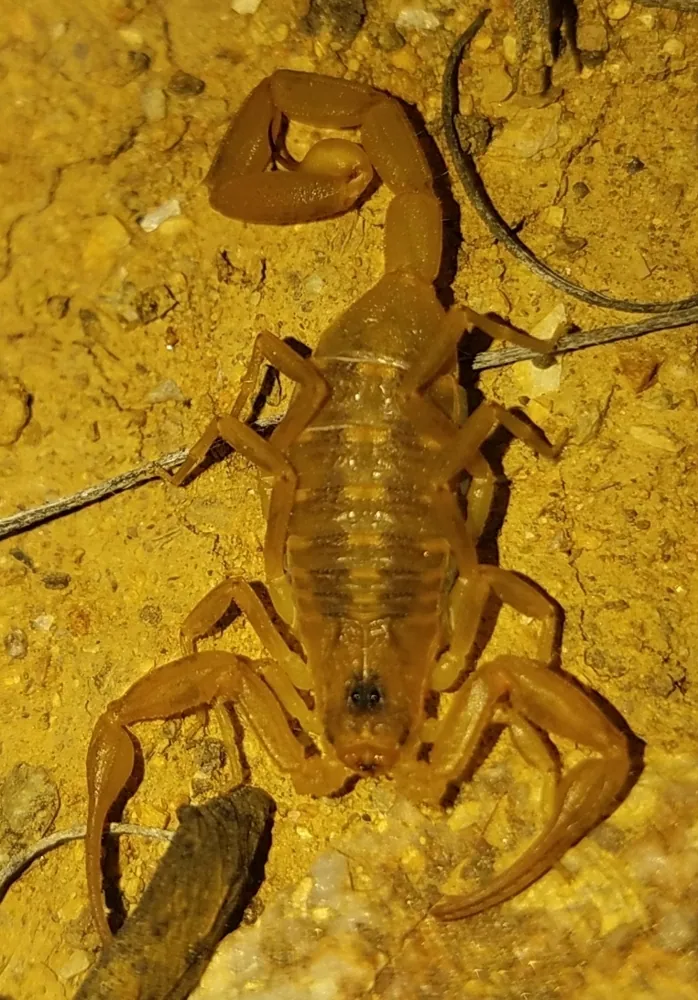
The Baja California bark scorpion is a slender scorpion with a long tail. It lives in the western deserts and wet places of North America, mainly in Baja California. It matters because it is closely related to the Arizona bark scorpion, and scientists only confirmed in 2004 that the two are separate species.1


 Comment le reconnaître
- Slender body with a long tail1
- Typically sand-coloured, though it can appear darker1
- Exoskeleton can be yellow, light brown or gold1
- Body length of about 3.8 to 7.6 cm1
- Rests its tail on the ground, unlike other scorpions that hold it arched over the back. It also has a subaculear tooth at the tip of its stinger1
Souvent confondu avec : It is closely related to the Arizona bark scorpion, and their body shapes can be almost impossible to tell apart. Differences in venom and DNA are used to separate the two species. The subaculear tooth at the tip of the stinger and the way the tail rests on the ground are the main features that set it apart from other scorpions.1
Puissance du venin
Le venin sort par un dard.
Que fait son venin ?
It uses venom to hunt, injecting it into prey to immobilise or kill it. Each scorpion species has a unique venom profile, which is used to tell species apart. In humans, its venom may cause difficulty breathing or muscle spasms.1
À quel point est-il dangereux pour l'homme ?
Danger pour l'homme: DouloureuxÇa peut faire très mal, mais ce n'est presque jamais grave.Its venom has the potential to be fatal to humans, but the chances of this happening are low. It is not considered dangerous, and it is less of a medical threat than its close relative, the Arizona bark scorpion.1
 S'il pique
- Refroidis la piqûre avec de la glace et garde la personne immobile. Va vite voir un médecin, surtout pour les enfants : certains scorpions sont mortels pour eux.
Appelle toujours d'abord ton numéro d'urgence (112, 000, 911). Ce sont des conseils généraux de premiers secours, pas un avis médical. Les bases des premiers secours
 Reste en sécurité
- Ne touche, n'attrape et n'embête jamais un animal sauvage, même petit, et même s'il a l'air endormi ou mort.
- Laisse-lui de la place. Si tu en croises un, reste calme, recule doucement et laisse-le passer son chemin.
- S'il te pique : reste calme, ne bouge pas, appelle ton numéro d'urgence (112, 000, 911) ou va vite à l'hôpital. Souviens-toi de quoi il avait l'air, une photo aide.
Il ne t'en veut pas. Il utilise son venin pour attraper sa nourriture ou se protéger, et il préfère de loin se cacher. Plus d'infos pour rester en sécurité
Où dans le monde ?
Quelle taille fait-il ?
Quelle longueur fait-il ?
 aussi long que 2,5 briques de construction en ligne
 pourrait parcourir 100 mètres en 260 secondes (l'humain le plus rapide met 9,6)
Quelle taille fait Baja California bark scorpion comparé à TOI ?
Juste des calculs dans ton navigateur. Rien n'est enregistré ni envoyé nulle part.
À quelle vitesse va-t-il ?


Faits
Démêle le vrai du faux
Idée reçue : It is the same species as the Arizona bark scorpion.
Vérité : The two were grouped as one species in 1980, but differences in venom toxicity and DNA analysis in 2004 showed they are separate species.1
D'où viennent les faits
- Centruroides exilicauda (Wikipedia (CC BY-SA 4.0))
- Centruroides exilicauda (iNaturalist): noms et classification.
- Venom Wiki: le niveau de danger, la taille typique et la vitesse estimée sont les nôtres. Regarde comment on les calcule : Comment on évalue le danger.
Chaque fait sur cette page a un numéro qui renvoie à sa source. Si on s'est trompés, désolés, on est des fans d'animaux, pas une revue scientifique. Dis-le-nous à [email protected] et on corrigera.
 Le scorpion a faim ! Venom Wiki est le projet d'une seule personne : gratuit, sans pub et sans traceurs. Un petit pourboire aide à le garder en ligne.Nourris le scorpion
 Arizona bark scorpion
 Cuban blue scorpion
 Striped bark scorpion
 Giant desert hairy scorpion
 Colima scorpion
 Durango scorpion
 Fer-de-lance d'Amérique centrale
 Eastern coral snake
 Eastern diamondback rattlesnake
 Eyelash viper
 Timber rattlesnake
 Western diamondback rattlesnake
.jpg)