
 Afrique
 Asie
Asie Europe
 Amérique du Sud
 Australie et Océanie
 Antarctique
 Océan Pacifique
 Océan Atlantique
 Océan Indien
 Océan Arctique
 Mer Méditerranée
 Mer Rouge
 Mer des Caraïbes
 Mer de Corail
 Mer de Chine méridionale
 Mer des Philippines
 Mer d'Andaman
 Mer du Nord
 Mer de Timor et d'Arafura
 Golfe du Bengale
 Golfe de Californie
Black long-spined urchin
 Épines venimeuses
The black long-spined urchin is a sea urchin with very long, hollow spines. It lives on coral reefs, sand flats and seagrass beds across the Indo-Pacific, and it is one of the most widespread sea urchins in that region. Its spines can deliver a mild venom, so it is best to watch where you put your feet.1


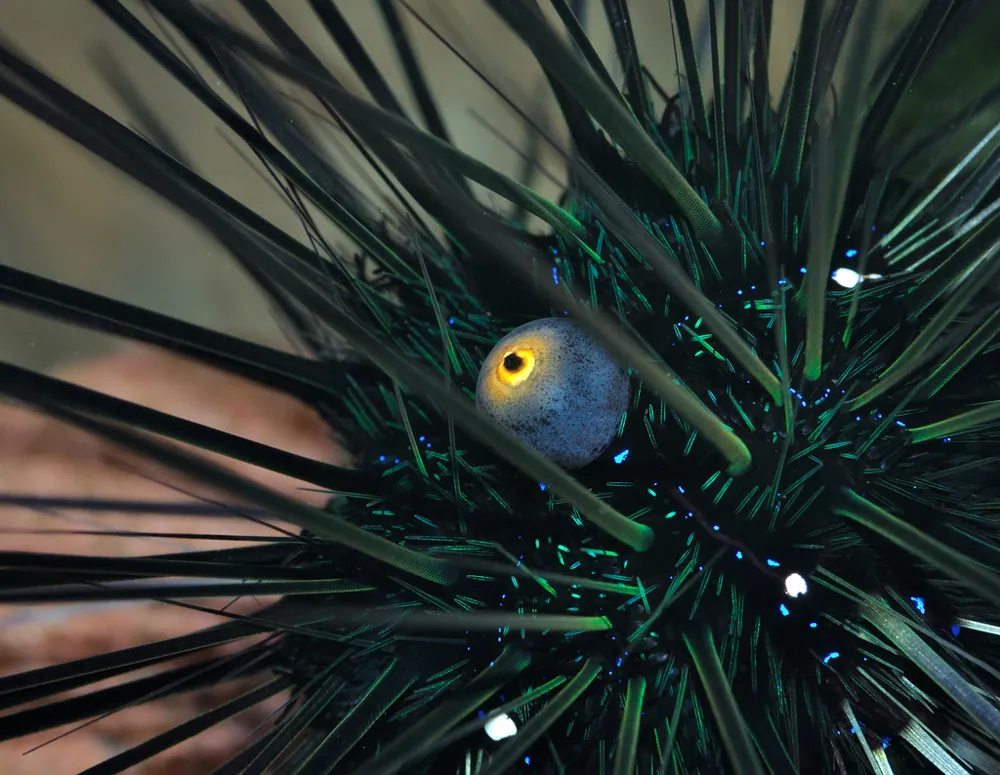
 Comment le reconnaître
- Black, near-spherical body (test) with extremely long, narrow, hollow spines, often black but sometimes brown-banded1
- Five white spots on the body, which separate it from other Diadema species1
- A bright orange ring around the periproctal cone (the 'anal cone'), which is often mistaken for an eye1
- Bluish spots on the genital plates and a line of blue spots along the body1
- Adults are no more than 70 mm across the body and about 40 mm high1
Souvent confondu avec : Other Diadema species are similar in shape and spines, but they lack the five white spots that mark this species. Its orange ring and blue spots also help to tell it apart.1
Puissance du venin
Des épines pointues portent le venin. Marcher dessus ou l'attraper fait mal.
Que fait son venin ?
The spines are hollow and contain a mild venom. The toxin mostly causes swelling and pain, which spreads gradually over several hours. The venom is not fatal to humans. The spines themselves are a bigger problem, because they are brittle and needle-like, break off in flesh and are difficult to remove.1
À quel point est-il dangereux pour l'homme ?
Danger pour l'homme: DouloureuxÇa peut faire très mal, mais ce n'est presque jamais grave.The venom is only mild, and the species is not considered a serious threat to humans. Stepping on it can cause painful stings.1
Que fait-il quand il a peur ?
When threatened by a sudden impact or by spines snapping, it rapidly flips its body over and 'runs' on the tips of its longest spines.1
 Si ses épines s'enfoncent dans ta peau
- Plonge la plaie dans de l'eau chaude, aussi chaude que la personne peut supporter sans se brûler, et va voir un médecin pour enlever les épines. Ne les retire pas toi-même.
Appelle toujours d'abord ton numéro d'urgence (112, 000, 911). Ce sont des conseils généraux de premiers secours, pas un avis médical. Les bases des premiers secours
 Reste en sécurité
- Ne touche, n'attrape et n'embête jamais un animal sauvage, même petit, et même s'il a l'air endormi ou mort.
- Laisse-lui de la place. Si tu en croises un, reste calme, recule doucement et laisse-le passer son chemin.
- Si ses épines s'enfoncent dans ta peau : reste calme, ne bouge pas, appelle ton numéro d'urgence (112, 000, 911) ou va vite à l'hôpital. Souviens-toi de quoi il avait l'air, une photo aide.
Il ne t'en veut pas. Il utilise son venin pour attraper sa nourriture ou se protéger, et il préfère de loin se cacher. Plus d'infos pour rester en sécurité
Où dans le monde ?
Quelle taille fait-il ?
Quelle longueur fait-il ?
Combien pèse-t-il ?

 aussi long que 2 briques de construction en ligne
 plus lent qu'un escargot de jardin
Quelle taille fait Black long-spined urchin comparé à TOI ?
Juste des calculs dans ton navigateur. Rien n'est enregistré ni envoyé nulle part.
À quelle vitesse va-t-il ?

Faits
It can move 760 mm in just 7 seconds by rolling and walking on the tips of its spines.1
It has no eye, but it has a diffuse light-sensing system that lets it detect light levels and the size and colour of objects.1
In 2006, living specimens were found off Turkey, making it the first invasive Erythrean sea urchin recorded in the Mediterranean.1
Goose barnacles of the genus Microlepas are known to live on it as parasites.1
It is considered one of the oldest living species in its genus, Diadema.1
Démêle le vrai du faux
Idée reçue : Black long-spined urchins are deadly and their stings can kill people.
Vérité : Their venom is mild and is not fatal to humans. The main problems are pain, swelling and spines that break off in the skin.1
Pour les experts en venin
- Nom scientifique
- Diadema setosum
- Groupe
- Oursins, étoiles et vers
- Famille
- Diadematidae2
- Ordre
- Diadematoida
- Continents
- Océan Indien, Océan Pacifique, Mer Rouge, Mer de Corail, Mer des Philippines, Mer d'Arabie et golfe Persique, Mer de Timor et d'Arafura, Golfe du Bengale, Les océans
- Petits
- It is a broadcast spawner, releasing eggs and sperm into the water. Spawning happens seasonally or year-round depending on the location, and in some places it follows the full moon.1
- Danger pour l'homme
- 2 / 5: Douloureux3
D'où viennent les faits
- Diadema setosum (Wikipedia (CC BY-SA 4.0))
- Diadema setosum (iNaturalist): noms et classification.
- Venom Wiki: le niveau de danger, la taille typique et la vitesse estimée sont les nôtres. Regarde comment on les calcule : Comment on évalue le danger.
Chaque fait sur cette page a un numéro qui renvoie à sa source. Si on s'est trompés, désolés, on est des fans d'animaux, pas une revue scientifique. Dis-le-nous à [email protected] et on corrigera.
 Le scorpion a faim ! Venom Wiki est le projet d'une seule personne : gratuit, sans pub et sans traceurs. Un petit pourboire aide à le garder en ligne.Nourris le scorpion
Plus du même groupe: Oursins, étoiles et vers
 Crown-of-thorns starfishOursins, étoiles et versNécessite un médecinNe pas toucher
 Flower urchinOursins, étoiles et versPeut tuer
 Fire urchinOursins, étoiles et versNécessite un médecinNe pas toucher
 Bearded firewormOursins, étoiles et versFait juste malNe pas toucher
 BloodwormOursins, étoiles et versFait juste mal
 Bobbit wormOursins, étoiles et versFait juste mal
Vit aussi en: Océan Indien
 Guêpe de merMéduses et piqueurs marinsMortelNe pas toucher
 Cône géographeCônes et pieuvresMortel
 Grand poulpe à anneaux bleusCônes et pieuvresMortel
 Poulpe à anneaux bleus du SudCônes et pieuvresMortel
 Hawksbill sea turtleAutres animaux vénéneuxPeut tuer
 Irukandji jellyfishMéduses et piqueurs marinsPeut tuerNe pas toucher