
 Afrique
 Asie
Asie Europe
 Amérique du Sud
 Australie et Océanie
 Antarctique
 Océan Pacifique
 Océan Atlantique
 Océan Indien
 Océan Arctique
 Mer Méditerranée
 Mer Rouge
 Mer des Caraïbes
 Mer de Corail
 Mer de Chine méridionale
 Mer des Philippines
 Mer d'Andaman
 Mer du Nord
 Mer de Timor et d'Arafura
 Golfe du Bengale
 Golfe de Californie
Black-necked spitting cobra
 Projette ou crache
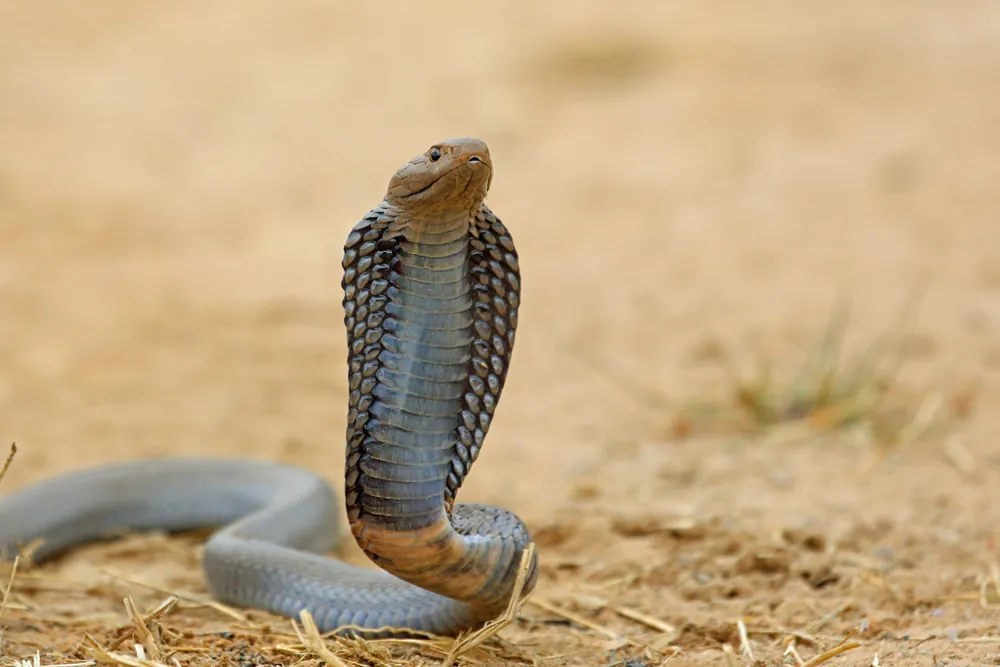
The black-necked spitting cobra is a venomous snake found mostly in sub-Saharan Africa. It can squirt venom from its fangs at a threat, and that venom can cause permanent blindness if it gets into the eyes. Its colours vary a lot from place to place.1



 Comment le reconnaître
- Moderately sized, with a moderately distinct head, and grows to 1.2 to 2.2 metres.1
- Many specimens have a broad black neck band, often with an orange or pinkish bar on the neck.1
- Colours vary by region: black or pale grey, yellowish-brown, deep reddish-brown, olive brown, striped black and white, or totally white with dark eyes.1
- Some have a yellow or reddish belly, while others lack the neck bands and belly colour.1
Puissance du venin
Il projette ou crache un liquide irritant sur ses attaquants.
Que fait son venin ?
Its venom is mostly cytotoxic, meaning it destroys cells, and it also has typical elapid neurotoxic (nerve-attacking) effects and cardiotoxic (heart-damaging) components. A bite causes severe bleeding from the wound, tissue death around the bite, and difficulty breathing. Venom in the eyes causes extreme burning pain, loss of coordination, partial loss of vision, and permanent blindness.1
À quel point est-il dangereux pour l'homme ?
Danger pour l'homme: Très dangereuxIl peut tuer une personne qui n'est pas soignée.Its venom is medically significant. The death rate for untreated bites is about 5 to 10%, and under 1% in areas where it is common. When death occurs, it is usually from paralysis of the diaphragm, the muscle used for breathing.1
Que fait-il quand il a peur ?
It spits venom from its fangs at a threat, reaching up to 7 metres with good accuracy. It also bites readily, even with only slight provocation.1
 S'il mord ou crache
- If venom gets into the eyes, it should be washed off, because permanent blindness can follow if it is not. Anyone bitten should get medical treatment, as untreated bites carry a much higher risk of death.1
- Garde la personne immobile et calme, enlève bagues et objets serrés, et va vite à l'hôpital : le traitement, c'est l'antivenin.
- Si du venin a été craché dans les yeux, rince-les tout de suite avec beaucoup d'eau propre.
Appelle toujours d'abord ton numéro d'urgence (112, 000, 911). Ce sont des conseils généraux de premiers secours, pas un avis médical. Les bases des premiers secours
 Reste en sécurité
- Ne touche, n'attrape et n'embête jamais un animal sauvage, même petit, et même s'il a l'air endormi ou mort.
- Laisse-lui de la place. Si tu en croises un, reste calme, recule doucement et laisse-le passer son chemin.
- S'il te mord ou te crache du venin dans les yeux : reste calme, ne bouge pas, appelle ton numéro d'urgence (112, 000, 911) ou va vite à l'hôpital. Souviens-toi de quoi il avait l'air, une photo aide.
Il ne t'en veut pas. Il utilise son venin pour attraper sa nourriture ou se protéger, et il préfère de loin se cacher. Plus d'infos pour rester en sécurité
Où dans le monde ?
Quelle taille fait-il ?
Quelle longueur fait-il ?
 aussi long que 4 chats domestiques du museau à la queue
 aussi long que 12 bananes mises bout à bout
 pourrait parcourir 100 mètres en 46 secondes (l'humain le plus rapide met 9,6)
Quelle taille fait Black-necked spitting cobra comparé à TOI ?
Juste des calculs dans ton navigateur. Rien n'est enregistré ni envoyé nulle part.
À quelle vitesse va-t-il ?


Faits
It can spit venom accurately more than 7 metres away.1
In 1944, a British eye surgeon, Major Harold Ridley, described eye damage from a spit from this cobra in Ghana. He treated the man and followed his case until the eye fully recovered.1
A single bite can deliver 200 to 350 mg of venom (dry weight), according to a 1974 study by Minton.1
It is an excellent tree climber and can live in trees at times.1
Wild-caught individuals tend to be nervous and spit readily, while captive-bred animals are much calmer.1
It can be active at night or during the day, depending on the season, location and temperature.1
Démêle le vrai du faux
Idée reçue : Spitting cobras only spit venom and do not bite.
Vérité : The black-necked spitting cobra also bites, and it will do so with only slight provocation.1
Pour les experts en venin
- Nom scientifique
- Naja nigricollis
- Groupe
- Cobras, mambas et bongares
- Famille
- Elapidae2
- Ordre
- Squamata
- Continents
- Afrique
- Petits
- Females usually lay 10 to 15 eggs, though they can lay between 8 and 22. The young are about 20 to 25 cm long at birth and are fully independent.1
- Danger pour l'homme
- 4 / 5: Très dangereux3
D'où viennent les faits
- Black-necked spitting cobra (Wikipedia (CC BY-SA 4.0))
- Naja nigricollis (iNaturalist): noms et classification.
- Venom Wiki: le niveau de danger, la taille typique et la vitesse estimée sont les nôtres. Regarde comment on les calcule : Comment on évalue le danger.
Chaque fait sur cette page a un numéro qui renvoie à sa source. Si on s'est trompés, désolés, on est des fans d'animaux, pas une revue scientifique. Dis-le-nous à [email protected] et on corrigera.
 Le scorpion a faim ! Venom Wiki est le projet d'une seule personne : gratuit, sans pub et sans traceurs. Un petit pourboire aide à le garder en ligne.Nourris le scorpion
 Mamba noir
 Cobra égyptien
 Cape cobra
 Eastern green mamba
 Jameson's mamba
 Western green mamba
 Scorpion jaune de Palestine
 Vipère heurtante
 Boomslang
 Fat-tailed scorpion
 Gaboon viper
 Western honey bee