
 Afrique
 Asie
Asie Europe
 Amérique du Sud
 Australie et Océanie
 Antarctique
 Océan Pacifique
 Océan Atlantique
 Océan Indien
 Océan Arctique
 Mer Méditerranée
 Mer Rouge
 Mer des Caraïbes
 Mer de Corail
 Mer de Chine méridionale
 Mer des Philippines
 Mer d'Andaman
 Mer du Nord
 Mer de Timor et d'Arafura
 Golfe du Bengale
 Golfe de Californie
Common wasp
 Piqûres
The common wasp is a yellow and black wasp that lives in colonies. It is found in parts of Europe, Asia, Australia, New Zealand and South America, and it often comes into gardens, orchards and buildings. It matters because it can sting people and damage fruit crops.1
 Comment le reconnaître
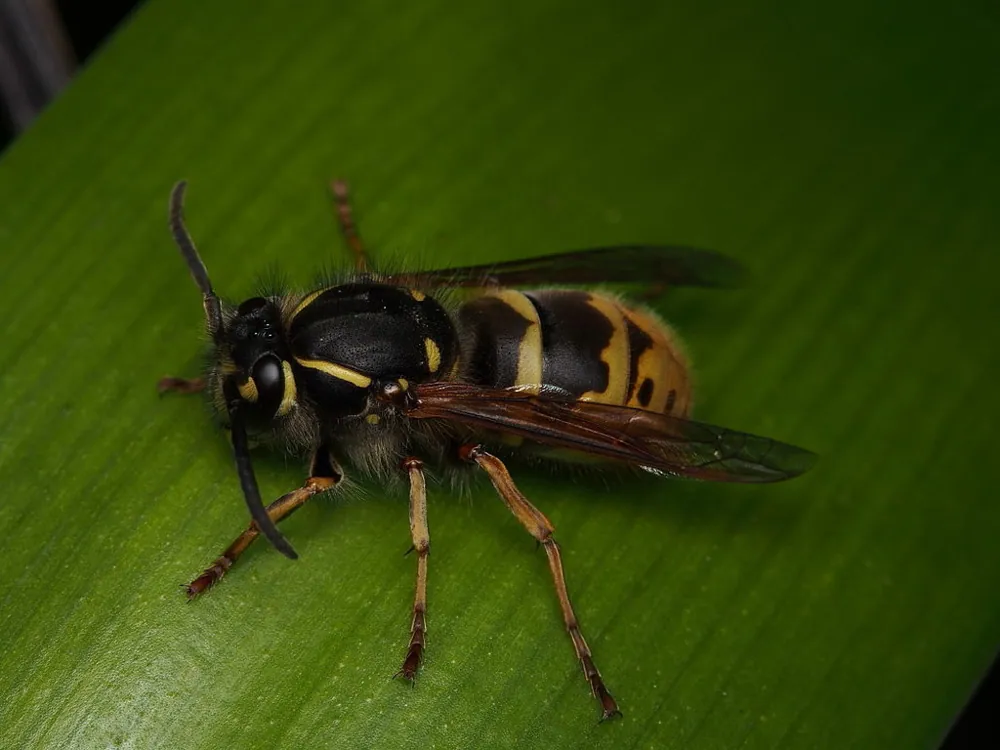
- Black and yellow warning colours, with yellow bands on the thorax and black dots and rings on the abdomen.1
- Seen from the front, the face has a single black mark on the clypeus, shaped like an anchor or a dagger.1
- Workers measure about 12–17 mm from head to tip of abdomen, while queens are about 20 mm long.1
- Its paper nest is brittle and tan coloured, with open cells and a column attaching it to the surface.1
Souvent confondu avec : The common wasp looks very similar to Vespula germanica, the German wasp. Seen head on, the German wasp has three black dots on its face, while the common wasp has only one black mark. Males of the two species are almost impossible to tell apart by eye and need the shape of their genitalia to identify them.1
Puissance du venin
Le venin sort par un dard.
À quel point est-il dangereux pour l'homme ?
Danger pour l'homme: DouloureuxÇa peut faire très mal, mais ce n'est presque jamais grave.The common wasp frequently damages fruit crops and can endanger humans.1
 S'il pique
- Gratte le dard d'abeille pour l'enlever et refroidis la zone.
- Si la personne a du mal à respirer, le visage ou la gorge qui gonflent, ou se sent mal, c'est une urgence allergique : appelle ton numéro d'urgence et utilise son stylo d'adrénaline si elle en a un.
Appelle toujours d'abord ton numéro d'urgence (112, 000, 911). Ce sont des conseils généraux de premiers secours, pas un avis médical. Les bases des premiers secours
 Reste en sécurité
- Ne touche, n'attrape et n'embête jamais un animal sauvage, même petit, et même s'il a l'air endormi ou mort.
- Laisse-lui de la place. Si tu en croises un, reste calme, recule doucement et laisse-le passer son chemin.
- S'il te pique : reste calme, ne bouge pas, appelle ton numéro d'urgence (112, 000, 911) ou va vite à l'hôpital. Souviens-toi de quoi il avait l'air, une photo aide.
Il ne t'en veut pas. Il utilise son venin pour attraper sa nourriture ou se protéger, et il préfère de loin se cacher. Plus d'infos pour rester en sécurité
Où dans le monde ?
Quelle taille fait-il ?
Quelle longueur fait-il ?
 à peu près aussi long qu'un trombone
 pourrait traverser tout un terrain de foot en volant en 16 secondes
Quelle taille fait Common wasp comparé à TOI ?
Juste des calculs dans ton navigateur. Rien n'est enregistré ni envoyé nulle part.
À quelle vitesse va-t-il ?


Faits
The nest has a chemical that repels ants, which is spread around the base of the nest column to stop ants attacking it.1
Workers use their wings as fans to cool the nest when it gets too hot, as its best temperature is around 32 °C.1
A new queen searches for a nest site and performs a dance-like wing movement that helps her find the spot again after she has left.1
The wasps mark the path from their nest to their food with pheromone trails, which are specific to the species rather than to each colony.1
The queen dies in autumn, and once she is gone the colony breaks down and the workers die of cold or starvation.1
Démêle le vrai du faux
Idée reçue : Common wasps found in North America are the same species as the common wasp of Europe.
Vérité : Until 2010 they were thought to be the same, but the North American ones are a different species, Vespula alascensis.1
D'où viennent les faits
- Vespula vulgaris (Wikipedia (CC BY-SA 4.0))
- Vespula vulgaris (iNaturalist): noms et classification.
- Venom Wiki: le niveau de danger, la taille typique et la vitesse estimée sont les nôtres. Regarde comment on les calcule : Comment on évalue le danger.
Chaque fait sur cette page a un numéro qui renvoie à sa source. Si on s'est trompés, désolés, on est des fans d'animaux, pas une revue scientifique. Dis-le-nous à [email protected] et on corrigera.
 Le scorpion a faim ! Venom Wiki est le projet d'une seule personne : gratuit, sans pub et sans traceurs. Un petit pourboire aide à le garder en ligne.Nourris le scorpion
Plus du même groupe: Abeilles, guêpes et frelons
 Asian giant hornetAbeilles, guêpes et frelonsPeut tuer
 European hornetAbeilles, guêpes et frelonsFait juste mal
 Western honey beeAbeilles, guêpes et frelonsFait juste mal
 Giant honey beeAbeilles, guêpes et frelonsNécessite un médecin
 Asian hornetAbeilles, guêpes et frelonsFait juste mal
 European paper waspAbeilles, guêpes et frelonsFait juste mal
 Common European adder
 Spanish fly
 Fire salamander
 Blunt-nosed viper
 Nose-horned viper
 Ottoman viper