
 Afrique
 Asie
Asie Europe
 Amérique du Sud
 Australie et Océanie
 Antarctique
 Océan Pacifique
 Océan Atlantique
 Océan Indien
 Océan Arctique
 Mer Méditerranée
 Mer Rouge
 Mer des Caraïbes
 Mer de Corail
 Mer de Chine méridionale
 Mer des Philippines
 Mer d'Andaman
 Mer du Nord
 Mer de Timor et d'Arafura
 Golfe du Bengale
 Golfe de Californie
Cow killer velvet ant
 Piqûres
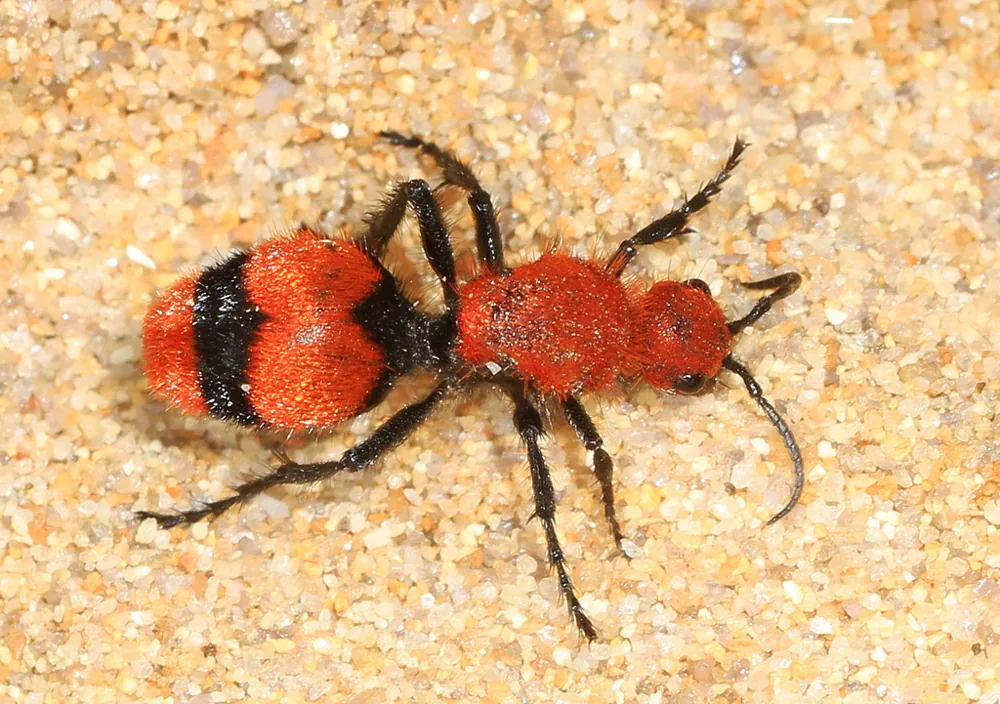
The cow killer velvet ant is a wasp that looks like a black and red ant. It lives in the eastern United States, from Connecticut and Kansas in the north to Florida and Texas in the south. It is known for a sting so painful that it earned the nickname cow killer.1

 Comment le reconnaître
- Black overall, with bright red on the upper side of the head, thorax and abdomen.1
- Females have no wings. Males have dark, translucent wings and no stinger.1
- Adults reach about 1.9 cm long, the largest velvet ant in the eastern United States.1
- Quick-moving, and often takes a defensive posture when threatened.1
- Adults are mostly seen in the summer months.1
Souvent confondu avec : It is often mistaken for an ant because of its appearance and its common name. It is actually a wasp, and only the males have wings.1
Puissance du venin
Le venin sort par un dard.
Que fait son venin ?
Its sting is among the most painful of any insect, ranked 3 out of 4 on the Schmidt sting pain index. The venom contains a peptide called Do6a, which triggers a pain response in fruit fly larvae in laboratory studies.1
À quel point est-il dangereux pour l'homme ?
Danger pour l'homme: DouloureuxÇa peut faire très mal, mais ce n'est presque jamais grave.The sting is extremely painful, ranked 3 out of 4 on the Schmidt sting pain index. This is the reason for the nickname cow killer.1
Que fait-il quand il a peur ?
It has a thickened exoskeleton, runs fast and evasively, shows warning colours, makes a squeaking sound by rubbing its abdominal segments together, releases a chemical secretion and uses its venom.1
 S'il pique
- Gratte le dard d'abeille pour l'enlever et refroidis la zone.
- Si la personne a du mal à respirer, le visage ou la gorge qui gonflent, ou se sent mal, c'est une urgence allergique : appelle ton numéro d'urgence et utilise son stylo d'adrénaline si elle en a un.
Appelle toujours d'abord ton numéro d'urgence (112, 000, 911). Ce sont des conseils généraux de premiers secours, pas un avis médical. Les bases des premiers secours
 Reste en sécurité
- Ne touche, n'attrape et n'embête jamais un animal sauvage, même petit, et même s'il a l'air endormi ou mort.
- Laisse-lui de la place. Si tu en croises un, reste calme, recule doucement et laisse-le passer son chemin.
- S'il te pique : reste calme, ne bouge pas, appelle ton numéro d'urgence (112, 000, 911) ou va vite à l'hôpital. Souviens-toi de quoi il avait l'air, une photo aide.
Il ne t'en veut pas. Il utilise son venin pour attraper sa nourriture ou se protéger, et il préfère de loin se cacher. Plus d'infos pour rester en sécurité
Où dans le monde ?
Quelle taille fait-il ?
Quelle longueur fait-il ?
 plus court que ton petit doigt
Quelle taille fait Cow killer velvet ant comparé à TOI ?
Juste des calculs dans ton navigateur. Rien n'est enregistré ni envoyé nulle part.
À quelle vitesse va-t-il ?


Faits
Both sexes squeak to warn predators. Velvet ants rub their abdominal segments together, while crickets rub their legs against their abdomen.1
North American velvet ant species form one of the most intricate mimicry rings in the natural world, split into eight separate rings of mimicry.1
Males find females by smelling pheromones and by following their squeaking sounds. They carry the female in their jaws to a shaded, safe spot to mate.1
Females are wingless, a feature shared by all females in the family Mutillidae.1
Females are believed to mate only once in their lifetime.1
Démêle le vrai du faux
Idée reçue : It is an ant because it looks like one and has the name ant.
Vérité : It is a parasitoid wasp. It is only commonly mistaken for an ant.1
Pour les experts en venin
- Nom scientifique
- Dasymutilla occidentalis
- Groupe
- Abeilles, guêpes et frelons
- Famille
- Mutillidae2
- Ordre
- Hymenoptera
- Continents
- Amérique du Nord
- Petits
- A female lays a single egg onto a host larva, such as one of the eastern cicada killer or horse guard wasp, and the grub that hatches eats the host larva.1
- Danger pour l'homme
- 2 / 5: Douloureux3
D'où viennent les faits
- Dasymutilla occidentalis (Wikipedia (CC BY-SA 4.0))
- Dasymutilla occidentalis (iNaturalist): noms et classification.
- Venom Wiki: le niveau de danger, la taille typique et la vitesse estimée sont les nôtres. Regarde comment on les calcule : Comment on évalue le danger.
Chaque fait sur cette page a un numéro qui renvoie à sa source. Si on s'est trompés, désolés, on est des fans d'animaux, pas une revue scientifique. Dis-le-nous à [email protected] et on corrigera.
 Le scorpion a faim ! Venom Wiki est le projet d'une seule personne : gratuit, sans pub et sans traceurs. Un petit pourboire aide à le garder en ligne.Nourris le scorpion
Plus du même groupe: Abeilles, guêpes et frelons
 Tarantula hawkAbeilles, guêpes et frelonsFait juste mal
 Executioner waspAbeilles, guêpes et frelonsNécessite un médecin
 Warrior waspAbeilles, guêpes et frelonsNécessite un médecin
 Bald-faced hornetAbeilles, guêpes et frelonsFait juste mal
 Eastern cicada killerAbeilles, guêpes et frelonsInoffensif
 Aerial yellowjacketAbeilles, guêpes et frelonsFait juste mal
 Fer-de-lance d'Amérique centrale
 Eastern coral snake
 Eastern diamondback rattlesnake
 Eyelash viper
 Timber rattlesnake
 Western diamondback rattlesnake