
 Afrique
 Asie
Asie Europe
 Amérique du Sud
 Australie et Océanie
 Antarctique
 Océan Pacifique
 Océan Atlantique
 Océan Indien
 Océan Arctique
 Mer Méditerranée
 Mer Rouge
 Mer des Caraïbes
 Mer de Corail
 Mer de Chine méridionale
 Mer des Philippines
 Mer d'Andaman
 Mer du Nord
 Mer de Timor et d'Arafura
 Golfe du Bengale
 Golfe de Californie
Golden silk orb-weaver
 Morsures
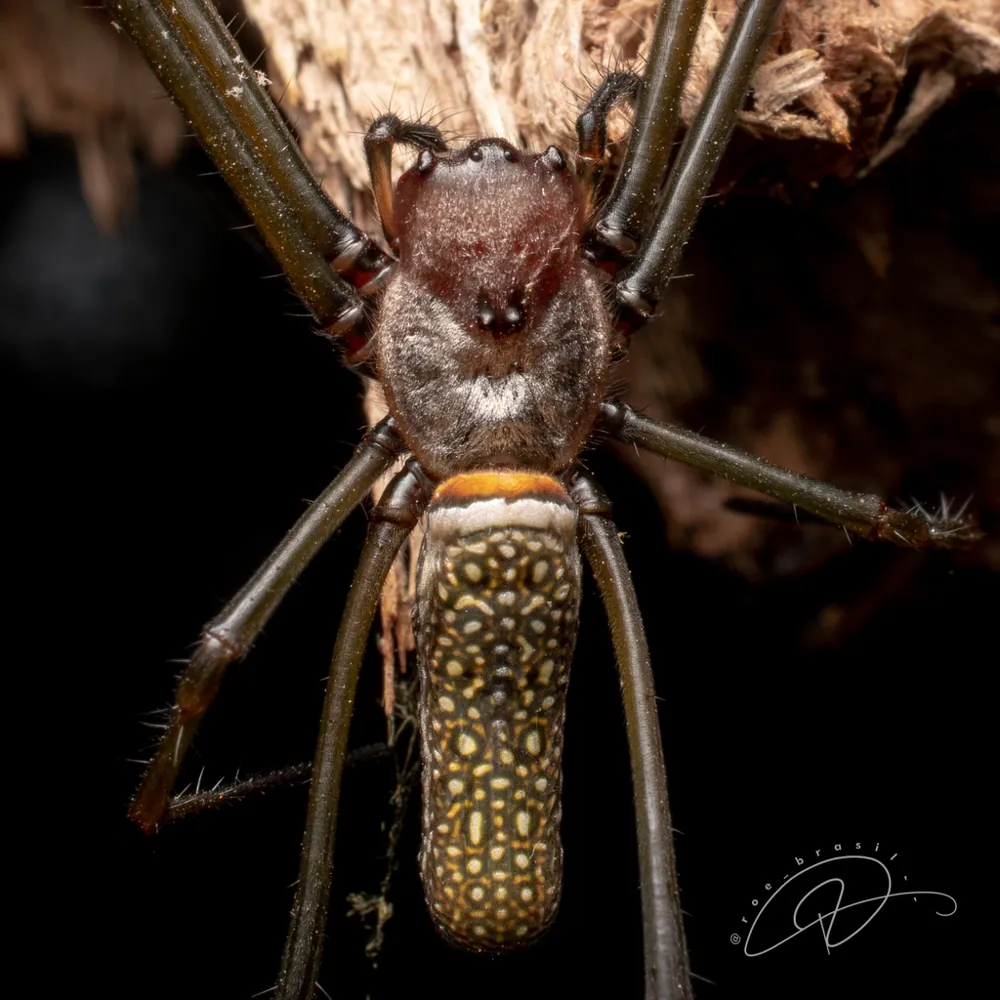
The golden silk orb-weaver is a large spider with silk that shines golden in sunlight. It lives in forests and wooded areas from the southern United States to Argentina. It is special because its silk is studied by scientists, and because it is one of the largest non-tarantula spiders in North America.1

 Comment le reconnaître
- Females have a silvery white front body (cephalothorax) and a longer orange-brown abdomen with two rows of small white-yellow spots.1
- Females have dark yellow and brown banding on their legs, with black brush-like tufts of hair near the joints of the first, second and fourth leg pairs.1
- Females are about 24 to 40 mm long when fully grown.1
- Males are much smaller, about 6 mm long, with a plain dark brown body and legs.1
- The large webs are circular and vertical, and the yellow pigment in the silk gives them a golden glow in good light.1
Souvent confondu avec : Trichonephila plumipes also has stiff hairs on its legs. In that species the hairs are set more closely together than in the golden silk orb-weaver.1
Puissance du venin
Le venin sort par ses crochets ou ses dents quand il mord.
Que fait son venin ?
Its venom has low toxicity. It is relatively harmless and poses little health concern to healthy adult humans.1
À quel point est-il dangereux pour l'homme ?
Danger pour l'homme: LégerComme une piqûre d'abeille ou moins. Pratiquement inoffensif pour l'homme.It is not known to be aggressive towards humans. It bites only in self-defence if it is touched, and its venom poses little health concern to healthy adults.1
Que fait-il quand il a peur ?
It bites only in self-defence if it is touched.1
 S'il mord
- Lave la morsure et mets de la glace contre la douleur. Va voir un médecin si la douleur est forte, s'étend ou si la personne se sent mal.
Appelle toujours d'abord ton numéro d'urgence (112, 000, 911). Ce sont des conseils généraux de premiers secours, pas un avis médical. Les bases des premiers secours
 Reste en sécurité
- Ne touche, n'attrape et n'embête jamais un animal sauvage, même petit, et même s'il a l'air endormi ou mort.
- Laisse-lui de la place. Si tu en croises un, reste calme, recule doucement et laisse-le passer son chemin.
- S'il te mord : reste calme, ne bouge pas, appelle ton numéro d'urgence (112, 000, 911) ou va vite à l'hôpital. Souviens-toi de quoi il avait l'air, une photo aide.
Il ne t'en veut pas. Il utilise son venin pour attraper sa nourriture ou se protéger, et il préfère de loin se cacher. Plus d'infos pour rester en sécurité
Où dans le monde ?
Quelle taille fait-il ?
Quelle longueur fait-il ?
 à peu près aussi long qu'un trombone
 pourrait parcourir 100 mètres en 210 secondes (l'humain le plus rapide met 9,6)
Quelle taille fait Golden silk orb-weaver comparé à TOI ?
Juste des calculs dans ton navigateur. Rien n'est enregistré ni envoyé nulle part.
À quelle vitesse va-t-il ?


Faits
Its silk may help in surgeries involving the nervous system, as shown in past experimental studies.1
It produces seven different types of silk, and its silk is valued in spider silk research.1
Its genome was the first of the orb-weaving spiders to be completely annotated, revealing 28 unique genes for spider silk proteins.1
Some individuals living in developed areas have grown significantly larger than their rural counterparts.1
Males rarely suffer sexual cannibalism or genital mutilation, unlike males of many related species, which makes it a focus of study into spider mating.1
Females are some of the largest non-tarantula spiders in North America, and may be the largest orb-weaver species native to the United States.1
Démêle le vrai du faux
Idée reçue : The golden silk orb-weaver is an aggressive spider that attacks people.
Vérité : It is not known to be aggressive towards humans. It bites only in self-defence if it is touched.1
D'où viennent les faits
- Trichonephila clavipes (Wikipedia (CC BY-SA 4.0))
- Trichonephila clavipes (iNaturalist): noms et classification.
- Venom Wiki: le niveau de danger, la taille typique et la vitesse estimée sont les nôtres. Regarde comment on les calcule : Comment on évalue le danger.
Chaque fait sur cette page a un numéro qui renvoie à sa source. Si on s'est trompés, désolés, on est des fans d'animaux, pas une revue scientifique. Dis-le-nous à [email protected] et on corrigera.
 Le scorpion a faim ! Venom Wiki est le projet d'une seule personne : gratuit, sans pub et sans traceurs. Un petit pourboire aide à le garder en ligne.Nourris le scorpion
 Brazilian wandering spider
 Brown recluse
 Southern black widow
 Amazon wandering spider
 Chilean recluse
 Northern black widow
 Fer-de-lance d'Amérique centrale
 Eastern coral snake
 Eastern diamondback rattlesnake
 Eyelash viper
 Timber rattlesnake
 Western diamondback rattlesnake