
 Afrique
 Asie
Asie Europe
 Amérique du Sud
 Australie et Océanie
 Antarctique
 Océan Pacifique
 Océan Atlantique
 Océan Indien
 Océan Arctique
 Mer Méditerranée
 Mer Rouge
 Mer des Caraïbes
 Mer de Corail
 Mer de Chine méridionale
 Mer des Philippines
 Mer d'Andaman
 Mer du Nord
 Mer de Timor et d'Arafura
 Golfe du Bengale
 Golfe de Californie
Greenland shark
 Toxique à manger
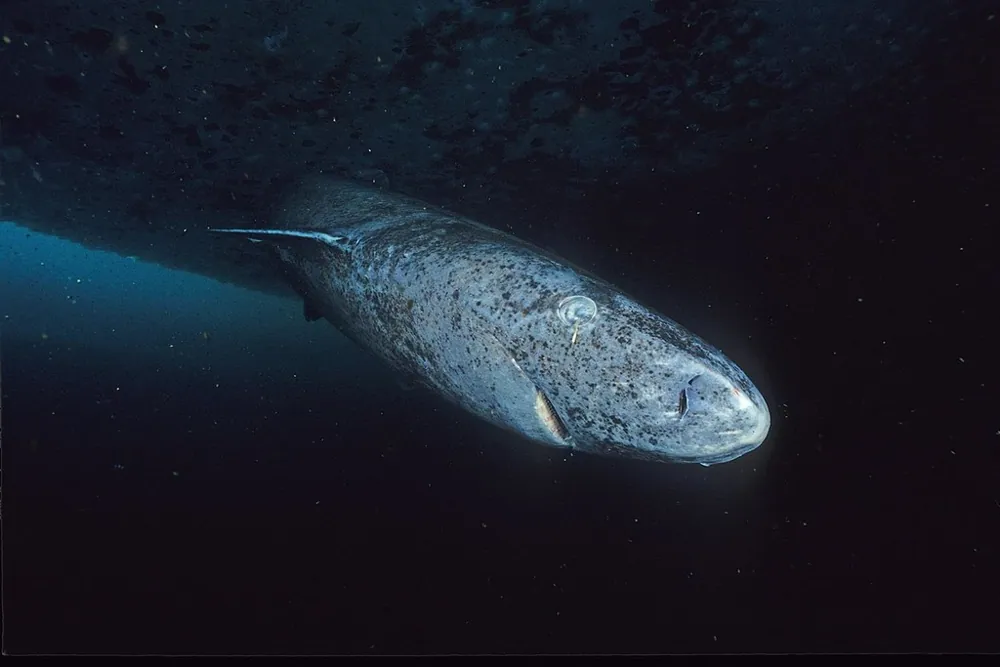
The Greenland shark is a huge, slow shark that lives in the cold, deep waters of the North Atlantic and Arctic Oceans. It is famous for living longer than any known vertebrate (animal with a backbone). Its flesh is poisonous to eat unless it is specially prepared.1



 Comment le reconnaître
- A thickset, heavy body with a short, rounded snout1
- Small eyes and small dorsal and pectoral fins1
- Five very small gill openings for its size1
- Colour ranges from pale creamy-grey to blackish-brown, usually uniform, sometimes with whitish spots or faint dark streaks on the back1
- Often has small parasitic copepods (crustaceans) attached to its eyes1
Puissance du poison
Il n'est dangereux que si quelque chose le mange.
Que fait son poison ?
The shark is not venomous. Its meat is poisonous to mammals because it contains high levels of trimethylamine N-oxide (TMAO), a natural chemical that makes the flesh toxic.1
À quel point est-il dangereux pour l'homme ?
Danger pour l'homme: DouloureuxÇa peut faire très mal, mais ce n'est presque jamais grave.Greenland sharks are not considered a threat to people, because they live deep in remote, cold waters. Only one possible attack is recorded, in 1936, and it was never linked to this species. One unverified report from around 1859 describes a human leg found in a shark's stomach.1
Que fait-il quand il a peur ?
When hauled onto a boat, it thrashes its tail so violently that it is dangerous to stand near it, and its muscles can still twitch after death.1
 Si quelqu'un l'a touché ou mangé
- Si quelqu'un l'a mangé ou a des symptômes après en avoir mangé : appelle tout de suite ton numéro d'urgence ou le centre antipoison.
Appelle toujours d'abord ton numéro d'urgence (112, 000, 911). Ce sont des conseils généraux de premiers secours, pas un avis médical. Les bases des premiers secours
 Reste en sécurité
- Ne touche, n'attrape et n'embête jamais un animal sauvage, même petit, et même s'il a l'air endormi ou mort.
- Laisse-lui de la place. Si tu en croises un, reste calme, recule doucement et laisse-le passer son chemin.
- Si tu l'as touché ou mangé : ne frotte pas tes yeux ni ta bouche, lave-toi les mains et va voir un médecin.
Il ne t'en veut pas. Son poison ne sert qu'à ce que personne ne le mange. Plus d'infos pour rester en sécurité
Où dans le monde ?
Quelle taille fait-il ?
Quelle longueur fait-il ?
Combien pèse-t-il ?
 aussi long que 6 chiens du museau à la queue
 aussi long que 36 bananes mises bout à bout
 pourrait nager la longueur d'une grande piscine (50 m) en 69 secondes
Quelle taille fait Greenland shark comparé à TOI ?
Juste des calculs dans ton navigateur. Rien n'est enregistré ni envoyé nulle part.
À quelle vitesse va-t-il ?

Faits
It is thought to have the longest lifespan of any known vertebrate, estimated at between 272 and 510 years.1
It is one of the slowest-swimming fish for its size, with a fastest cruising speed of about 2.7 km/h.1
Parasitic copepods often attach to its eyes and can damage them, but this does not seem to shorten its life, because it relies mainly on smell and hearing.1
It is one of the largest shark species alive, with the largest confirmed specimen weighing around 1,023 kg.1
In Iceland, a specially treated form of its meat is eaten as a pungent delicacy called kæstur hákarl.1
Its slow metabolism is thought to be linked to its very long life, although this is still a hypothesis.1
Démêle le vrai du faux
Idée reçue : The Greenland shark is a dangerous threat to humans.
Vérité : It is not considered a threat to people. It lives deep in cold, remote waters, and the only report of a possible attack was never confirmed as this species.1
Pour les experts en venin
- Nom scientifique
- Somniosus microcephalus
- Groupe
- Autres animaux vénéneux
- Famille
- Somniosidae2
- Ordre
- Squaliformes
- Continents
- Océan Arctique, Océan Atlantique, Les océans
- Petits
- Pups are born alive, after an estimated gestation period of 8 to 18 years. Females reach sexual maturity at around 150 years of age.1
- Danger pour l'homme
- 2 / 5: Douloureux3
D'où viennent les faits
- Greenland shark (Wikipedia (CC BY-SA 4.0))
- Somniosus microcephalus (iNaturalist): noms et classification.
- Venom Wiki: le niveau de danger, la taille typique et la vitesse estimée sont les nôtres. Regarde comment on les calcule : Comment on évalue le danger.
Chaque fait sur cette page a un numéro qui renvoie à sa source. Si on s'est trompés, désolés, on est des fans d'animaux, pas une revue scientifique. Dis-le-nous à [email protected] et on corrigera.
 Le scorpion a faim ! Venom Wiki est le projet d'une seule personne : gratuit, sans pub et sans traceurs. Un petit pourboire aide à le garder en ligne.Nourris le scorpion
Plus du même groupe: Autres animaux vénéneux
 Fugu tigreAutres animaux vénéneuxMortel
 Hawksbill sea turtleAutres animaux vénéneuxPeut tuer
 Silver-cheeked toadfishAutres animaux vénéneuxMortel
 Blackspotted pufferAutres animaux vénéneuxPeut tuer
 White-spotted pufferAutres animaux vénéneuxPeut tuer
 Long-spine porcupinefishAutres animaux vénéneuxNécessite un médecin
 Lion's mane jellyfish
 Moon jellyfish
 Spiny dogfish
 Bootlace worm