
 Afrique
 Asie
Asie Europe
 Amérique du Sud
 Australie et Océanie
 Antarctique
 Océan Pacifique
 Océan Atlantique
 Océan Indien
 Océan Arctique
 Mer Méditerranée
 Mer Rouge
 Mer des Caraïbes
 Mer de Corail
 Mer de Chine méridionale
 Mer des Philippines
 Mer d'Andaman
 Mer du Nord
 Mer de Timor et d'Arafura
 Golfe du Bengale
 Golfe de Californie
King cobra
 Morsures
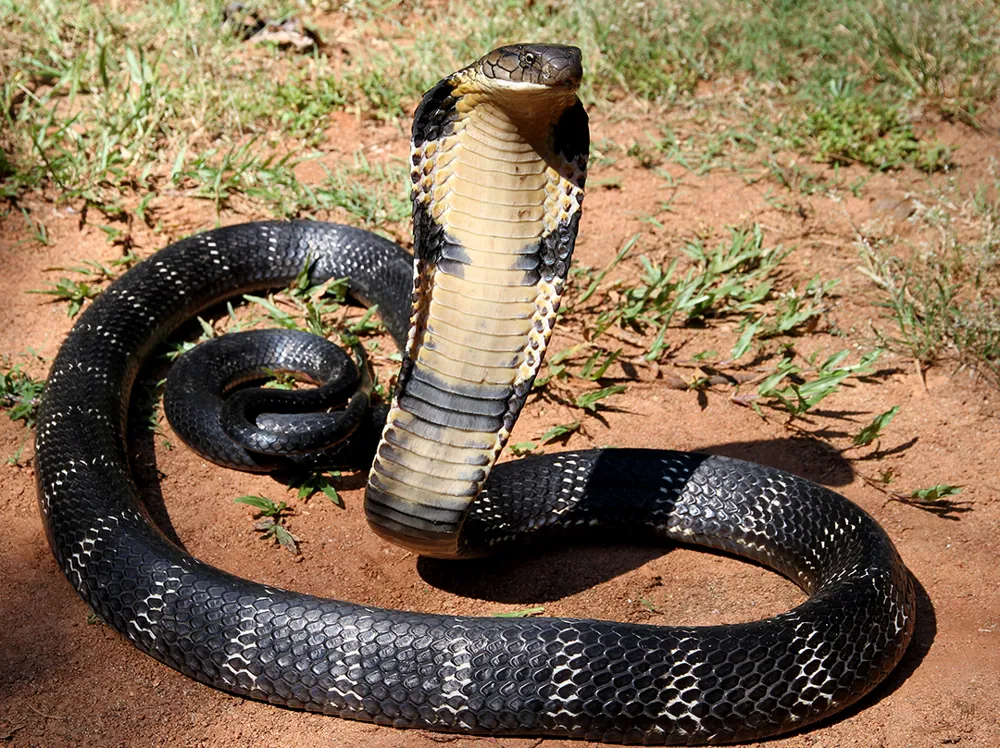
The king cobra is a large venomous snake of tropical Asia. It is the world's longest venomous snake, and it mostly eats other snakes. It is widely spread across its range, but people do not often see it.1



 Comment le reconnaître
- Adults are olive green with black and white bands across the trunk that run towards the head.1
- The head has 15 drab-coloured shields that are edged in black.1
- The hood is oval, with two black spots between the two lowest scales.1
- Juveniles are black with chevron-shaped white, yellow or buff bars that point towards the head.1
- The tail is yellowish green and marked with black.1
Souvent confondu avec : Despite its common name and some resemblance, it is not a true cobra: it belongs to its own genus.1
Puissance du venin
Le venin sort par ses crochets ou ses dents quand il mord.
Que fait son venin ?
The venom is neurotoxic, which means it attacks the nerves, and cytotoxic, which means it damages cells. Symptoms can start rapidly after a bite. The cobra can strike at a considerable range and height, and it has an immense venom yield.1
À quel point est-il dangereux pour l'homme ?
Danger pour l'homme: MortelL'un des animaux les plus dangereux du monde.The king cobra is not considered aggressive and usually avoids humans. Attacks usually happen when an individual is cornered or accidentally exposes itself, or when people come close by chance.1
 Bonne nouvelle : les médecins ont un médicament (antivenin) ou un traitement pour ça.1
Que fait-il quand il a peur ?
When threatened, it spreads its neck flap, raises its head, hisses or growls loudly, and sometimes charges.1
 S'il mord
- After a bite, prompt antivenom is needed, so get to medical care as fast as possible.1
- Garde la personne immobile et calme, enlève bagues et objets serrés, et va vite à l'hôpital : le traitement, c'est l'antivenin.
Appelle toujours d'abord ton numéro d'urgence (112, 000, 911). Ce sont des conseils généraux de premiers secours, pas un avis médical. Les bases des premiers secours
 Reste en sécurité
- Ne touche, n'attrape et n'embête jamais un animal sauvage, même petit, et même s'il a l'air endormi ou mort.
- Laisse-lui de la place. Si tu en croises un, reste calme, recule doucement et laisse-le passer son chemin.
- S'il te mord : reste calme, ne bouge pas, appelle ton numéro d'urgence (112, 000, 911) ou va vite à l'hôpital. Souviens-toi de quoi il avait l'air, une photo aide.
Il ne t'en veut pas. Il utilise son venin pour attraper sa nourriture ou se protéger, et il préfère de loin se cacher. Plus d'infos pour rester en sécurité
Où dans le monde ?
Quelle taille fait-il ?
Quelle longueur fait-il ?
Combien pèse-t-il ?

 aussi long que 6 chiens du museau à la queue
 aussi long que 32 bananes mises bout à bout
 pourrait parcourir 100 mètres en 36 secondes (l'humain le plus rapide met 9,6)
Quelle taille fait King cobra comparé à TOI ?
Juste des calculs dans ton navigateur. Rien n'est enregistré ni envoyé nulle part.
À quelle vitesse va-t-il ?


Faits
Its growl is much lower than most snakes' hisses, with a dominant frequency near 600 Hz, which is closer to a human voice.1
It is dominant over all other snakes except large pythons.1
It can swallow prey much larger than its head because of its flexible jaws.1
It can go many months without another meal after a large meal because its metabolism is slow.1
It is considered the national reptile of India and has an important place in the mythology and folk traditions of India, Bangladesh, Sri Lanka and Myanmar.1
Its common name 'hamadryad' is still used in older books.1
Démêle le vrai du faux
Idée reçue : King cobras are aggressive and attack people on sight.
Vérité : The king cobra is not considered aggressive and usually avoids humans. It defends its eggs fiercely and may strike if it is cornered or accidentally exposed.1
Pour les experts en venin
- Nom scientifique
- Ophiophagus hannah
- Groupe
- Cobras, mambas et bongares
- Famille
- Elapidae2
- Ordre
- Squamata
- Continents
- Asie
- Petits
- It lays eggs. The female builds a nest of dry leaf litter and guards the eggs through the incubation period.1
- Comment il se porte dans la nature
- Vulnerable (IUCN Red List, since 2010)1
- Danger pour l'homme
- 5 / 5: Mortel3
D'où viennent les faits
- King cobra (Wikipedia (CC BY-SA 4.0))
- Ophiophagus hannah (iNaturalist): noms et classification.
- Venom Wiki: le niveau de danger, la taille typique et la vitesse estimée sont les nôtres. Regarde comment on les calcule : Comment on évalue le danger.
Chaque fait sur cette page a un numéro qui renvoie à sa source. Si on s'est trompés, désolés, on est des fans d'animaux, pas une revue scientifique. Dis-le-nous à [email protected] et on corrigera.
 Le scorpion a faim ! Venom Wiki est le projet d'une seule personne : gratuit, sans pub et sans traceurs. Un petit pourboire aide à le garder en ligne.Nourris le scorpion
 Indian cobra
 Caspian cobra
 Common krait
 Malayan krait
 Many-banded krait
 Monocled cobra
 Deathstalker
 Indian saw-scaled viper
 Vipère heurtante
 Vipère de Russell
 Asian giant hornet
 Komodo dragon