
 Afrique
 Asie
Asie Europe
 Amérique du Sud
 Australie et Océanie
 Antarctique
 Océan Pacifique
 Océan Atlantique
 Océan Indien
 Océan Arctique
 Mer Méditerranée
 Mer Rouge
 Mer des Caraïbes
 Mer de Corail
 Mer de Chine méridionale
 Mer des Philippines
 Mer d'Andaman
 Mer du Nord
 Mer de Timor et d'Arafura
 Golfe du Bengale
 Golfe de Californie
Saddleback caterpillar
 Poils urticants
The saddleback caterpillar is the larva of a moth found in eastern North America and Mexico. It is green with a brown saddle-shaped marking on its back, and its spiny hairs can cause a painful rash. Gardeners who handle plants where it lives are most at risk of contact.1

 Comment le reconnaître
- Primarily lime-green, with brown at both ends.1
- A dark brown centre marking, outlined in white and black, that looks like a saddle.1
- A pair of fleshy horns, called tentacles, at each end of the body, which are orange or black as the caterpillar grows.1
- Tufts of spines along the body, with a row of orange spines along the sides.1
- Some larvae have a false face at the rear, with two pale dots that look like large eyes.1
Puissance du venin
De minuscules poils se cassent dans la peau et piquent.
Que fait son venin ?
The hairs and spines contain an irritating venom that is released when they touch skin or are broken. Contact causes a painful, swollen rash and sometimes nausea. Severe reactions are possible and can include migraines, breathing trouble related to asthma, anaphylactic shock (a dangerous allergic reaction) and bleeding. Symptoms can last from a few hours to a few days, depending on how sensitive a person is.1
À quel point est-il dangereux pour l'homme ?
Danger pour l'homme: DouloureuxÇa peut faire très mal, mais ce n'est presque jamais grave.This caterpillar has one of the strongest stings of its kind. Gardeners are most at risk because the caterpillar is common on ornamental plants. Symptoms vary from mild to severe, and the sensitivity of the person affected makes a difference.1
 Bonne nouvelle : les médecins ont un médicament (antivenin) ou un traitement pour ça.1
Que fait-il quand il a peur ?
When threatened, the larva curls outwards so its spines are hard for a predator to avoid, and its bright colours warn of its toxicity.1
 Si tu touches ses poils
- Remove the spines from the skin immediately using adhesive tape over the affected area, with a new piece of tape for each treatment, to stop the venom spreading. Ice packs, corticosteroids and antihistamines (taken orally or applied to the skin) have been reported to help relieve pain. Symptoms are relieved with prescribed medication on a case-by-case basis.1
- Pour les poils urticants de chenille : enlève-les avec du ruban adhésif, puis lave la peau. Ne frotte pas.
- Pour les morsures : lave et refroidis. Va voir un médecin si la personne se sent mal ou saigne facilement.
Appelle toujours d'abord ton numéro d'urgence (112, 000, 911). Ce sont des conseils généraux de premiers secours, pas un avis médical. Les bases des premiers secours
 Reste en sécurité
- Ne touche, n'attrape et n'embête jamais un animal sauvage, même petit, et même s'il a l'air endormi ou mort.
- Laisse-lui de la place. Si tu en croises un, reste calme, recule doucement et laisse-le passer son chemin.
- Si tu touches ses poils : reste calme, ne bouge pas, appelle ton numéro d'urgence (112, 000, 911) ou va vite à l'hôpital. Souviens-toi de quoi il avait l'air, une photo aide.
Il ne t'en veut pas. Il utilise son venin pour attraper sa nourriture ou se protéger, et il préfère de loin se cacher. Plus d'infos pour rester en sécurité
Où dans le monde ?
Quelle taille fait-il ?
Quelle longueur fait-il ?
 à peu près aussi long qu'un trombone
 plus lent qu'un escargot de jardin
Quelle taille fait Saddleback caterpillar comparé à TOI ?
Juste des calculs dans ton navigateur. Rien n'est enregistré ni envoyé nulle part.
À quelle vitesse va-t-il ?

Faits
The false face on the rear end is thought to confuse predators, which may attack the wrong end.1
Its cocoon is made of silk mixed with its stinging spines, which protect the pupa during metamorphosis.1
Braconid wasps often lay their eggs inside these caterpillars, and the wasp larvae feed from the inside and later emerge through holes in the body.1
Like other slug caterpillars, it moves on suckers and mucus, which help it roll and stick to surfaces.1
The adult moth has no sting and lives about 10 days on average.1
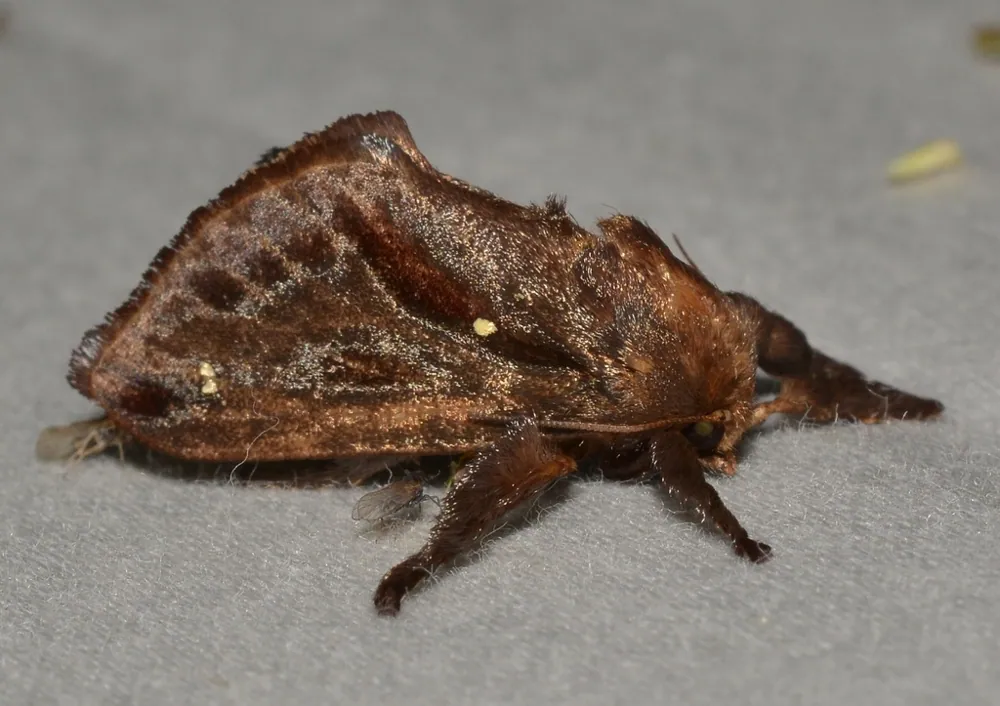
The adult moth loses the caterpillar's bright colours and has velvety dark brown forewings and cream hindwings.1
D'où viennent les faits
- Saddleback caterpillar (Wikipedia (CC BY-SA 4.0))
- Acharia stimulea (iNaturalist): noms et classification.
- Venom Wiki: le niveau de danger, la taille typique et la vitesse estimée sont les nôtres. Regarde comment on les calcule : Comment on évalue le danger.
Chaque fait sur cette page a un numéro qui renvoie à sa source. Si on s'est trompés, désolés, on est des fans d'animaux, pas une revue scientifique. Dis-le-nous à [email protected] et on corrigera.
 Le scorpion a faim ! Venom Wiki est le projet d'une seule personne : gratuit, sans pub et sans traceurs. Un petit pourboire aide à le garder en ligne.Nourris le scorpion
Plus du même groupe: Chenilles et insectes
 Giant water bugChenilles et insectesFait juste mal
 Puss caterpillarChenilles et insectesFait juste malNe pas toucher
 Wheel bugChenilles et insectesFait juste mal
 Giant vinegaroonChenilles et insectesInoffensif
 Rhodnius kissing bugChenilles et insectesNécessite un médecin
 Black-waved flannel mothChenilles et insectesFait juste malNe pas toucher
 Fer-de-lance d'Amérique centrale
 Eastern coral snake
 Eastern diamondback rattlesnake
 Eyelash viper
 Timber rattlesnake
 Western diamondback rattlesnake