
 África
 Asia
Asia Europa
 América do Sur
 Australia e Oceanía
 Antártida
 Océano Pacífico
 Océano Atlántico
 Océano Índico
 Océano Glacial Ártico
 Mar Mediterráneo
 Mar Vermello
 Mar Caribe
 Mar do Coral
 Mar da China Meridional
 Mar de Filipinas
 Mar de Andamán
 Mar do Norte
 Mar de Timor e de Arafura
 Golfo de Bengala
 Golfo de California
Broad-banded copperhead
 Morde
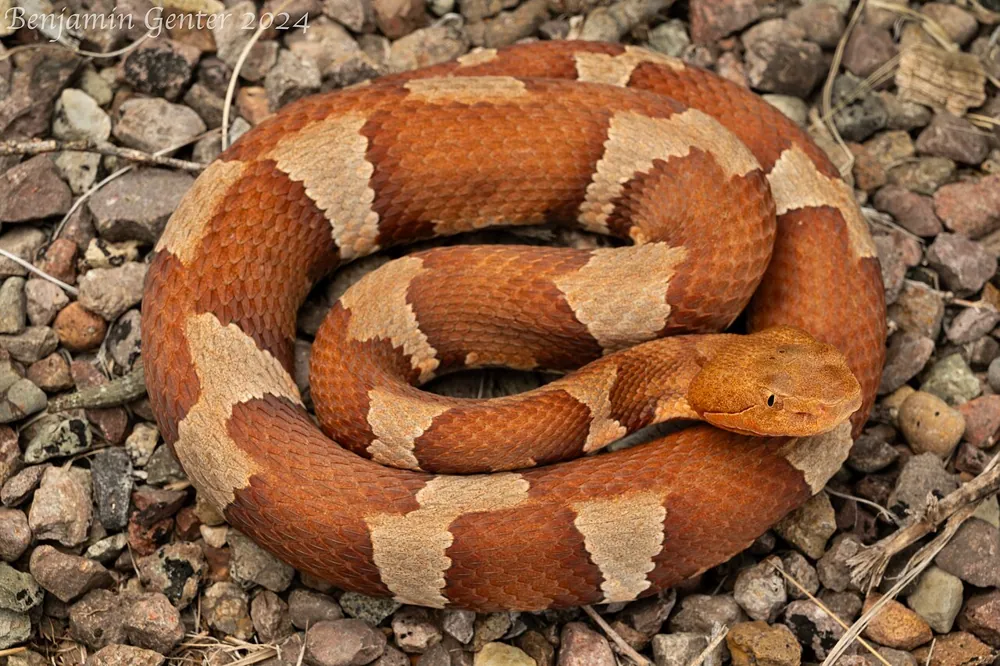
MordeThe broad-banded copperhead is a venomous pit viper, a type of snake that uses heat-sensing pits between its eyes and nostrils to find prey. It lives in the central United States, mainly Oklahoma and central Texas, and in parts of northern Mexico. For a long time it was thought to be a form of the eastern copperhead, but it is now treated as its own species.1


 Como recoñecelo
- Typically light tan with wide, darker brown crossbands, which give it its common name.1
- Colour varies by location, from red-brown to grey-brown.1
- The bands stay even in width. The eastern copperhead's bands narrow at the spine to form hourglass shapes.1
- Young snakes have a bright green-yellow tail tip that fades to grey or brown at about one year old.1
Adoita confundirse con: The eastern copperhead overlaps with this species in the south of its range, and the two can be hard to tell apart there. Look at the bands: the broad-banded copperhead has even bands, while the eastern copperhead's bands narrow at the spine.1
Poder da pezoña
A pezoña sae polos seus cairos ou dentes cando morde.
Que fai a súa pezoña?
Its venom is hemotoxic, meaning it mainly damages blood and tissue. It is injected through hinged, hollow fangs in a single quick strike. The bite can cause localised swelling, necrosis (death of tissue at the bite site) and severe pain.1
Que perigoso é para as persoas?
Perigo para as persoas: GraveUnha mordedura precisa un médico. As mortes son moi raras.Copperhead venom is not considered life-threatening to an otherwise healthy adult. Any bite from a venomous snake should still be treated as serious.1
 Boas novas: os médicos teñen un medicamento (antiveleno) ou un tratamento para isto.1
 Se morde
- Any bite from a venomous snake should be treated as serious, and medical treatment should be sought. Doctors may use CroFab in severe cases, which is made using cottonmouth venom because no antivenin is made specifically for copperheads.1
- Mantén a persoa quieta e tranquila, mantén o membro mordido á altura do corazón, quítalle aneis e cousas apertadas e vai rápido a un hospital.
Chama sempre primeiro ao teu número de emerxencias (112, 000, 911). Isto son consellos xerais de primeiros auxilios, non consello médico. Primeiros auxilios básicos
 Mantente a salvo
- Nunca toques, collas nin molestes un animal salvaxe, aínda que sexa pequeno e aínda que pareza durmido ou morto.
- Déixalle espazo. Se atopas un, mantén a calma, recúa amodo e déixao ir polo seu camiño.
- Se un te morde: mantén a calma, non te movas, chama ao teu número de emerxencias (112, 000, 911) ou vai rápido a un hospital. Lembra como era, unha foto axuda.
Non vai a por ti. Usa a súa pezoña para cazar comida ou para defenderse, e prefire con moito agocharse. Máis sobre como estar a salvo
En que lugar do mundo?
Que tamaño ten?
Canto mide?
 mide coma 4 bananas postas en fila
 podería percorrer 100 metros en 110 segundos (o humano máis rápido precisa 9,6)
Que tamaño ten Broad-banded copperhead comparado CONTIGO?
Só son contas no teu navegador. Non se garda nin se envía nada a ningures.
Que rápido é?


Datos
It can swim across large bodies of water and has been found swimming more than a quarter of a mile from shore in Lake Texoma, Texas.1
In one radio tracking study, a snake was found with a Texas horned lizard inside it. The snake later passed the tracking device without harm.1
Although it is not tree-dwelling, it can climb and has been seen coiled and resting in trees about 2 metres above the ground.1
Some copperheads in Kansas are hybrids of the eastern and broad-banded copperheads. Genetic studies in that state found no genetically pure broad-banded copperheads.1
It is known by colourful local names, including thunder snake, rattlesnake pilot and red eye.1
Desmontamitos
Mito: Copperhead bites are harmless.
Verdade: A bite is not life-threatening to a healthy adult, but it can cause swelling, tissue death and severe pain. Any bite should be treated seriously and medical care sought.1
Para expertos en pezoñas
De onde veñen os datos
- Agkistrodon laticinctus (Wikipedia (CC BY-SA 4.0))
- Agkistrodon laticinctus (iNaturalist): nomes e clasificación.
- Venom Wiki: o nivel de perigo, o tamaño típico e a velocidade estimada son nosos. Mira como os calculamos: Como valoramos o perigo.
Cada dato desta páxina ten un número que leva á súa fonte. Se nos equivocamos nalgo, sentímolo, somos fans dos animais, non unha revista científica. Dínolo en [email protected] e arranxarémolo.
 O escorpión ten fame! Venom Wiki é un proxecto dunha soa persoa: gratis, sen anuncios e sen rastrexadores. Unha pequena propina axuda a mantelo en liña.Dálle de comer ao escorpión
 Terciopelo
 Eyelash viper
 Cottonmouth
 Eastern copperhead
 Cantil
 Central American bushmaster
 Eastern coral snake
 Eastern diamondback rattlesnake
 Timber rattlesnake
 Western diamondback rattlesnake
 Arizona bark scorpion
 Brown recluse
.jpg)