
 África
 Asia
Asia Europa
 América do Sur
 Australia e Oceanía
 Antártida
 Océano Pacífico
 Océano Atlántico
 Océano Índico
 Océano Glacial Ártico
 Mar Mediterráneo
 Mar Vermello
 Mar Caribe
 Mar do Coral
 Mar da China Meridional
 Mar de Filipinas
 Mar de Andamán
 Mar do Norte
 Mar de Timor e de Arafura
 Golfo de Bengala
 Golfo de California
Cow killer velvet ant
 Pica
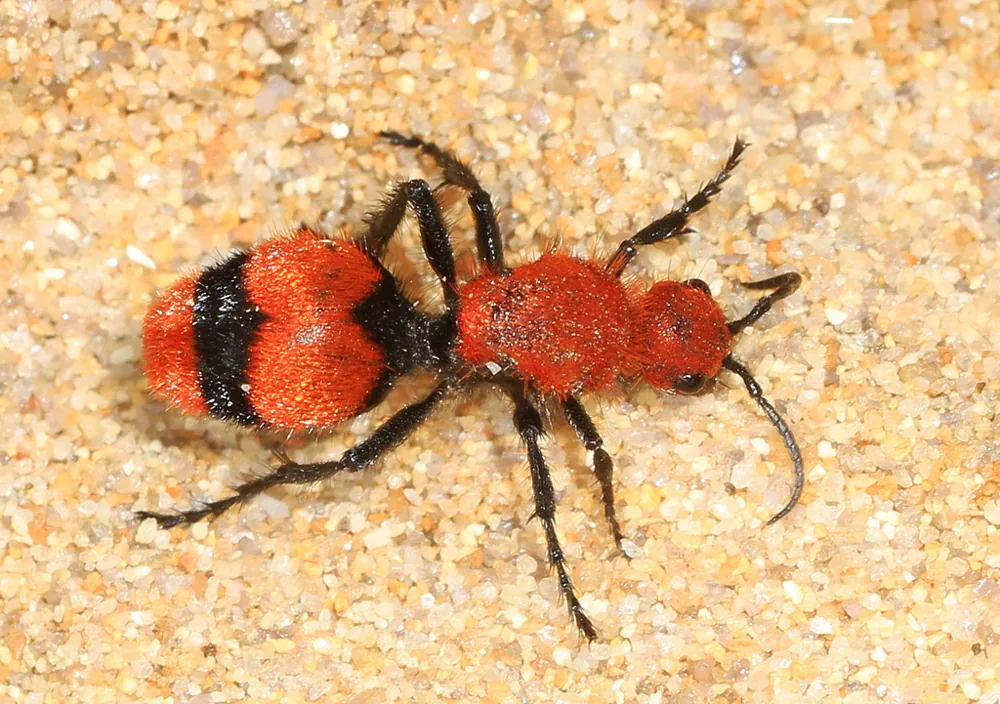
PicaThe cow killer velvet ant is a wasp that looks like a black and red ant. It lives in the eastern United States, from Connecticut and Kansas in the north to Florida and Texas in the south. It is known for a sting so painful that it earned the nickname cow killer.1

 Como recoñecelo
- Black overall, with bright red on the upper side of the head, thorax and abdomen.1
- Females have no wings. Males have dark, translucent wings and no stinger.1
- Adults reach about 1.9 cm long, the largest velvet ant in the eastern United States.1
- Quick-moving, and often takes a defensive posture when threatened.1
- Adults are mostly seen in the summer months.1
Adoita confundirse con: It is often mistaken for an ant because of its appearance and its common name. It is actually a wasp, and only the males have wings.1
Poder da pezoña
A pezoña sae por un ferrete.
Que fai a súa pezoña?
Its sting is among the most painful of any insect, ranked 3 out of 4 on the Schmidt sting pain index. The venom contains a peptide called Do6a, which triggers a pain response in fruit fly larvae in laboratory studies.1
Que perigoso é para as persoas?
Perigo para as persoas: DolorosoPode doer moito, pero case nunca é grave.The sting is extremely painful, ranked 3 out of 4 on the Schmidt sting pain index. This is the reason for the nickname cow killer.1
Que fai cando ten medo?
It has a thickened exoskeleton, runs fast and evasively, shows warning colours, makes a squeaking sound by rubbing its abdominal segments together, releases a chemical secretion and uses its venom.1
 Se pica
- Rasca para quitar o ferrete da abella e arrefría a zona.
- Se a persoa ten dificultade para respirar, a cara ou a gorxa inchadas, ou sente que se vai desmaiar, é unha emerxencia alérxica: chama ao teu número de emerxencias e usa o seu autoinxector de adrenalina se ten un.
Chama sempre primeiro ao teu número de emerxencias (112, 000, 911). Isto son consellos xerais de primeiros auxilios, non consello médico. Primeiros auxilios básicos
 Mantente a salvo
- Nunca toques, collas nin molestes un animal salvaxe, aínda que sexa pequeno e aínda que pareza durmido ou morto.
- Déixalle espazo. Se atopas un, mantén a calma, recúa amodo e déixao ir polo seu camiño.
- Se un te pica: mantén a calma, non te movas, chama ao teu número de emerxencias (112, 000, 911) ou vai rápido a un hospital. Lembra como era, unha foto axuda.
Non vai a por ti. Usa a súa pezoña para cazar comida ou para defenderse, e prefire con moito agocharse. Máis sobre como estar a salvo
En que lugar do mundo?
Que tamaño ten?
Canto mide?
 máis curto ca o teu dedo meniño
Que tamaño ten Cow killer velvet ant comparado CONTIGO?
Só son contas no teu navegador. Non se garda nin se envía nada a ningures.
Que rápido é?


Datos
Both sexes squeak to warn predators. Velvet ants rub their abdominal segments together, while crickets rub their legs against their abdomen.1
North American velvet ant species form one of the most intricate mimicry rings in the natural world, split into eight separate rings of mimicry.1
Males find females by smelling pheromones and by following their squeaking sounds. They carry the female in their jaws to a shaded, safe spot to mate.1
Females are wingless, a feature shared by all females in the family Mutillidae.1
Females are believed to mate only once in their lifetime.1
Desmontamitos
Mito: It is an ant because it looks like one and has the name ant.
Verdade: It is a parasitoid wasp. It is only commonly mistaken for an ant.1
Para expertos en pezoñas
- Nome científico
- Dasymutilla occidentalis
- Grupo
- Abellas, avespas e avespóns
- Familia
- Mutillidae2
- Orde
- Hymenoptera
- Continentes
- América do Norte
- Crías
- A female lays a single egg onto a host larva, such as one of the eastern cicada killer or horse guard wasp, and the grub that hatches eats the host larva.1
- Perigo para as persoas
- 2 / 5: Doloroso3
De onde veñen os datos
- Dasymutilla occidentalis (Wikipedia (CC BY-SA 4.0))
- Dasymutilla occidentalis (iNaturalist): nomes e clasificación.
- Venom Wiki: o nivel de perigo, o tamaño típico e a velocidade estimada son nosos. Mira como os calculamos: Como valoramos o perigo.
Cada dato desta páxina ten un número que leva á súa fonte. Se nos equivocamos nalgo, sentímolo, somos fans dos animais, non unha revista científica. Dínolo en [email protected] e arranxarémolo.
 O escorpión ten fame! Venom Wiki é un proxecto dunha soa persoa: gratis, sen anuncios e sen rastrexadores. Unha pequena propina axuda a mantelo en liña.Dálle de comer ao escorpión
Máis do mesmo grupo: Abellas, avespas e avespóns
 Tarantula hawkAbellas, avespas e avespónsSó doe
 Executioner waspAbellas, avespas e avespónsPrecisa un médico
 Warrior waspAbellas, avespas e avespónsPrecisa un médico
 Bald-faced hornetAbellas, avespas e avespónsSó doe
 Eastern cicada killerAbellas, avespas e avespónsInofensivo
 Aerial yellowjacketAbellas, avespas e avespónsSó doe
 Terciopelo
 Eastern coral snake
 Eastern diamondback rattlesnake
 Eyelash viper
 Timber rattlesnake
 Western diamondback rattlesnake