
 África
 Asia
Asia Europa
 América do Sur
 Australia e Oceanía
 Antártida
 Océano Pacífico
 Océano Atlántico
 Océano Índico
 Océano Glacial Ártico
 Mar Mediterráneo
 Mar Vermello
 Mar Caribe
 Mar do Coral
 Mar da China Meridional
 Mar de Filipinas
 Mar de Andamán
 Mar do Norte
 Mar de Timor e de Arafura
 Golfo de Bengala
 Golfo de California
Egyptian cobra
 Morde
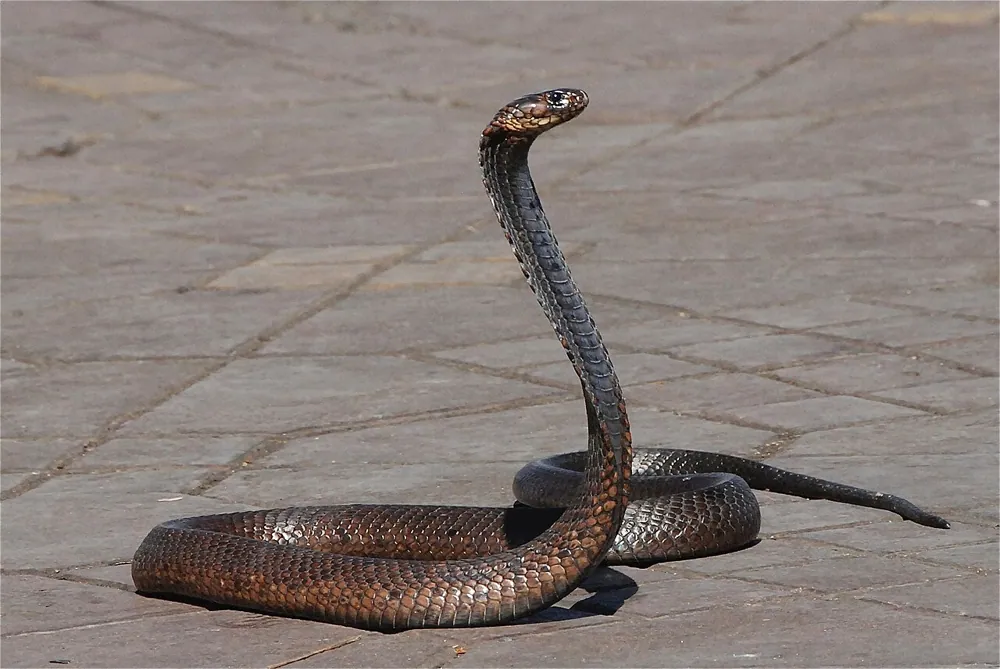
MordeThe Egyptian cobra is one of the most venomous snakes in Northern Africa. It lives across much of North Africa and the savannas of West Africa, and it often lives close to people, sometimes entering villages and houses. Its bite is dangerous, so it is important to know what it looks like.1



 Como recoñecelo
- Its large, flattened head is slightly distinct from its neck, and it can spread a hood like other cobras.1
- Most individuals are some shade of brown, often with a tear-drop mark below the eye.1
- Some are copper-red or grey-brown, and those from Morocco are almost entirely black.1
- The belly is mostly creamy white, yellow brown, grey, blue grey, dark brown or black, often with dark spots.1
- It is a large snake, with an average length of roughly 1.4 metres.1
Poder da pezoña
A pezoña sae polos seus cairos ou dentes cando morde.
Que fai a súa pezoña?
Its venom is mainly made of neurotoxins, which attack the nerves, and cytotoxins, which damage cells. The venom stops nerve signals reaching the muscles, and in later stages it also affects the heart and lungs, which can lead to death from respiratory failure. A bite causes local pain, severe swelling, bruising, blistering and tissue death, and may also cause headache, vomiting, dizziness, convulsions or paralysis.1
Que perigoso é para as persoas?
Perigo para as persoas: MortalUn dos animais máis perigosos do mundo.The venom is strong enough to kill a person. A single bite can release an average of 175 to 300 mg of venom. Its venom is slow-acting and does not always cause death. Venom from northern African populations, especially from Egypt, Tunisia, Algeria and Libya, is more potent than venom from southern and western populations.1
 Boas novas: os médicos teñen un medicamento (antiveleno) ou un tratamento para isto.1
Que fai cando ten medo?
When approached, it usually tries to escape, but if threatened it rises up with its hood spread and strikes.1
 Se morde
- Get to a hospital fast: antivenom is the treatment. In a 2018 case, a bitten man was evacuated to Egypt, treated with antivenom and made a full recovery.1
- Mantén a persoa quieta e tranquila, quítalle aneis e cousas apertadas e vai rápido a un hospital: o tratamento é o antiveleno.
Chama sempre primeiro ao teu número de emerxencias (112, 000, 911). Isto son consellos xerais de primeiros auxilios, non consello médico. Primeiros auxilios básicos
 Mantente a salvo
- Nunca toques, collas nin molestes un animal salvaxe, aínda que sexa pequeno e aínda que pareza durmido ou morto.
- Déixalle espazo. Se atopas un, mantén a calma, recúa amodo e déixao ir polo seu camiño.
- Se un te morde: mantén a calma, non te movas, chama ao teu número de emerxencias (112, 000, 911) ou vai rápido a un hospital. Lembra como era, unha foto axuda.
Non vai a por ti. Usa a súa pezoña para cazar comida ou para defenderse, e prefire con moito agocharse. Máis sobre como estar a salvo
En que lugar do mundo?
Que tamaño ten?
Canto mide?
 mide coma 2,5 cans do fociño á cola
 mide coma 14 bananas postas en fila
 podería percorrer 100 metros en 44 segundos (o humano máis rápido precisa 9,6)
Que tamaño ten Egyptian cobra comparado CONTIGO?
Só son contas no teu navegador. Non se garda nin se envía nada a ningures.
Que rápido é?


Datos
Most ancient sources blame an Egyptian cobra for the death of Cleopatra and her two handmaidens, though recent researchers have questioned this.1
Ancient Egyptian pharaohs wore a stylised cobra, the uraeus, on their diadem as a symbol of sovereignty.1
In 2006, a pet cobra escaped in Toronto and forced the evacuation of a house for more than five months.1
In 2011, a venomous female cobra went missing from the Bronx Zoo and was found in a dark corner of the reptile house six days later. Staff named her "Mia", for "missing in action".1
It is often found in water, and there are records of it swimming in the Mediterranean Sea.1
Desmontamitos
Mito: Egyptian cobras spit venom, like some other African cobras.
Verdade: This species does not spit venom. It delivers its venom by biting.1
De onde veñen os datos
- Egyptian cobra (Wikipedia (CC BY-SA 4.0))
- Naja haje (iNaturalist): nomes e clasificación.
- Venom Wiki: o nivel de perigo, o tamaño típico e a velocidade estimada son nosos. Mira como os calculamos: Como valoramos o perigo.
Cada dato desta páxina ten un número que leva á súa fonte. Se nos equivocamos nalgo, sentímolo, somos fans dos animais, non unha revista científica. Dínolo en [email protected] e arranxarémolo.
 O escorpión ten fame! Venom Wiki é un proxecto dunha soa persoa: gratis, sen anuncios e sen rastrexadores. Unha pequena propina axuda a mantelo en liña.Dálle de comer ao escorpión
 Black mamba
 Cape cobra
 Eastern green mamba
 Jameson's mamba
 Western green mamba
 Ashe's spitting cobra
 Deathstalker
 Puff adder
 Boomslang
 Fat-tailed scorpion
 Gaboon viper
 Western honey bee