
 África
 Asia
Asia Europa
 América do Sur
 Australia e Oceanía
 Antártida
 Océano Pacífico
 Océano Atlántico
 Océano Índico
 Océano Glacial Ártico
 Mar Mediterráneo
 Mar Vermello
 Mar Caribe
 Mar do Coral
 Mar da China Meridional
 Mar de Filipinas
 Mar de Andamán
 Mar do Norte
 Mar de Timor e de Arafura
 Golfo de Bengala
 Golfo de California
Gila monster
 Morde
MordeThe Gila monster is a heavy, slow-moving lizard with a venomous bite. It lives in the south-western United States and the Mexican state of Sonora. It is the only venomous lizard native to the United States, but it rarely poses a real threat to people.1



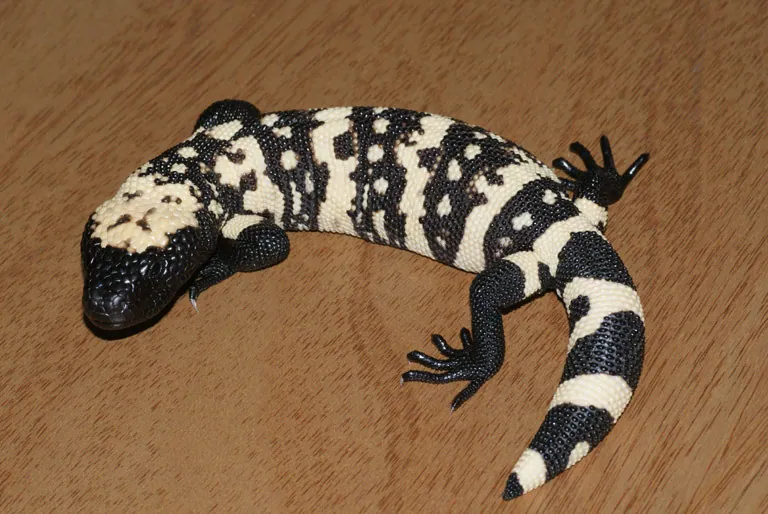
 Como recoñecelo
- Adults are yellow to pink on a black background.1
- Hatchlings have a simple, uniform pattern that is less colourful, and it changes over their first 6 months.1
- It has a heavy body, a stout snout and a massive head.1
- Adults can reach 56 cm in total length.1
- Males often have larger, more triangular heads than females.1
Adoita confundirse con: Its closest relatives are beaded lizards, which live in Mexico and Guatemala. In the United States, the Gila monster is the only venomous lizard.1
Poder da pezoña
A pezoña sae polos seus cairos ou dentes cando morde.
Que fai a súa pezoña?
The venom is made in glands in the lower jaw and flows along grooves in the lower teeth into the bite. It contains more than a dozen peptides and other substances, which cause pain and swelling. Four potentially lethal toxins have been found, which can cause bleeding inside the organs.1
Que perigoso é para as persoas?
Perigo para as persoas: GraveUnha mordedura precisa un médico. As mortes son moi raras.The venom is usually not fatal to healthy adults. One death has been confirmed since 1930, on 16 February 2024. Earlier deaths involved adults who were drunk or whose bite was treated badly. Bites are painful and can cause shock, but the lizard is sluggish and rarely a real threat.1
Que fai cando ten medo?
Its bright colours may warn predators to keep away, because it can inflict pain.1
 Se morde
- Bites are painful and need emergency medical care, because the venom may cause shock. Get medical help as quickly as possible.1
- Lava a ferida, mantén a persoa tranquila e busca axuda médica.
Chama sempre primeiro ao teu número de emerxencias (112, 000, 911). Isto son consellos xerais de primeiros auxilios, non consello médico. Primeiros auxilios básicos
 Mantente a salvo
- Nunca toques, collas nin molestes un animal salvaxe, aínda que sexa pequeno e aínda que pareza durmido ou morto.
- Déixalle espazo. Se atopas un, mantén a calma, recúa amodo e déixao ir polo seu camiño.
- Se un te morde: mantén a calma, non te movas, chama ao teu número de emerxencias (112, 000, 911) ou vai rápido a un hospital. Lembra como era, unha foto axuda.
Non vai a por ti. Usa a súa pezoña para cazar comida ou para defenderse, e prefire con moito agocharse. Máis sobre como estar a salvo
En que lugar do mundo?
Que tamaño ten?
Canto mide?
Canto pesa?
 mide coma 3 bananas postas en fila
 mide coma 18 pezas de construción de xoguete en fila
 podería percorrer 100 metros en 150 segundos (o humano máis rápido precisa 9,6)
Que tamaño ten Gila monster comparado CONTIGO?
Só son contas no teu navegador. Non se garda nin se envía nada a ningures.
Que rápido é?


Datos
Exendin-4, one of the venom's peptides, led to the development of GLP-1 receptor agonists, which treat type 2 diabetes and obesity.1
Young Gila monsters can swallow up to half of their body weight in a single meal.1
It can store fat in its tail and survive a whole season on three to four large meals in spring.1
Its venom is thought to have evolved mainly for defence, because its prey is mostly eggs, small animals and other helpless prey.1
It can climb trees, cacti and fairly straight, rough-surfaced walls.1
Its teeth are replaced throughout its life, and broken teeth are replaced by the teeth behind them.1
Desmontamitos
Mito: Its bite is always fatal, and its breath is poisonous.
Verdade: The venom is usually not fatal to healthy adult humans. One death has been confirmed since 1930.1
De onde veñen os datos
- Gila monster (Wikipedia (CC BY-SA 4.0))
- Heloderma suspectum (iNaturalist): nomes e clasificación.
- Venom Wiki: o nivel de perigo, o tamaño típico e a velocidade estimada son nosos. Mira como os calculamos: Como valoramos o perigo.
Cada dato desta páxina ten un número que leva á súa fonte. Se nos equivocamos nalgo, sentímolo, somos fans dos animais, non unha revista científica. Dínolo en [email protected] e arranxarémolo.
 O escorpión ten fame! Venom Wiki é un proxecto dunha soa persoa: gratis, sen anuncios e sen rastrexadores. Unha pequena propina axuda a mantelo en liña.Dálle de comer ao escorpión
Máis do mesmo grupo: Lagartos pezoñentos
 Mexican beaded lizardLagartos pezoñentosPrecisa un médico
 Chiapan beaded lizardLagartos pezoñentosPrecisa un médico
 Guatemalan beaded lizardLagartos pezoñentosPrecisa un médico
 Rio Fuerte beaded lizardLagartos pezoñentosPrecisa un médico
 Komodo dragonLagartos pezoñentosPode matar
 Desert monitorLagartos pezoñentosSó doe
 Terciopelo
 Eastern coral snake
 Eastern diamondback rattlesnake
 Eyelash viper
 Timber rattlesnake
 Western diamondback rattlesnake