
 África
 Asia
Asia Europa
 América do Sur
 Australia e Oceanía
 Antártida
 Océano Pacífico
 Océano Atlántico
 Océano Índico
 Océano Glacial Ártico
 Mar Mediterráneo
 Mar Vermello
 Mar Caribe
 Mar do Coral
 Mar da China Meridional
 Mar de Filipinas
 Mar de Andamán
 Mar do Norte
 Mar de Timor e de Arafura
 Golfo de Bengala
 Golfo de California
Indian cobra
 Morde
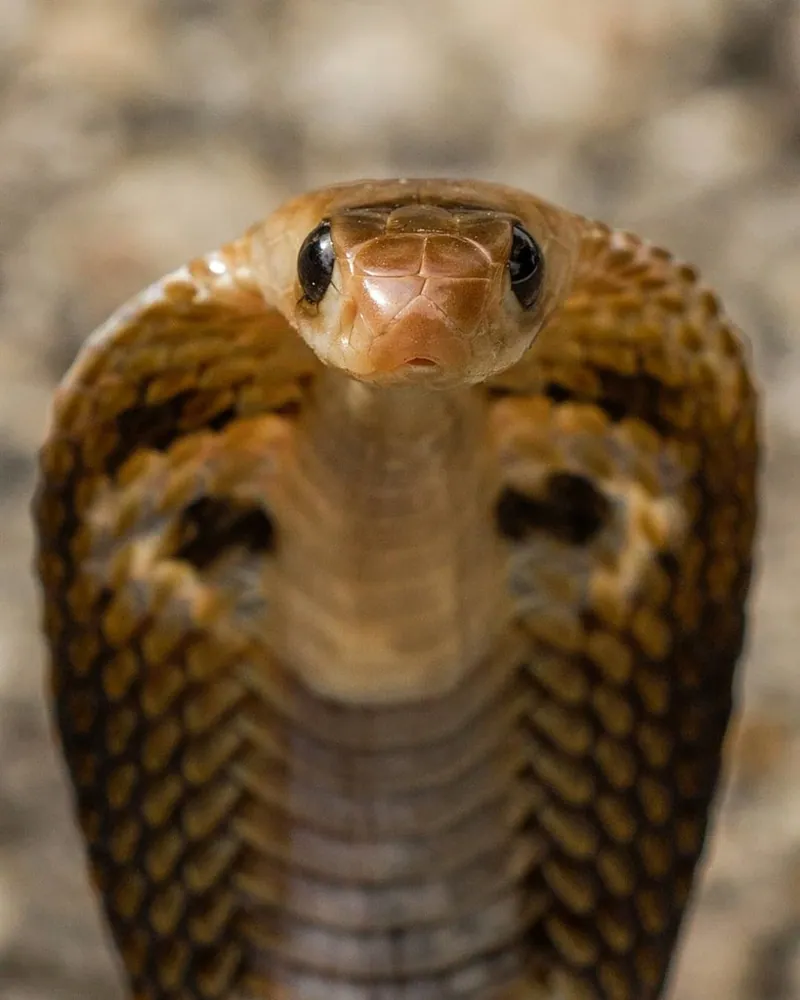
MordeThe Indian cobra is a heavy-bodied venomous snake that lives across the Indian subcontinent. It is famous for the large hood it spreads when threatened. It is one of the four snakes responsible for the most snakebites in India and Sri Lanka, so knowing how to recognise it matters.1



 Como recoñecelo
- A relatively large hood, which it expands when threatened.1
- Many individuals have a hood mark on the back of the hood: two round eye-like patterns joined by a curved line, looking like a pair of spectacles.1
- Colour varies widely. The underside can be grey, yellow, tan, brown, reddish or black, and many adults have salt-and-pepper speckles on the upper scales.1
- Adults in southern Pakistan are often uniformly black on top, with a light underside.1
Adoita confundirse con: The Oriental rat snake is often mistaken for this cobra, but it is much longer and has a more ridged-looking body. The monocled cobra has an O-shaped pattern on the back of its hood, while the Indian cobra has a spectacles-shaped pattern. The Caspian cobra can be confused with it where they share range in Pakistan and Afghanistan, but it is never fully black.1
Poder da pezoña
A pezoña sae polos seus cairos ou dentes cando morde.
Que fai a súa pezoña?
Its venom mainly contains a powerful neurotoxin, which attacks the nerves, and a cardiotoxin, which harms the heart. The neurotoxin paralyses muscles, and severe bites can lead to respiratory failure (breathing failure) or cardiac arrest (the heart stopping). Symptoms may appear between 15 minutes and two hours after a bite. Early signs include severe local pain and swelling that spreads up the limb, followed by darkening and blistering of the skin, as well as headache, nausea, vomiting, dizziness and drowsiness.1
Que perigoso é para as persoas?
Perigo para as persoas: MortalUn dos animais máis perigosos do mundo.It is responsible for many snakebites and most snakebite cases in Bangladesh. In one study, untreated bite victims had a mortality rate of about 20–30%. In another study of patients who received prompt medical treatment, the rate was 9%. The amount of venom delivered varies from bite to bite.1
 Boas novas: os médicos teñen un medicamento (antiveleno) ou un tratamento para isto.1
Que fai cando ten medo?
When threatened, it spreads its large hood.1
 Se morde
- Prompt medical treatment and antivenom reduce deaths from this snake's bites. Polyvalent serum, an antivenom that works against several snake species, is available for treating these bites.1
- Mantén a persoa quieta e tranquila, quítalle aneis e cousas apertadas e vai rápido a un hospital: o tratamento é o antiveleno.
Chama sempre primeiro ao teu número de emerxencias (112, 000, 911). Isto son consellos xerais de primeiros auxilios, non consello médico. Primeiros auxilios básicos
 Mantente a salvo
- Nunca toques, collas nin molestes un animal salvaxe, aínda que sexa pequeno e aínda que pareza durmido ou morto.
- Déixalle espazo. Se atopas un, mantén a calma, recúa amodo e déixao ir polo seu camiño.
- Se un te morde: mantén a calma, non te movas, chama ao teu número de emerxencias (112, 000, 911) ou vai rápido a un hospital. Lembra como era, unha foto axuda.
Non vai a por ti. Usa a súa pezoña para cazar comida ou para defenderse, e prefire con moito agocharse. Máis sobre como estar a salvo
En que lugar do mundo?
Que tamaño ten?
Canto mide?
 mide coma 4 gatos domésticos do fociño á cola
 mide coma 12 bananas postas en fila
 podería percorrer 100 metros en 46 segundos (o humano máis rápido precisa 9,6)
Que tamaño ten Indian cobra comparado CONTIGO?
Só son contas no teu navegador. Non se garda nin se envía nada a ningures.
Que rápido é?


Datos
Its venom is used as an intoxicant in India. Snake charmers have been paid to provide bites from their snakes, and the effects include loss of consciousness, euphoria and sedation.1
Hatchlings are independent from birth and have fully working venom glands, so even young snakes can deliver venom.1
It is revered in Hindu mythology and culture, and is often seen with snake charmers.1
It is protected under the Indian Wildlife Protection Act (1972).1
De onde veñen os datos
- Indian cobra (Wikipedia (CC BY-SA 4.0))
- Naja naja (iNaturalist): nomes e clasificación.
- Venom Wiki: o nivel de perigo, o tamaño típico e a velocidade estimada son nosos. Mira como os calculamos: Como valoramos o perigo.
Cada dato desta páxina ten un número que leva á súa fonte. Se nos equivocamos nalgo, sentímolo, somos fans dos animais, non unha revista científica. Dínolo en [email protected] e arranxarémolo.
 O escorpión ten fame! Venom Wiki é un proxecto dunha soa persoa: gratis, sen anuncios e sen rastrexadores. Unha pequena propina axuda a mantelo en liña.Dálle de comer ao escorpión
 King cobra
 Caspian cobra
 Common krait
 Malayan krait
 Many-banded krait
 Monocled cobra
 Deathstalker
 Indian saw-scaled viper
 Puff adder
 Russell's viper
 Asian giant hornet
 Komodo dragon